
Published:
2005-01-02
Updated:
2026-05-11
Learning Ukulele with Curt
The Harmonized Major and Minor Chord Scale Charts
The "Major Scale" or Ionian scale is a diatonic scale, made up of seven distinct notes, plus an eighth which duplicates the first one octave higher. In solfege these notes correspond to the syllables Do, Re, Mi, Fa, Sol, La, Ti/Si, (Do), the Do in the parenthesis at the end being the octave of the root.
Author(s): Curt Sheller Publisher: Curt Sheller Publications Code: UL124
Main Category: Chords Main Instrument: Any
Categories: Chords

2026-08-23
Number of Pages: 4
If you're a registered site member and have the correct permissions you can view ALL the pages of this PDF at a larger size using the LearningUkulele.com Online PDF Viewer (button below).
Download PDFThis Download is NOT part of your LearningUkulele.com & Learning Ukulele with Curt membership level.
Sign-up for Premium Site Access or Upgrade Your Plan to download this PDF or your can purchase a copy for download
Sign In for Access…Contact Us if there are any issues.
The Major Scale or Ionian scale is a diatonic scale, made up of seven distinct notes, plus an eighth which duplicates the first one octave higher. In solfege these notes correspond to the syllables “Do, Re, Mi, Fa, Sol, La, Ti/Si, (Do)”, the “Do” in the parenthesis at the end being the octave of the root.
The simplest major scale to write or play on the piano is C major, the only major scale that does not require sharps or flats. The C major scale uses only the white keys on the piano keyboard.
The seven pitches of any diatonic scale can also be obtained by using a chain of six perfect fifths starting on the root os the scale. The seven natural pitch classes that form the C-major scale can be obtained from a stack of perfect fifths starting from F. perfect fourth from the root C:
F –> C –> G –> D –> A –> E –> B.
Major Scales
A major scale can be seen as two identical tetrachords separated by a whole tone, or whole step. A tetrachord is a series of three intervals filling in the interval of a perfect fourth separated by a whole tone, or whole step. Or a set of steps Whole, Whole, Half, Whole, Whole, Whole, Half. Each tetrachord consists of two whole steps followed by a half step. Western scales do not skip any line or space on the staff, and they do not repeat any note with a different accidental. This has the effect of forcing the key signature to feature just sharps or just flats.
Any major scale can be figured out using this step sequence.

Or as the number of steps between each note of the scale:
2 2 1 2 2 2 1
C Major is: C W D W E H F W G W A W B H C’
More The Harmonized Major and Minor Chord Scale Charts
content below, continue exploring...
More The Harmonized Major and Minor Chord Scale Charts
The C Major Scale
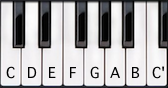
C D E F G A B C' - The white keys of a piano.
Each note of a major scale can be numbered relative to its distance or number of steps from the tonic or one (1), the first note of the scale.
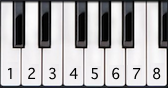
These numbers are also referred to as scale degrees. D is the second, E the third, F the fourth, G the fifth, A the sixth, B the seventh and finally, C again at the octave.
They also have the familiar solfège names used to teach pitch and sight singing - basically vocal training.
- Do
- Re
- Mi
- Fa
- So
- La
- Si or Ti
C Major Scale Uses
Ear Training – Using familiar songs you can train your ear to recognize common intervals.
Using a fixed Do and ascending intervals here are some common songs you can use.
- Do to Do - C to C, Perfect Unison [ Happy Birthday to You ]
This one should be easy as the note does not change. If you really have a hard time hearing this one you might consider a different hobby or career.
- Do, Re - C to D, Major Second [ Frère Jacques)
- Do, Mi - C to E, Major Third [ Michael Row Your Boat Ashore, Kumbaya, Do-Re-Mi (first and third notes) ]
- Do, Fa - C to F, Perfect Fourth [ Here Comes the Bride, Amazing Grace, Smells Like Teen Spirit, The Look of Love ]
- Do, Sol - C to G, Perfect Fifth [ Twinkle Twinkle Little Star, My Favorite Things, Georgie Girl, Scarborough Fair, Theme from Star Wars ]
- Do, La - C to A, Major Sixth [ My Bonnie Lies over the Ocean, NBC Theme Song, Take the 'A' Train ]
- Do, Si - C to B, Major Seventh [ Theme from Fantasy Island ]
- Do to Do - C to C, Perfect Octave [ Over the Rainbow, Hi Ho Hi Ho, The Christmas Song, Let It Snow ]
Here is a related lesson and with more information on Ear Training .
C Major Scale Chords
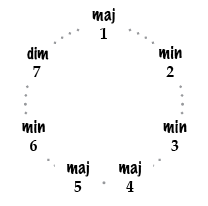
The chords for a C major scale are:
- Triads: C Dm Em F G Am Bdim
- 4-part “jazz” Chords: Cmaj7 Dm7 Em7 Fmaj7 G7 Am7 Bm7b5
The sequence of major, minor, minor, major, major, minor, diminished. Is the same sequence for ALL the major keys. And, by starting the sequence at a different spot it's also the same chords for the scale modes: Dorian, Phrygian, Lydian, Mixolydian, Aeolian, Locrian, and Ionian.
C Major Scale as Your Reference Scale
From the C major scale you can get the other major scales and their modes, major, relative minor and modes key signatures and the chords of the same.
Just memorize the key signature of the major keys and substitute place the sharp or flats in the circle of notes. Use a chart or the major scale step pattern: W W H W W W H, to figure out the scale.
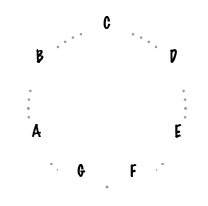
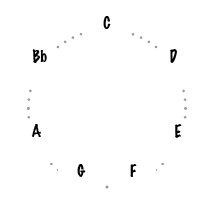
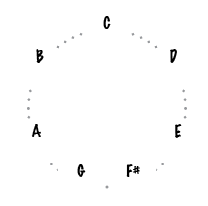
From the Major scales you can get the Traditional Scales: Natural Minor, Minor, Harmonic Minor, Melodic Minor, Tonic Minor, Diminished and Whole Tone.
Scale Modes: Ionian, Dorian, Phrygian, Lydian, Mixolydian, Aeolian, Locrian
Contemporary Scales: Blues, Minor Pentatonic and Major Pentatonic
Altered Scales: Mixolydian +4, Mixolydian -2-6
Some scales are know by different names. Mixolydian is the Dominant scale. The Mixolydian +4 is the Lydian Dominant. Lots of names for the same scales.


End of Lesson - Thanks, Hope You Enjoyed It!
Related Lessons, Videos, Lesson Series, Songs, Books & Reference Charts, Resources & Assets, Workshops are below.