Learning Ukulele with Curt
All 975 Lessons
With over 900+ lessons on LearningUkulele.com and Learning Ukulele with Curt, it can be a bit of an overwhelming task to navigate and find what you're looking for. The LessonSERIES section is a good place to start, as it presents a structured approach and curated list of lessons on a specific area of study.

2026-08-22
4-part Contemporary Chords, a.k.a. Jazz Chords
Core Chords is a series of lessons for building your 4-part chords. These chords commonly called jazz chords, are really just 4-part chords used in a wide range of musical styles. Beyond basic open position chords, basic movable form chords and a core set of 4-part chords. There are just too many chords shapes too memorize. Learning the principles of how chords are constructed and the ukulele fingerboard are the way to go. Then you can create more advanced chords like 9#11, 7#5-9, 13b5, 7+9 on the fly as needed.
A Practical Approach to Exploring Scales
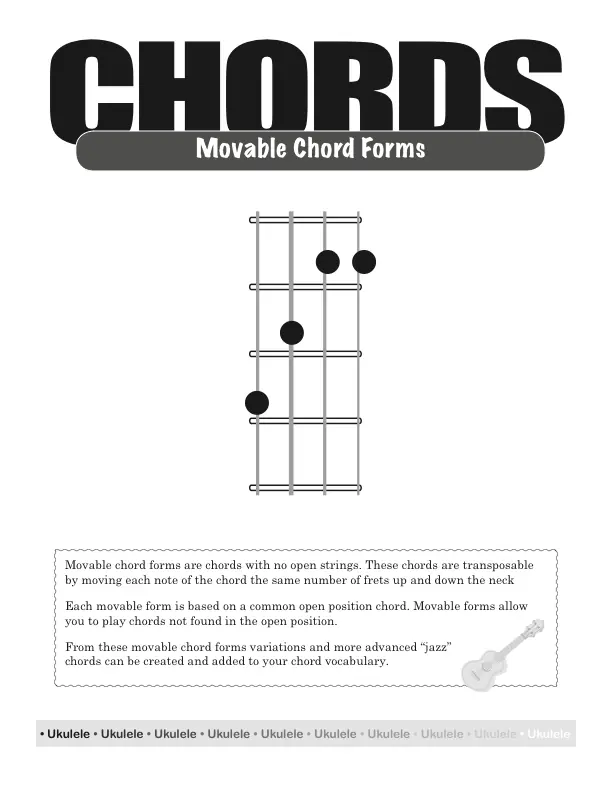
On ukulele there aren't many positions where you can play a one octave scale from the root to octave. An instrument like the guitar with the additional lower strings five and six allows one to play a one octave scale in multiple positions in the basic 4-fret, 4-finger position. On ukulele there might be one or two depending on the scale and the key - and whether your using a low string four tuning. This lesson offers a practical approach to practicing your scales on ukulele.
Advanced Guide to Chords - Chord Building Chart
Chords can be categorized into four basic chord types; Major, Minor, Diminished and Augmented. Here are the formulas for building the 11 basic 4-part chord types as well as the traditional triads. This chart can be used as a companion to any volume of The Advanced Guide to Guitar Chords and A Guide to Advanced Chords for Ukulele, which presents a highly organized and efficient approach to the mysterious subject of 4-part chords.
Altered Seventh Chords on `Ukulele
Beyond basic open position chords, basic movable form chords, and a core set of 4-part chords. There are just too many chords shapes too memorize. Learning the principles of how chords are constructed and the ukulele fingerboard are the way to go. You can then create more advanced chords like 9#11, 7#5-9, 13b5, 7+9 on the fly as needed from your core set of chords.
Alternating Thumb Style, Building a Solid Foundation - The Basics
As the subtitle of this Fingerpicking Basics lesson for Ukulele implies, this lesson's focus is on the alternating thumb part of the style. Commonly called Travis Picking on guitar and Scrugg's Style for banjo. For guitar it’s an alternating bass note style with the thumb playing the lower, bass notes.
Alternating Thumb Style, Conclusion
Fingerpicking for Ukulele – Alternating Thumb Style explored a lot of material. This style of fingerpicking or fingerstyle be can used in a wide variety of music. It’s a great addition to your music toolbox. A special thanks to my musical mentor Chuck Anderson, Glen Hirabayashi and Jan BroFka-Berends for their contributions to this book.
Alternating Thumb Style, Reading TAB
Tablature, or "TAB" for short, is a musical notation system for indicating instrument fingering rather than musical pitches in the standard music tradition. Tablature is common for fretted stringed instruments such as the lute, vihuela, or guitar. Tablature has been around for centuries and was common during the Renaissance and Baroque eras.
Alternating Thumb Style, Remembering the Patterns
In addition to the individual rhythmic make-up of the pattern which is represented in the Standard Music Notation. Musical direction and the strings can help in remembering the patterns. The string pattern can really help with getting the plucking hand to actually execute the pattern as intended.
Alternating Thumb Style, Rhythmic Variations
Rhythmic variations can be incorporated into this style of fingerpicking, creating a variety of syncopated patterns. All previous patterns were steady in nature, with the thumb alternating and playing on every downbeat. Many of the following patterns are syncopated, creating rhythmic variety.
Alternating Thumb Style, The Pinch
All the previous lessons in the "Fingerpicking for Ukulele, Alternating Thumb Style Series" where melodic, single notes only. This lesson introduces The *Pinch, where any one of the thumb/index finger or thumb/middle finger combinations can be played together - harmonically.
Alternating Thumb Style, Thumb and One Finger - Level Four
All the previous lessons in the "Fingerpicking for Ukulele, Alternating Thumb Style Series" where melodic, single notes only. This lesson introduces The *Pinch, where any one of the thumb/index finger or thumb/middle finger combinations can be played together - harmonically.
Alternating Thumb Style, Thumb and One Finger - Level One
In this lesson we’re introducing the index finger once to the alternating thumb pattern mastered in the Alternate Thumb Fingerpicking Style - Introduction. There are four possible patterns when adding the index finger once in common or cut time.
Alternating Thumb Style, Thumb and One Finger - Level Two
In this lesson we’re introducing the index finger twice to the alternating thumb pattern mastered in the Alternate Thumb Fingerpicking Style - Introduction. There are six possible patterns in common or cut time.ssible variations in this lesson.
BOGUS Lesson Four for Testing
Cum sociis natoque penatibus et magnis dis parturient montes, nascetur ridiculus mus. Curabitur blandit tempus porttitor. Morbi leo risus, porta ac consectetur ac, vestibulum at eros. Nullam quis risus eget urna mollis ornare vel eu leo. Cum sociis natoque penatibus et magnis dis parturient montes, nascetur ridiculus mus.
Vestibulum id ligula porta felis euismod semper. Aenean lacinia bibendum nulla sed consectetur. Donec ullamcorper nulla non metus auctor fringilla. Donec ullamcorper nulla non metus auctor fringilla. Aenean eu leo quam. Pellentesque ornare sem lacinia quam venenatis vestibulum. Sed posuere consectetur est at lobortis.
Backdoor Chord Progressions
In jazz and jazz harmony, the chord progression from IV7 to bVII7 to I has been nicknamed the backdoor progression or the backdoor II-V. This name derives from an assumption that the normal progression to the tonic, the II-V-I turnaround (II-V7 to I, see also authentic cadence) is, by inference, the front door. It can be considered a minor plagal cadence in traditional theory.
Banjo `Ukuleles
The Banjolele (brand name; sometimes banjo ukulele or banjo uke) is a four-stringed musical instrument with a small banjo-type body and a fretted ukulele neck. 'Banjolele', sometimes also spelled 'banjelele' or 'banjulele' is a generic nickname given to the instrument, which was derived from the 'banjulele-banjo' introduced by Alvin D. Keech in 1917.
Baritone `Ukuleles
The Baritone ukulele is the largest of the standard, most common sized ukuleles. It is tuned just like the thin, higher four strings of a standard tuned guitar (D G B A). This makes it a great starting instrument for little tikes wanting to play guitar but can't handle the steel strings and larger body size of the most acoustic guitars.
Barre Chords
"barre", the old English spelling vs. bar which refers to a measure of music, is used to indicate a placing of a finger across two or more strings. If covering all the strings it's called a full barre and if fewer than all the strings it’s a partial barre. It’s a classical guitar technic used for guitar, ukulele, mandolin and other fretted string instruments regardless of style.
Basic Blues Progressions in C Major
Basic and Quick Change blues chord progressions in the key of C major using the core 7th chords from the Big Six series of lessons. This is a great way to explore this core chord in various keys. These are the two most common blues progressions used in traditional and contemporary music.
Basic Blues Progressions in G Major
Basic and Quick Change blues chord progressions in the key of G major using the core 7th chords from the Big Six series of lessons. This is great way to explore this core chord in various keys. These are the two most common blues progressions used in traditional and contemporary music.
Basic Open Position Guitar Chords
Sometimes referred to as cowboy or folk chords. These chords are played in the fret one, two, and three are of the guitar neck and include at least one open string. Technically the open position includes the open strings and frets one, two, three and four. These are typically the first chords anyone learning to play the guitar learn.
Basic Open Position `Ukulele Chord Chart for Lefties
A core set of basic ukulele chords that ALL Left Handed Ukulele players should know in the five common keys of C, G, D, A and E. With the possible seventh chords for the same common keys. The chart is organized in common keys and covers basic chords in these keys.
Basic Single Note Drills for `Ukulele
Basic one, two, three and four note single string drills for ukulele for developing finger strength and independence. It's critical a player develop the finger strength and independence to explore their full musical potential. By developing a great fingerboard hand, you will be able to explore more challenging musical situations.
Basic `Ukulele Chord Fingering
The art and science of chord fingering. Learning your basic open position chords in common keys. We have four fingers and there're all not equal. Some shorter then others and some stronger that others. Everybody's hand is a little different. This does play a role in fingering chords.
Basic `Ukulele Strums and Variations
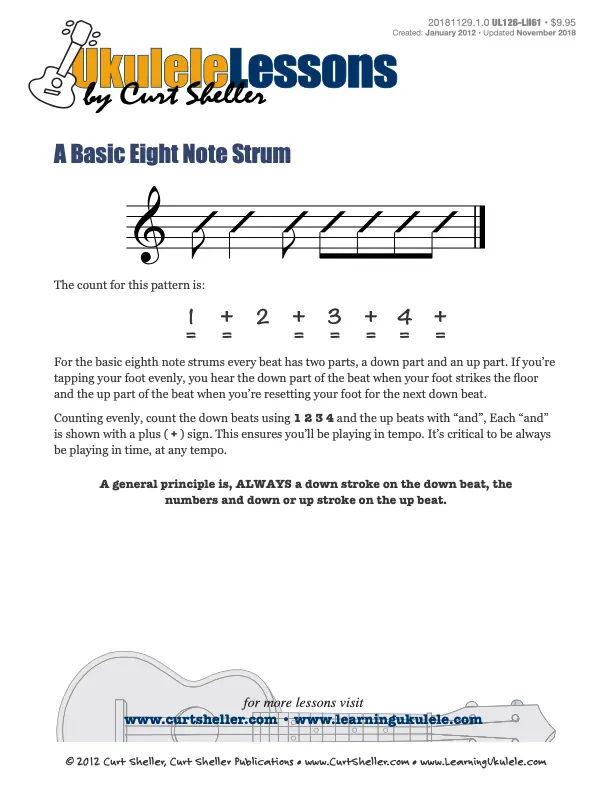
"A strum is the execution of a specific rhythmic pattern, at tempo, in a particular style." A strum can be broken down into its rhythmic syllables. These rhythmic syllables are defined by what particular style is being performed. Basic ukulele strums and variations to get you started.
Bogus Lesson Five for Testing
Bernard Matthew "Barney" Rubble is a fictional character who appears in the television animated series The Flintstones. He is the diminutive, blond-haired caveman husband of Betty Rubble and adoptive father of Bamm-Bamm Rubble. His best friend is his next door neighbor, Fred.
Bogus Lesson Two for Testing
Cras mattis consectetur purus sit amet fermentum. Vestibulum id ligula porta felis euismod semper. Fusce dapibus, tellus ac cursus commodo, tortor mauris condimentum nibh, ut fermentum massa justo sit amet risus. Vestibulum id ligula porta felis euismod semper. Integer posuere erat a ante venenatis dapibus posuere velit aliquet.
Bossa Nova
Bossa Nova is a genre of Brazilian music, which developed and was popularized in the 1950s and 1960s and is today one of the best-known Brazilian music genres abroad. The phrase bossa nova means literally “new trend”. A lyrical fusion of samba and jazz, bossa nova acquired a large following in the 1960s initially among young musicians and college students. Since its inception, it has remained a vital part of the standard jazz repertoire.
Chord Shapes and Learning `Ukulele Chords
Pick up any chord dictionary, and one thought that should go through your mind is - TOO MANY CHORDS There is now way to memorize all those shapes. It would be better off learning how they came up with all those shapes. Most chord dictionaries are also just like pages transposed to all possible keys.
Chord Spelling - Triads
This lesson presents the traditional approach for learning the chord tones of chords with a little twist to make it a bit easier. A Chord is three or more notes sounded simultaneously - together or almost together. The minimum number of notes required for a chord are three. These three note chords are called triads. Two notes are usually referred to as an interval or dyad. Each note of a chord is called a chord tone.
Chord Switching - Double Stops
Switching chords are all about finger independence and working together. This can be developed using the "double stop" fingering drills presented in this lesson. A "double stop" is a term borrowed from violin technique where you are stopping two strings or two notes - an interval.
Chord a Day, January 11th - D7
Learn a new Ukulele chord every day of the year. The chord for January 11th is D7. This partial D7 is ofter referred to as the Hawaiian D7 chord after its use in the Chord sequence C D7 G7, a common turnaround in Hawaiian music. So much so that it's called the Hawaiian Turnaround.
Chord a Day, March 3rd - F7
Learn a new Ukulele chord every day of the year. The chord for March 3rd is F7. We are now entering into the so-called “Jazz” chord, world of chords. Technically “Jazz” chords are simply 4-part contemporary chords that find the use in a wide variety of traditional and contemporary music.
Color Tones and Chords
The most important notes or chord tones in a chord are the notes that contribute most to the actual sound or “color” of the chord. For a major or minor triad, the third of the chord performs this function. For other chords, any note that makes it different from other chord types with the same root are the color tones.
This lesson is a more for less type of lesson exploring what notes are actually important in chords. The best place to start with this concept is 4-part chords and the Big Six Core Chords.
Common Chord Progressions for the Key of C Major
Sometimes called the “learning key,” the key of C major is one of the easiest keys to memorize and begin using. C major (often just C or key of C) is a musical major scale based on C, with pitches C D E F G A B C. Its key signature has no flats or sharps. Its relative minor is A minor: A B C D E F G A B r, and its parallel minor is C minor: C D E F G Ab Bb C D Eb.
Common Chord Progressions for the Key of Cb
Using the primary and secondary chords for the key explore these common chord progressions for the key of Cb. The key of Cb is a pretty rare key but actually an easy key to relate to the key of C. The key of C has ALL natural notes and the key of Cb has all flat notes for the scale: Cb Db Eb Fb Gb Ab Bb Cb`. The names of the notes are the easy part, the chords are typically played as movable form chords with only the Fb ( the enharmonic equivalent name is E ) available as an open string in the C tuning.
Common Progressions, Major Keys
Every wonder why certain chords seem to popup together time and time again? All harmonic or chord movement in a chord progression is a combination of the active and passive quality of individual chords within the progression or song. Chords provide tension and resolution, the feeling of movement and non-movement in songs and progressions.
Comping the Blues for Guitar, String Family 1234
Using the blues progression will can explore all voicings on string family 1 2 3 4. Using Voice Leading principles we will explore all 4 voicings of a seventh chords. To goal here is to play a different voicing in each measure. By transposing the C7 voicings to F7 (up 5 frets) and G7 (up 2 frets from F7).
Connecting Scale Positions on `Ukulele
Whether it’s connecting licks, riffs, scale positions, arpeggios, sequences or melodies – navigating the fingerboard and connecting the various positions - it’s all about using sound fingering principles. I’ve adapted Chuck Anderson's, The Six Secrets of Guitar Fingering to the ukulele in my book The Six Secrets of Ukulele Fingering. It’s from these six fingering principles that connecting positions and navigating the multitude of possible pathways on the ukulele can become second nature.
Core Chords - Building a Solid Foundation of Contemporary Chords
"Core Chords" are a concept that I typically apply to 4-part chords and your more contemporary modern chords. This where a solid foundation of a core set of chords really help in learning the massive amount of chords that are required for play contemporary music or jazz on ukulele or guitar. Not such a task on ukulele with on one four string set of strings to build your 4-part chords vs. the theoretically possible 15 sets available for guitar.
Core Chords - The Big Six - Building a Solid Chord Foundation
The Big Six Core Chords is a series of lessons for building your core, essential 4-part chords. These chords commonly called jazz chords, are really just 4-part chords used in a wide range of musical styles. These chords include: Seventh , Major Seventh, Minor Seventh, Half Diminished Seventh or Minor Seven Flat Five, Diminished Seventh, and Augmented Seventh. These six chords form a core set of chords.
Core Ukulele Chords - Level One
The remaining chords for The Big Six, Level I Core Chords. The Big Six chords include: Seventh 7, Major Seventh maj7, Minor Seventh m7, Half Diminished Seventh or Minor Seven Flat Five diminished 7 m7b5, Diminished Seventh o7 and Augmented Seventh +7. These six chords form a core set of chords.
Core Ukulele Chords - Triads, Add Chords
A triad is a three note chord. In traditional chord theory there are four traditional triad chord types: major, minor, diminished and augmented. And four contemporary triad chord types: sus2, sus4, add2 and add9. This series of lessons explores contemporary add chords using triads covered in earlier lessons of this series.
Core Ukulele Chords - Triads, Suspended Chords
A triad is a three note chord. In traditional chord theory there are four traditional triad chord types: major, minor, diminished and augmented. And four contemporary triad chord types: sus2, sus4, add2 and add9.
This series of lessons explores contemporary suspended or sus chords using triads cover is earlier lessons of this series.
Creating Introductions and Turnarounds for `Ukulele
Introductions are a composed or improvised pieces of music that introduce - sets the stage for - a song or composition. Introductions, or intro for short, are used in all types of music. In this lesson, the focus is on introductions in contemporary pop, rock, blues, country, folk and jazz styles.
Essential Ab Major Scale Patterns for Ukulele
Essential Ab Major scale patterns for ukulele. Learning scales typically starts with learning a position or pattern by shape. For a lot of players that's where it stops. With the many possible shapes between chords and scales to learn - there has to be a better way - There is!!!
Essential C Major Scale Patterns for `Ukulele
Essential C Major scale patterns for ukulele. Learning scales typically starts with learning a position or pattern by shape. For a lot of players that‘s where it stops. With the many possible shapes between chords and scales to learn - there has to be a better way - There is!!!
Essential Db Major Scale Patterns for Ukulele
Essential DbMajor scale patterns for ukulele. Learning scales typically starts with learning a position or pattern by shape. For a lot of players that's where it stops. With the many possible shapes between chords and scales to learn – there has to be a better way – There is!!!
Essential Eb Major Scale Patterns for Ukulele
Essential Eb Major scale patterns for ukulele. Learning scales typically starts with learning a position or pattern by shape. For a lot of players that's where it stops. With the many possible shapes between chords and scales to learn - there has to be a better way - There is!!!
Essential G Major Scale Patterns for Ukulele
Essential G Major scale patterns for ukulele. Learning scales typically starts with learning a position or pattern by shape. For a lot of players that's where it stops. With the many possible shapes between chords and scales to learn - there has to be a better way - There is!!!
Essential Scales
A scale is a collection of pitches a.k.a. notes, used for creating melodies, either pre composed or improvised on the spot. A scale is also used for the harmony – the chords. The melodies and chords create a tonality. The most common source for these melodies and chords is the Major scale. Also known as the Ionian scale or mode.
Exploring Improvisation on `Ukulele Using Tetrachords
Traditionally, a "Tetrachord" is a series of four tones filling in the interval of a perfect fourth. In modern usage a tetrachord is any four-note segment of a scale or tone row including the augmented fourth (+4). The term tetrachord derives from ancient Greek music theory, it literally means four strings.**
Exploring Jazz ``Ukulele
Wikipedia defines "Jazz" as a musical art form which originated at the beginning of the 20th century in African American communities in the Southern United States from a confluence of African and European music traditions. The style's West African pedigree is evident in its use of blue notes, improvisation, polyrhythms, syncopation, and the swung note.
Exploring Major Triads Plus One - Fingering Solutions 1 2 3 5
Exploring the triads plus one series is best done using the QuickStart series format and the fingering principles from my book The Six Secrets of Ukulele Fingering. The QuickStart series format single fingering solution for starting on each finger on strings four, three, two and one. Using the fingering principles from my book The Six Secrets of Ukulele Fingering allows you to explore scales, arpeggios, intervals and sequences from every finger-every strings, creating multiple pathways through any single note passage.
Exploring Major Triads on Ukulele Using a I IV I V Progression - C Major
Building major triads using the primary chords of C major. Triads are one of the first chords that really bring to light the need to know the notes of the neck. This lesson shows the three voicings and the solutions for playing a common "1 4 1 5" progression using C, F and G triads on the string 1 2 3 set.
Exploring Major Triads on `Ukulele Using a I IV I V Progression - Key of D
Exploring major triads using the primary chords of D major. Triads are one of the first chords that really bring to light the need to know the notes of the neck. This lessons shows the three voicings and the solutions for playing a common 1 4 1 5 progression using D, G and A triads on the string 1 2 3 set.
Exploring Major Triads on `Ukulele Using a I IV I V Progression - Key of G
Exploring major triads using the primary chords of G major. Triads are one of the first chords that really bring to light the need to know the notes of the neck. This lesson shows the three voicings and the solutions for playing a common 1 4 1 5 progression using G, C and D triads on the string 1 2 3 set.
Exploring Minor Triads Plus One - Fingering Solutions 1 2 b3 5
Exploring the triads plus one series is best done using the QuickStart series format and the fingering principles from my book The Six Secrets of Ukulele Fingering. The QuickStart series format single fingering solution for starting on each finger on strings four, three, two and one. Using the fingering principles from my book The Six Secrets of Ukulele Fingering allows you to explore scales, arpeggios, intervals and sequences from every finger-every strings, creating multiple pathways through any single note passage.
Finding a Good Teacher
It's unfortunate that there' s no oversight or organization that regulates private music teachers. This is especially true for private guitar and ukulele teachers. Anyone can hang a shingle out advertising private lessons or put content online. So finding a good teacher can be a problem. Here are a few questions you can ask prospective teachers and generally speaking what their answers should be. I'll also input my perspective which should give some info on accurately evaluating a prospective teacher or online content.
Fingering Gymnastics - a.k.a. Fingering Drills Introduction
Ukulele Gymnastics series contains quite a few lessons for developing your finger strength and independence of the fretting hand. The fretting hand is responsible for playing chords and single notes. The fretting hand and plucking hand are responsible for getting the music out.
Fingerpicking for Ukulele - Getting Started
There are two distinctly different Fingerpicking Styles. The Classical (pima) and "Alternating Thumb Style" commonly called "Travis Picking" in the guitar world and "Scruggs Style" in the banjo world. The focus of this series is on the classical (pima) style.
Fingerpicking on `Ukulele - Alternating Thumb Style
There are two common styles of fingerpicking on ukulele. This series of lessons explores the Alternating Thumb Style. A future series will explore the Thumb and three finger style, the traditional p i m a classical guitar style that we’ll adapt to ukulele.
First `Ukulele Lesson
This is a scan of a typical first lesson that ALL students new to the ukulele might get in one of my private one-on-one lessons. View the full lesson for my notes and my comments on what doesn't make it on every the sheet. There's a lot that goes on in an individual private lesson and is different from student to student.
Four Finger Slide Fingering Drills for Ukulele
Slide, used when the passage cannot be played within a single 4 fret span or when more notes per string required to produce a particular effect. I's also used in situations where a gradually ascending or descending diagonal motion best solves the physical and musical demands of the passage.
Four Finger-Four Note Basic Single String Fingering Drills for `Ukulele
To play the ukulele effectively, your fingers need physical strength, agility, flexibility and coordination. This four finger-four note drill is designed to get your hands in shape. These exercises work no matter what style of ukulele you play or want to play.
Getting Started with Ukulele - Introduction
Here are the first suggested lessons that ALL my private students and site members get. This series of lessons lay the foundation and establishes common musical terminology for communication and future lesson material. The whole goal of this series of lessons under the "Getting Started with Ukulele" lessons series is to get you playing basic chords in common keys using the common strums.
Guitar (applies to `Ukulele also) Fingering and Creativity
This is a guest lesson/article by internationally renowned jazz guitarist and educator Chuck Anderson. Normally, we think of fingering as a technical subject. Using a good and efficient fingering makes sense. It should make anything that you play easier and more dependable.
Guitar `Ukuleles (Guitarele, Guilele)
The "Guitarele, guilele" is a tenor body sized ukulele with additional stow strings, five and size. Tuned A D G C E A. This is the same tuning as the top four strings of C tuning with a low G with an added A and D.. Also the same tuning as a standard tuned guitar an a capo at the fifth fret (A D G C E A).
Harmonic Analysis - Basic Concepts
Harmonic Analysis is the process of determining the root movement of chords within a chord progression, the chord types that are used as well as identifying tonal centers. This root movement can be determined and categorized using one of six harmonic principles and the harmonized chord charts referenced in the lessons.
Harmonic Analysis - Chord Substitution Principles
A "Substitution" is when a chord replaces or is used in addition to an existing chord. Chords can have an active or passive quality to them. Active chords tend to be restless and want to move on to other chords. Passive chords tend to offer a feeling of rest and resolution. This cycle of active and passive chords are what gives chord progressions their feeling of movement.
Harmonic Analysis - Chromatic
Harmonic Analysis is the understanding of the functional sequence of chords. It is the process used to analyze the harmonic structure of a progression, song, or composition. This analysis is then used to make scale selections for improvisation and chord substitution. This lesson covers the Chromatic harmonic principle.
Harmonic Analysis - Cycles
Harmonic Analysis is the understanding of the functional sequence of chords. It is the process used to analyze the harmonic structure of a progression, song, or composition. This analysis is then used to make scale selections for improvisation and chord substitution. This lesson covers the Cycles harmonic principle.
Harmonic Analysis - Full Diatonic
Harmonic Analysis is the understanding of the functional sequence of chords. It is the process used to analyze the harmonic structure of a progression, song, or composition. This analysis is then used to make scale selections for improvisation and chord substitution. This lesson covers the Full Diatonic harmonic principle.
Harmonic Analysis - Internal Modulation
Harmonic Analysis is the understanding of the functional sequence of chords. It is the process used to analyze the harmonic structure of a progression, song, or composition. This analysis is then used to make scale selections for improvisation and chord substitution. This lesson covers the Internal Modulation harmonic principle.
Harmonic Analysis - Partial Diatonic
"Partial Diatonic" is defined as a chord that HAS its root in the - "Harmonize Chord Chart," but its species or chord type is NOT in the Harmonized Chord Chart. Partial Diatonic chords are used to link chords without leaving the current key center. Secondary Dominant chords are a big part of this harmonic principle.
Harmonic Analysis - Unresolved
Harmonic Analysis is the understanding of the functional sequence of chords. It is the process used to analyze the harmonic structure of a progression, song, or composition. This analysis is then used to make scale selections for improvisation and chord substitution. This lesson covers the Unresolved harmonic principle.
Harmonic Analysis Lesson Series
Harmonic Analysis ( HA ) is the process used to determine the harmonic function of chords within a chord progression. A chord progression is defined as a sequence of chords, each chord has a root and has a particular chord type. The relationship of a chord's root to a scale determines its function within that scale's tonality. Once a chord's function is identified, scale selections along with chord and scale substitutions can be made. This process is called Root Movement Analysis ( RMA ). This series of lessons are extracted from my book for use with individual private and on-line students. Each lesson directly corresponds the chapters in my book Harmonic Analysis for Scale Selection and Chord Substitution by Curt Sheller (me).
Hearing the Changes
"Hearing The Changes" is knowing what the chords of a song or chord progression are and when they change. This lesson gets you on the road to developing this ability. This involves know the chords of the keys and scales that are used for common progressions and songs. And the ability to recognize the sound of intervals, the distance between intervals.
High Thumb Technique
Unless there is an overwhelming musical reason for your thumb to get in on the action and play notes or mute strings. In most cases and for most players the thumb should function in its supporting role of providing equal and opposite pressing motion to the fingers. There are few if any exceptions.
How Playing an Instrument Benefits Your Brain - Anita Collins
When you listen to music, multiple areas of your brain become engaged and active. But when you actually play an instrument, that activity becomes more like a full-body brain workout. What's going on? Anita Collins explains the fireworks that go off in musicians' brains when they play, and examines some of the long-term positive effects of this mental workout.
I Ain't Got Nobody (And Nobody Cares For Me)
"I Ain't Got Nobody" (sometimes referred to as "I'm So Sad and Lonely" or "I Ain't Got Nobody Much") is a popular song and copyrighted in 1915. It was first recorded by Marion Harris, and became a perennial standard, recorded many times over the following generations, in styles ranging from pop to jazz to country music.
I Feel Fine
"I Feel Fine" is a song by the English rock band the Beatles that was released in November 1964 as the A-side of their eighth single. It was written by John Lennon and credited to the Lennon–McCartney partnership. The recording includes one of the earliest uses of guitar feedback in popular music.
I'll Fly Away
"I'll Fly Away"(Roud 18437) is a hymn written between 1929 and 1932 by Albert E. Brumley and published in 1932 by the Hartford Music Company in a collection titled Wonderful Message. Albert took three years to write the song after getting the idea while picking cotton in 1928. Over the years multiple derivative versions have been created and will be licensed for decades to come. Brumley's writing was influenced by the 1924 secular ballad "The Prisoner's Song".
I'll Follow The Sun
"I'll Follow the Sun" is a song by the English rock band the Beatles. It is a ballad written and sung by Paul McCartney and credited to Lennon–McCartney. It was released in 1964 on the Beatles for Sale album in the United Kingdom and on Beatles '65 in the United States. The band played the song on the BBC radio programm Top Gear, and the track was released on On Air – Live at the BBC Volume 2 in 2013.
If I Had A Hammer (The Hammer Song)
"If I Had a Hammer (The Hammer Song)" is a protest song written by Pete Seeger and Lee Hays. It was written in 1949 in support of the Progressive movement, and was first recorded by the Weavers, a folk music quartet composed of Seeger, Hays, Ronnie Gilbert, and Fred Hellerman.
Imagine
A song by John Lennon from his 1971 album of the same name. The best-selling single of his solo career, the lyrics encourage listeners to imagine a world of peace, beginning with living without religion and its concepts, without economic materialism, and without borders separating nations. Shortly before his death, Lennon said that much of the song's lyrics and content came from his wife, Yoko Ono, and in 2017, she received a co-writing credit.
Improvising Using Augmented Triads Plus One Note
Using Augmented Triad Arpeggios - Plus One for Creating Melodic Solos. With chord tones, the notes of a chord playing a predominant role in writing melodies and in improvised melodies. The triad plus one additional note is a great melodic device for creating melodies - either written or improvised.
Improvising Using Diminished Triads Plus One Note
Using Diminished Triad Arpeggios - Plus One for Creating Melodic Solos. With chord tones, the notes of a chord playing a predominant role in writing melodies and in improvised melodies. The triad plus one additional note is a great melodic device for creating melodies - either written or improvised.
Improvising Using Major Triads Plus Flat Seventh
Building on the Major Triad Arpeggios - Plus One for Creating Melodic Solos lesson you can add a b7 to a major triad for a 4-part Seventh chord. With chord tones, the notes of a chord playing a predominant role in writing melodies and in improvised melodies. The triad plus one additional note is a great melodic device for creating melodies - either written or improvised.
Improvising Using Major Triads Plus One Note
Using Major Triad Arpeggios - Plus One for Creating Melodic Solos. With chord tones, the notes of a chord playing a predominant role in writing melodies and in improvised melodies. The triad plus one additional note is a great melodic device for creating melodies - either written or improvised.
Improvising Using Minor Triads Plus One Note
Using Minor Triad Arpeggios - Plus One for Creating Melodic Solos. With chord tones, the notes of a chord playing a predominant role in writing and in and improvised melodies. The triad plus one additional note is a great melodic device for creating melodies - either written or improvised.
Intervals
An interval is the distance between two notes. An interval has a name and a type. Intervals can be played melodically, ascending or descending. Or played harmonically by playing both notes at the same time. An interval can be inverted. Intervals can be diatonic to a scale or chromatic and not from a scale.
Introduction to Scales and Soloing on `Ukulele - Major Pentatonic
An "Introduction to Scales and Soloing on Ukulele" using the C Pentatonic Scale. Taking what you might already know and using it in different ways. Exploring the entire ukulele fingerboard have hours of fun just doodling around and exploring the ukulele's possibilities.
Introduction to Scales and Soloing on `Ukulele - Minor Pentatonic
An Introduction to Scales and Soloing on Ukulele using the C Minor Pentatonic Scale. Taking what you might already know and using it in different ways. Exploring the entire ukulele fingerboard. Anyone can have hours of fun just doodling around and exploring the ukulele's possibilities.
Key Signatures - Bb Major and G Minor
"Bb Major" (or the key of Bb) is a major scale based on Bb, with the pitches Bb C D Eb F G A. Its key signature has two flats: Bb Eb. Its Relative Minor scale is G Minor. Its Parallel Minor is Bb Minor. B-flat major is a suitable key for most wind instruments, especially those for which it is their home key, such as clarinets, trumpets, tenor saxophone, soprano saxophone and flutes in B-flat.
Key Signatures - C Flat Major and A Flat Minor
"Cb Major" (or the key of Cb) is a major scale centered around Cb, with the following pitches: Cb, Db, Eb, Fb, Gb, Ab, and Bb. The key signature of Cb Major includes seven flats: Bb, Eb, Ab, Db, Gb, Cb, and Fb. The relative minor scale of Cb Major is Ab Minor, while the parallel minor is Cb Minor. Cb Major is considered relatively easy to memorize, as all of its notes are flat.
Key Signatures - C Major and A Minor
In music, it is important to learn and recognize the key signature for C Major and A Minor. These two keys have corresponding major and natural minor scales, along with basic ukulele chords that can be used with each scale. The key of C Major, also known as the learning key, is particularly easy to memorize and start using.
Key Signatures - C Sharp Major and A Sharp Minor
"C# Major" (or the key of C#) is a major scale based on C#, with the pitches, all sharps C# D# ES F# G# A#. Its key signature has seven sharps: F# C# G# D# A# E# B#. Its Relative Minor scale is A# Minor. Its Parallel Minor is C# Minor, and its enharmonic equivalent is Db minor. C# is a somewhat easy key and scale to memorize as all the note are sharp.
Key Signatures - Eb Major and C Minor
"Eb Major" (or the key of Eb) is a major scale based on Eb, with the pitches Eb F G Ab Bb C D. Its key signature has three flats: Bb Eb Ab. Its Relative Minor scale is C Minor. Its Parallel Minor is Eb Minor. E flat major is often associated with bold, heroic music, in part because of Beethoven's usage.
Key Signatures - F Major and D Minor
"F# Major" (or the key of F#) is a major scale based on F#, with the pitches F# G# A# B C# D# E#. Its key signature has six sharps: F# C# G# D# A# E#. Its Relative Minor scale is G# Minor. Its Parallel Minor is F# Minor and, its enharmonic equivalent is Gb minor.
Key Signatures - F Sharp Major and D Sharp Minor
"F# Major" (or the key of F#) is a major scale based on F#, with the pitches F# G# A# B C# D# E#. Its key signature has six sharps: F# C# G# D# A# E#. Its Relative Minor scale is G# Minor. Its Parallel Minor is F# Minor and, its enharmonic equivalent is Gb minor.
Key Signatures - G Flat Major and E Flat Minor
"Gb Major" (or the key of Gb) is a major scale based on Gb, with the pitches Gb Ab Bb Cb Db Eb Ab F. Its key signature has six flats: Bb Eb Ab Db Gb Cc. Its Relative Minor scale is Eb Minor. Its Parallel Minor is Gb Minor, usually replaced by F-sharp minor, since G flat minor, which would have nine flats, is theoretically possible but is not typically used.
Key Signatures - Introduction
A key signature is a summary of the sharps or flats in a Major or its relative Natural Minor scale. Key signatures are generally written immediately after the clef at the beginning of a line of standard musical notation. Each major and minor key has an associated key signature that sharpens or flattens the notes which are used in its scale.
Learning Core Seventh Chords on `Ukulele
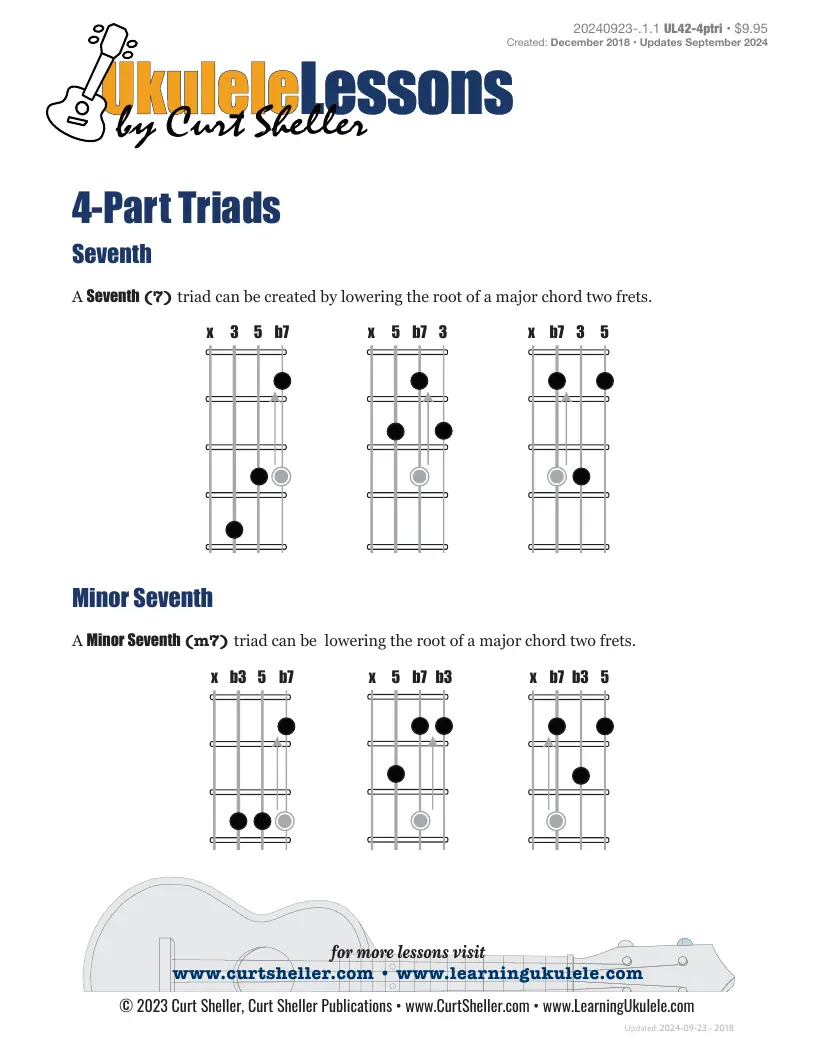
Beyond basic open position chords, basic movable form chords and a core set of 4-part chords. There are just too many chords shapes too memorize. Learning the principles of how chords are constructed and the ukulele fingerboard are the way to go. Then you can create more advanced chords like 9#11, 7#5-9, 13b5, 7+9 on the fly as needed.
Learning The Blues Scale on `Ukulele
Learn the Blues ( Minor Pentatonic ) and Pentatonic ( Major Pentatonic ) scales on ukulele. A practical approach to learning theses two essential scales using the Blues. These five note scales, the Major Pentatonic and the Blues or Minor Pentatonic scales are two of the most common scales used in contemporary music.
Learning Ukulele - Recipe for Success Workshop
"Where Do I Start?" This is a common question. This workshop/lesson covers ukulele tunings, learning the ukulele fingerboard, basic chords and strums. This workshop gets you rolling on having some fun playing the ukulele. This is the workshop-lesson handout that given to ukulele players attending the "Learning Ukulele - A Recipe for Success" beginner workshop.
Learning `Ukulele - Recipe for Success
"Where Do I Start?" This is a common question. This workshop-lesson covers ukulele tunings, learning the ukulele fingerboard, basic chords and strums. This workshop gets you rolling on having some fun playing the ukulele. This is the workshop-lesson handout that I give ukulele players attending my Learning Ukulele - A Recipe for Success beginner workshop.
Learning the Bo Diddley Strum
The Bo Diddley strum is named after Bo Diddley. Bo Diddley is an American R&B vocalist, guitarist, songwriter ( usually as Ellas McDaniel ), and rock and roll pioneer. He introduced more insistent, driving rhythms and a hard-edged electric guitar sound on a wide-ranging catalog of songs, along with African rhythms and a signature beat (a simple five-accent clave rhythm) that remains a cornerstone of rock and pop.
Learning the Fingerboard, C Tuning - Fret (2)
There is nothing that returns more value when learning a fretted musical instrument like the ukulele than really, and I mean really knowing the names of the notes of the fingerboard. This is not the same as learning to read music but simply knowing the name of any note on the fingerboard.b
Learning the Fingerboard, C Tuning - Fret (5)
Nothing when learning a fretted musical instrument like the ukulele returns more value than really, and I mean really knowing the names of the notes of the ukulele fingerboard. This is not the same as learning to read music — but simply knowing the name of any note on the fingerboard.
Learning the Fingerboard, C Tuning - Open Strings
There is nothing that returns more value for your investment when learning a fretted musical instrument like the ukulele than really, and I mean really knowing the names of the notes of the fingerboard. This is not the same as learning to read music - but simply knowing the name of any note on the fingerboard - intuitively, second-nature. At a minimum you need to know the open strings to tune the ukulele. In C tuning they are G C E A.
Learning the Fingerboard, C Tuning - Random Shape
There is nothing that returns more value when learning a fretted musical instrument like the ukulele than really , and I mean really knowing the names of the notes of the fingerboard. This exercise takes any random fingerboard shape and names the notes using any combination of their natural, sharps and or flats names.
Learning the `Ukulele Fingerboard (Finally!!!)
Most players struggle with learning the names of the notes of the ukulele fingerboard. There doesn't seem to a pattern and notes repeat. There is an easy way and "it's easier that you think." Most players know the names of the open strings for their favorite tuning.
Leciono Uno for TeStInG - CSP
Fred Flintstone is the main character of the animated sitcom The Flintstones, which aired during prime-time on ABC during the original series' run from 1960 to 1966. Fred is the husband of Wilma Flintstone and father of Pebbles Flintstone. His best friend is his next door neighbor, Barney, who has a wife named Betty and an adopted son, named Bamm-Bamm.
Major & Relative Minor Key Signatures
A "Key Signature" is a series of sharp or flat symbols placed on the staff, designating the notes that are to be consistently played higher or lower than the equivalent natural notes. Key signatures are generally written immediately after the clef at the beginning of a line of musical notation. Each major and minor key has an associated key signature that sharpens or flattens the notes which are used in its scale.
Maui Hawai'ian Sup'pa Man
This is cool, fun song that is part of a lot of Hawai'ian musicians repertoire and a lot of fun to play. I was always honored to have Gordon Velasco ask me to sit in with him and Debi and this was always on of my favorites to play and jam on. Basically an Andalusian chord progression: Am G F E7.
Modal Interchange
"Modal Interchange" is temporarily borrowing chords from a parallel tonality or mode that shares the same root. These borrowed chords originate from the major or minor parallel modes, including their respective harmonic and melodic minor, as well as symmetrical scales sharing the same root. You can borrow from any parallel scale or mode.
Modes of the Melodic Minor Scale
A great deal of modern jazz harmony arises from the modes of the ascending form of the melodic minor scale, also known as the Jazz Melodic Minor Scale. This scale is essentially a diatonic major scale with a lowered third, for example C–D–E♭–F–G–A–B–C. As with any other scale, the modes are derived from playing the scale from different root notes, causing a series of jazz scales to emerge.
Modular Phonetic Rhythm
"Modular Phonetic Rhythm" by Chuck Anderson represents a significant advance in the teaching and application of rhythm. Eliminating many inefficient aspects of rhythm education, Modular Phonetic Rhythm streamlines the traditional educational approach, resulting in a reflexive reaction to rhythm. This approach is applicable to all ages and to all styles of music.
Natural, Sharp and Flat Notes of the `Ukulele Fingerboard - D Tuning
The D Tuning comes in two versions where string four is either tuned to the "A", a major second below string one or low "A" where string fours is a perfect fifth below string three. The D tuning with a low A is the same as the thin four strings of a standard tuned guitar with a capo at fret (7).
Natural, Sharp and Flat Notes of the `Ukulele Fingerboard - G Tuning
The G Tuning comes in two versions where string four is either tuned to the "D", a major second below string one or low "D" where string four is a perfect fifth below string three. The G tuning with a low D is the same as the thin four strings of a standard tuned guitar.
Pachalbel's Canon Progression
In the key of C major Pachelbel's Canon is: C G Am Em F C F G. This is a I V VI III IV I IV V in harmonic analysis notation. In Nashville Numbering it's 1 5 6 3 4 1 4 5. It is a full diatonic progression with all the chords coming from it's parent major scale. A bit of a varaition of the Four Chord Pop progression.
Playing by Ear - Chords
Playing chords, chord progressions, and songs by ear is all about getting your ear to recognize the sound of chords and chord progressions and just like melodies, train the fingers and the hand to follow your inner ear and play these chords, chord progressions, and songs on demand.
Playing by Ear - The Ultimate Goal
The ultimate goal for any musician when playing a musical instrument is to "Play by Ear". It’s true whether you’re singing, banging a drum, strumming a guitar, or our favorite instrument, the ukulele. If your fingers can already interpret and follow what your inner ear commands, you’ve obtained your goal and are "Playing by Ear."
Playing in Time
Playing in time is an essential skill that every musician must possess. There are no shortcuts or alternatives when it comes to this aspect of music. Keeping your place while playing is a crucial lesson that focuses on honing your ability to maintain a consistent tempo and rhythm throughout your performance.
Practice, Practice, Practice
As far as practice is concerned, do as much as you can. Realize that there are many things and activities competing for your time and attention: work, family, school, money, etc., etc. You WILL progress if you stick with it. Only your rate of progress is variable and, of course, related to the time and effort you put into it. No matter the time available.
Quarter Note Strum
Chords and music are organized into bars or measures with the most common number of beats per bar or measure being four. One of the most basic strumming patterns and the foundation for ALL future strumming is the "Quarter Note Strum". As the name implies this strumming pattern is one quarter note per beat.
QuickStart Chord Progressions Play-along Tracks, Introduction and Tuning Notes
The QUICKSTART Rhythm Section CD contains 24 unique styles designed for contemporary lead guitar. Each track is devoted to a scale covered in the QUICKSTART Scale Fingerings series of books. There are four background tracks for each scale, featuring the chords of the scale. These tracks give you the opportunity to explore the sound of each scale in an improvisational setting.
QuickStart Scale and Arpeggio Fingerings for Ukulele, Getting Beyond Shapes
Over the years, people have come up with various fingering systems, patterns, and even gadgets to make learning the ukulele easier. Most systems are shape and pattern based and geared to the beginning student and do not require any knowledge of the ukulele fingerboard beyond what a fret is and the location of strings.
QuickStart Scale and Arpeggio Lesson Series
"QuickStart Scale and Arpeggio Fingerings" are a highly organized, efficient system of scale and arpeggio fingerings. Each fingering pattern is shown with a fingerboard shape, TAB and standard music notation. Related chords are also explained for each scale. Master these fingerings and unlock your potential for solos and improvisation.
Reading Music on Ukulele Series - Reading in Open Position, Alternate Note Locations
One of the reasons it is hard to read music on the guitar and the ukulele is, alternate note locations. In the open position there is one alternate note location. The open E, string two can also be played on string three, fret (3). If there is no overwhelming musical reason to play one location vs. the other. Then play the one that is easier to play. Use your ear as the final judge as to which one you prefer.
Reading Music on Ukulele Series - Reading in Open Position, Songs
The following songs can be played in open position using the natural notes covered in the previous lessons of this primer. These songs do not use any signatures, no time signature or key signature is shown. All songs are played with a quarter note taking one beat.
Reading Music on Ukulele Series - Reading in Open Position, What About String Four?
"C Tuning, Low G", extends the melodic range to G below middle C. This expanded range allows for a wider selection when selecting songs to play. The G, A and B are the same names as a high string four but sounding one octave lower.
Reading Music on `Ukulele Series - Reading in Open Position
This series of lessons will allow you finally, to check that Reading item off your music To Do list. Learning to read standard music notation opens a world of music to you. Music notation is the Lingua franca of amateur and professional musicians alike.
Reading Music on `Ukulele Series - Reading in Open Position, Introduction
There are a few things in music that students and players avoid. These are things like learning to read and knowing the notes of their own instrument. It is hard on guitar - but not so hard on ukulele. With the right guidance and plan of attack. IT IS EASY. It is really quite easy on a uke. Starting with natural notes in in the open position you can finally check off the Reading Music to do item. Learning to read standard music notation is really, really easy.
Reading Songs and Leadsheets
Playing music, especially the ukulele, is all about getting together with others and playing songs. Reading music opens you to a world of music beyond the ukulele. And, It's not as hard as you might think to read chord charts, Leadsheets, fake books, and navigating your way through a song's roadmap.
Reading Ukulele TAB - Alternate Notation
"TAB" or "Tablature", is an alternate form of musical notation, which tells players where to place their fingers on a particular instrument rather than which pitches to play. TAB is sort of a secret language between guitar players and ukulele players. Although a shortcut to getting started it actually serves to alienate one from the rest of the music world.
Reading for `Ukulele - Lesson Four, Key Signatures, Sharps
This lessons covers the natural symbol and the sharp key signatures keys. In musical notation, a key signature is a collection of sharp or flat symbols placed together on the staff. Key signatures are generally written immediately after the clef at the beginning of a line of musical notation, although they can appear in other parts of a score, notably after a double barline. A key signature is use to indicate the “auto sharping or flatting of specified notes. Key signatures are also used to identify the key of a composition.
Reading for `Ukulele - Lesson One, Introduction
This is a series of lessons for reading music for ukulele at a pro level. Reading can be thought of on many different levels. 1) the ability to slowly and painfully “work out” the written music. 2) the ability to “hear” the music by looking at the notation. 3) the ability to “notate” your ideas in standard music notation. 4) the ability to “read” music as you read a book or an article. 5) the ability to communicate with other musicians in the written language of music. 6) the ability to learn songs that you’ve never heard.
Reading for `Ukulele - Lesson Six, Ties
This lessons's work will advance rhythm by introducing Ties. Many ukulele players can find the notes on their instrument but can't read rhythm with enough accuracy and speed to be considered "sight readers". Remember that sight reading is just a level of reading. It's not some special and mysterious skill. When you read a book or magazine, you don't have to "work out" the words before you "read" them. You just read them.
Reading for `Ukulele - Lesson Three, Open Position
Now that you can recognize the notes on the staff in the Treble clef, it’s time to start connecting that knowledge to the ukulele. One of the most significant problems in reading for the ukulele, is that many of the same notes can be found in multiple locations on the neck. For example, the same A note is an open string one, string two - fret (5) and string three, fret (9) and if using a high G tuning - string four fret (2). The only way to cut down this complexity is to organize the ukulele into positions where this duplication is either eliminated or at least, minimized.
Reading for `Ukulele - Lesson Two, Note Recognition
Once you understand the basic concept of reading, it’s time to get down to the development of the skills. We know our goal is to read music as well as we read words. Now, how do we get there? Note Recognition - If you can’t recognize the notes on the staff, you certainly can’t read them. For anyone who is past this step, great! But in many cases, the recognition of notes on the staff is not as good as it should be. If you can’t read music, this skill doesn’t exist at all.
Reading for `Ukulele - Lessons Five, Key Signatures, Flats
This lessons covers the natural symbol and the flat key signatures keys. In musical notation, a key signature is a collection of sharp or flat symbols placed together on the staff. Key signatures are generally written immediately after the clef at the beginning of a line of musical notation, although they can appear in other parts of a score, notably after a double barline. A key signature is use to indicate the “auto sharping or flatting of specified notes. Key signatures are also used to identify the key of a composition.
Remembering Songs
Listening to songs and wanting to play the same songs on ukulele – that's what draws most people to the ukulele. That and it looks like a load of fun and easy to play – which it is. Then you need to actually remember the songs that you're learning, so you can play them again. And, hopefully, not have to read them off a sheet all the time.
Repeating Note - Single String Fingering Drills Conclusion
At this point, you can be creative and create any number of repeating note gymnastics to work on specific problem areas you encounter in your technique. This is actually where a good teacher can help in identifying problem areas in your playing.
Repeating Note Single String Fingering Drills
Building on the single note, 1, 2, 3, and 4 finger basic gymnastics. Now with a repeating note or two. This series of lessons, although the examples are shown for ukulele, are appropriate for any fretted string instrument like guitar, banjo, or mandolin.
Resonator `Ukuleles
A Resonator ukulele or resophonic ukulele is a ukulele whose sound is produced by one or more spun aluminum cones (resonators) instead of the wooden soundboard (ukulele top/face). These instruments are sometimes referred to as Dobro ukuleles, however the term Dobro is currently trademarked by the Gibson Guitar Corporation.
Rhythm - Avoid at Your Own Peril
The often neglected and taken for granted subject of Rhythm. Music is Melody, Harmony and Rhythm. We are drawn, initially to music by melody at a very early age, with the instrument of our voice. With ukulele you typically learn chords - the harmony and never really dive into learning rhythm. Unless you're a drummer we take rhythm for granted.
Secondary Chords - D Major
The secondary chords for any major key are the II, III and VI chords of its corresponding major scale. For D Major the secondary chords are: Em, F#m and Bm. From the primary and secondary chords of a major key countless songs and chords progressions can be played. This lesson covers the basic open position chords for D Major.
Secondary Dominant V of ...
A "Secondary Dominant" chord is defined as any seventh chord built on a scale root that is diatonic to the key that resolves up a perfect fourth or down a perfect fifth to a full diatonic chord. These chords function as a dominant (V) chord to the next chord, serving to temporarily tonicize the following chord.
Selecting a `Ukulele
A `Ukulele is: Light Weight, Affordable and Portable | Four Strings and Four Fingers | Less Need for Strumming Accuracy | There is nott a lot expected from a ukulele player. The 'Ukulele (pronounced oo-koo-lele) comes in four standard sizes: Soprano (sometimes called Standard), Concert, Tenor and Baritone.
Simple - Basic Chord Progression
Diatonic scales such as the major and minor scales lend themselves particularly well to the construction of common chords because they contain a large number of perfect fifths. Such scales predominate in those regions where harmony is an essential part of music, as, for example, in the common practice period of western classical music.
Simulating Various Ukulele Scale Lengths
If you don't have any concert size instruments nearby to try in a store you can create the scale length on your tenor with an inexpensive capo. A capo on the second or third frets of a tenor leaves you with a scale length (and fret spacing) similar to a concert and the neck width at that level should be very close to that found on most concerts. And if you want to get an idea of what a soprano scale would feel like put the capo at the 4th fret and you'll be almost exactly at the standard 13 5/8 inch length. However the width at that point on a tenor will in most cases be greater than at the nut of a soprano.
Six Essential Scales for `Ukulele
The six essential scales are: Blues Major Pentatonic Mixolydian Dorian Aeolian and Ionian From the six essential scales, you can get through a wide variety of traditional and contemporary music. A scale is simply a collection of pitches or notes, not really a "this is a Jazz scale", "this is a Blues" or "this is a Rock scale". It's how a scale is used that really matters not its name.
Six Essential Scales for `Ukulele - C Pentatonic
Essential C Pentatonic or Major Pentatonic scale patterns for ukulele. Learning scales typically starts with learning a position or pattern by shape. For a lot of players that's where it stops. With the many possible shapes between chords and scales to learn - there has to be a better way - There is!!!
Six Essential Scales for `Ukulele - Major Scale Five Position Summaries
The five "Major/Ionian" scale positions — a summary. The five basic positions are simply the expansion above and below the root and octave of the one octave scale fingerings using the notes that are available in that position. This lesson explores that on the lowest note of the position with every finger.
Six Secrets of Ukulele Fingering - Hand Position
Efficiency of motion and energy is the key to technique. The thumb should be flat against the back of the neck approximately under the first or second finger. The exact position varies with thumb, neck and hand size. The thumb pushes up against the neck while the fingers press down.
Solidbody Electric `Ukuleles
Most acoustic ukuleles can be plugged in with the addition of a internal pickup or stick-on pickup. This page focuses on purely "Electric Ukuleles". These are typically solid body instruments with pickups. Either magnetic pickups in the same vein as solid body guitar electric pickups or a piezo under the saddle pickups.
Songs Using a Common 1 5 6 4 Chord Progression
There's actually a lot in common between songs when it comes to chord progressions. Here is an every growing list of songs that use the common 1 5 6 4 chord progression. This is a “Full Diatonic” chord progression, with each chord coming from its corresponding major scale. This common progression is called the “Four Chord, Pop Progression.”
Technique
Musical Technique is simply the physical aspect of playing a musical instrument. The ability to exert efficient, optimal control in order to produce the precise musical effects that are desired. Improving one's technique generally entails practicing exercises that improve one's muscular sensitivity and agility. Technique is independent of musicality.
The Andalusian Chord Progression
The "Andalusian" cadence is a term adopted from flamenco music for a chord progression comprising four chords descending stepwise. It is otherwise known as the minor descending tetrachord. Traceable back to the Renaissance, its effective sonorities made it one of the most popular progressions in classical music.
The Big Six Core Chords - F6, Four Voicings
The Big Six Core Chords: "F6". This is the Level II of your core 4-part "Jazz" chords. The F6 is a 1 3 5 6 of the major scale, based on the root of the chord. A major 6th chord can be derived either from a seventh or major seventh chord. From a seventh chord lower the flat seventh one fret. From a major seventh chord lower the natural seventh two frets.
The Big Six Core Chords - F7, Four Voicings
The Big Six Core Chords, Level I - F7, four voicings. The F7 is a 1 3 5 b7 of the major scale, based on the root of the chord. For F7 the chord tones are: F A C Eb. These ARE the four F7 chord voicings that are used for deriving other chords. If all else fails when trying to remember a particular chord you can go back to your base seventh chords and go through the chord formula for deriving the chord you need.
The Big Six Core Chords - F7, four voicings, Chord Intervals
The Big Six Core Chords - Level I: "F7" is created from the "1 3 5 b7" of the major scale, based on the root of the chord. For "F7" the chord tones are: F A C Eb. This lesson introduces the four "F7" voicings on the string set, strings 1, 2. 3, and 4. The Chords are shown for C Tuning, Low and High G.
The Big Six Core Chords - Fdim7, Four Voicings
The Big Six Core Chords, Level I - Fdim7, four voicings. Fdim7 is a 1 b3 b5 bb7 of the major scale, based on the root of the chord. These are the four Fdim7 chord voicings that will be used for deriving other chords. There are far too many chord shapes to memorize thousands of shapes.
The Big Six Core Chords - Fm6, Four Vocings
The Big Six Core Chords: "Fm6". This is the Level II of your core 4-part "Jazz" chords. The Fm6 is a 1 b3 5 6 of the major scale, based on the root of the chord. A minor 6th chord can be derived either from a minor seventh or major sixth chord. From a minor seventh chord lower the flat seventh one fret. From a major sixth chord lower the natural third one fret.
The Big Six Core Chords - FmL7, Four Voicings
The Big Six Core Chords - Level II: "FmL7" is created from the "1 b3 5 7" of the major scale, based on the root of the chord. For "FmL7" the chord tones are: F Ab C E. The L is a contemporary chord designation and refers to a large seventh, a major seventh.
The Big Six Core Chords - Fmaj7, Four Voicings
The Big Six Core Chords, Level I - Fmaj7, four voicings. Fmaj7 is a 1 3 5 7 of the major scale, based on the root of the chord. These are the four Fmaj7 chord voicings that will be used for deriving other major seventh derived chords. There are far too many chord shapes to memorize thousands of shapes.
The Downbeat
Locating the downbeats, pulse, and especially beat one is really important in music. Tracking the downbeats on a strumming instrument like ukulele is really important as it relates to the stroke direction and weak and strong part of downbeats and upbeats. These strong and weak parts of the beat need to be reinforced and telegraphed in order for listeners and fellow musicians to play and follow along.
The Harmonized Major and Minor Chord Scale Charts
The "Major Scale" or Ionian scale is a diatonic scale, made up of seven distinct notes, plus an eighth which duplicates the first one octave higher. In solfege these notes correspond to the syllables Do, Re, Mi, Fa, Sol, La, Ti/Si, (Do), the Do in the parenthesis at the end being the octave of the root.
The Learning Process - The Mind, Hands and Ears
For music and learning an instrument like the ukulele or guitar, it's all about the making the connection between your Mind, your Hands, and your Ear. When listening to music, we enjoy it at the tempo the composer or artist intended, in real time. Only the ear is involved in listening. This is passive listening and you're simply enjoying the music. This is what we do every day and it's what draws us to want to learn a musical instrument.
The Muted Strum
The muted strum is executed by relaxing the chord hand during the strum. If the chord is a barre, relaxing the pressure is enough to create the percussive, drum like effect. If holding an open chord, the fingers relax but maintain enough finger pressure to get the muted sound. This is what a few players are calling, The Universal Muted Chord. You're utilizing your ukulele as a percussive instrument and there is no discernible pitch - just like a drum. This chord works on any song just as a drum works with any song and does't care what the key is. This is a great chord to use when learning a new strum.
The Trouble with TAB
TAB, short for tablature is a form of musical notation using numbers and letters on a staff that corresponds to the number of strings of a fretted string instrument. These numbers tell a player which fret to place their fingers on the fingerboard. TAB has a history with lute music from centuries ago and has found wide use in the music publishing industry, catering to the guitarist who can't or doesn't want to learn to read.
This Is A 2026 Bogus Lesson
Hawaii can be heaven and it can be hell. Going back to the noir fiction of the 30s, 40s and 50s. It's very contemporary. The universe is so big, there's so many worlds, there must be one of them or more, something that's alive. People work harder when conditions are worse. It's an important fact of life, war.
Three Finger Slide Fingering Drills for `Ukulele
Slide is used when the passage cannot be played within a single 4 fret span or when more notes per string required to produce a particular effect. I's also used in situations where a gradually ascending or descending diagonal motion best solves the physical and musical demands of the passage.
Traditional and Contemporary Triads
A "Triad" is a three note chord. In traditional chord theory there are four traditional triad chord types: major, minor, diminished and augmented. And four contemporary triad chord types: sus2, sus4, add2 and add9. Triads can be used harmonically, as chords and melodically, as single notes. Triads are a great way to get started with creating melodic solos and improvising.
Transposing Individual `Ukulele Chords
"Transposition" is the process of moving a note, chord, scale or any musical passage from one key to another key. All music can be transposed, from a single note to a complex musical score. This lesson deals with transposing chords on ukulele and transposing chords.
Triplet Based Strums - 12/8
A triplet, as the “tri” in the name implies, means three. It’s the subdivision of the beat into three even parts. Notice that I had used the word three for the number 3 in my writing. So, if I’m counting any beat which can be sub divided by three, it’s 1 2 3. No need to use words such as trip-o-let or one triplet, two triplet, etc to count.
Two Finger Pass Fingering Drills for `Ukulele
Pass maximizes the number of notes per string, making the timbre consistent. It's used to move up or down the neck to cope with a passage in which the range is unusually large. The pass provides an effective way to move straight up the first string. It's particularly useful in developing 3 octave fingerings and in playing melodies with an adjacent drone string.
Two Finger Slide Fingering Drills for `Ukulele
Slide is used when the passage cannot be played within a single 4 fret span or when more notes per string required to produce a particular effect. I's also used in situations where a gradually ascending or descending diagonal motion best solves the physical and musical demands of the passage.
Two Finger-Two Note Basic Single String Fingering Drills for `Ukulele
To play the ukulele effectively, your fingers need physical strength, agility, flexibility and coordination. This two finger-two note drill is designed to get your hands in shape. These exercises work no matter what style of ukulele you play or want to play.
Types of `Ukulele Chords
Naturally, for Ukuleles, all chords need to be voiced using only the four strings available. You would think that this is limiting, when in actuality it's quite liberating when you learn the makeup of chords. Chords can be categorized into four categories: “Open Position Chords”, “Movable Form Chords”, “4-part - a.k.a. Jazz Chords”, and “Free Form Chords.”
Understanding Diatonic Intervals
An interval is the distance between two notes. An interval has a name and a type. Intervals can be played one note (melodic) or two notes (harmonic) at a time, ascending or descending. Simple and Compound Intervals are taken from a major scale. Chromatic Intervals are NOT taken from a major scale. They are derived from the diatonic intervals.
Upper Partial Chord Tones
Upper Partials or extensions for chords are the 9th, 11th, and 13ths of a chord. The 9, 11 and 13 can be altered chord tones depending on the type: e.g: b9, #9, #11, b13. These numbers, the 9, 11 and 13 refer to the scale tone/chord tone relative to the major scale used for building all chords.
Upper Partials and Chord Extensions
A chord extension or upper partial are the chord tones above the octave and not one of the fundamental 4-part chord tones. These are the ninths, elevenths and thirteenths of chords. All chord extensions on ukulele will displace a fundamental chord tone. This is even true for guitar with the ability to add the extension to another string.
Using Songs to Learn `Ukulele
There are two approaches when learning a musical instrument like the ukulele or guitar. The first approach and one that is very popular with the ukulele goes right along with its easy to play reputation. This approach uses songs to learn the ukulele. A second approach is to learn what would be consider the the basics before working with songs.
Using Triads on `Ukulele
In music or music theory, a triad is a three-note chord (or, more generally, any set of three notes, pitches, or tones). Triads can be used harmonically, as chords and melodically, as single notes. These lessons explore both. Using triads as chords like any other chord and using triads as a basis for creating melodies and improvising.
What Finger is What?
Just what are the fingers of the plucking and fretting hand called. There can be a bit of confusion as to what the names and numbers of your fretting hand and the plucking or strumming hand are. Here are some of the common fingering notations I’ve encounter over the course of my studying ukulele and guitar.
What is the Blues?
The Blues are at the heart of all American music. It has influenced Country, Rock, Folk, Jazz, Bluegrass and just about every form of American music we listen to today. The Blues - a chord progression, a scale, a feeling. This lesson presents an introduction to the blues progression and a couple of scale position of the pentatonic scale to get you started improvising.
What is the Difference Between a Scale and a Mode?
The terms "scale" and "mode" are often used interchangeably, but strictly speaking, there is a significant difference between them in music theory. Although they may share the same set of notes, a scale and a mode or modal scale are not the same thing. It's important to note that a scale and a mode can contain the same notes.
Which Way Is Up? - Up, Down, Ascending, Descending, etc...
What is up, down, higher, lower, top, bottom, ascending, descending on a guitar? Up, down, higher, lower, top, bottom, ascending, descending should refer to musical pitch and not to direction as we know it. Up and higher refers to the raising of musical pitch. Down and lower refer to the lowering of musical pitch. Top refers to the upper note of a chord voicing or musical phrase and bottom refers to the lowest note.
Your First `Ukulele Chord
Your first ukulele chord is typically an open position "C Major Chord." It's only one finger and ukulele players love to show new players this, the easiest, usable ukulele chord for new players. Especially someone coming from guitar where an open position C major is three fingers and not that easy as the first chord.
`Ukulele Strums - Core Pattern 4.1
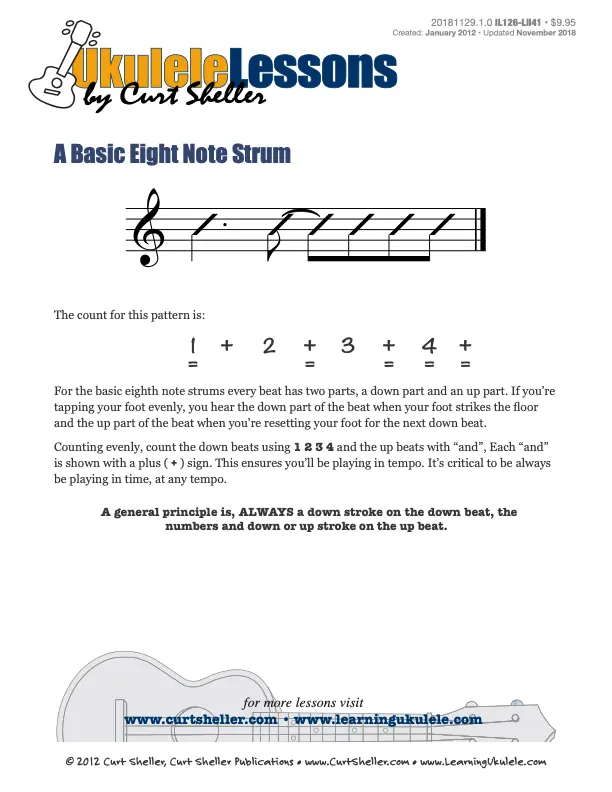
Another one of the 72 possible strumming patterns based of the Modular Phonetic Rhythm systems level II rhythmic syllables. A dotted quarter note and one eight note to four eight notes. Basically one rhythmic rhythmic syllable from the Modular Phonetic Rhythm tied to another syllable from the system.
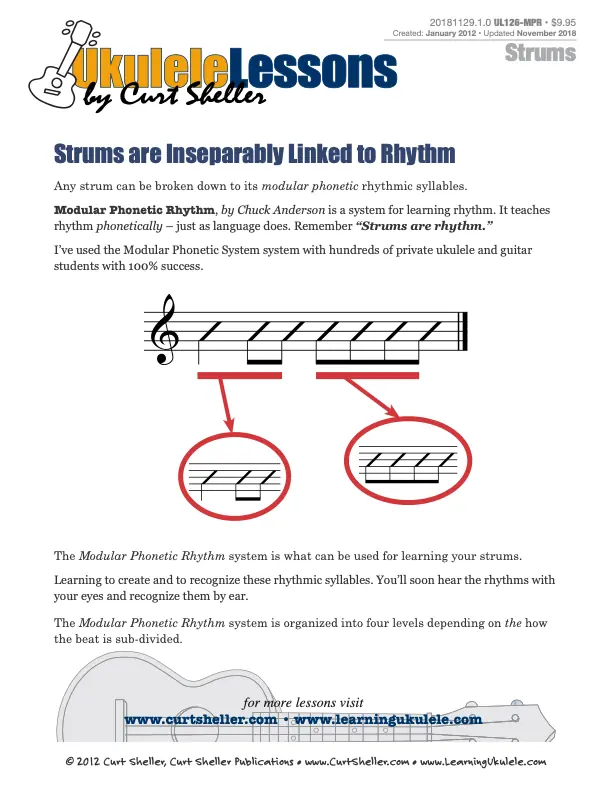
`Ukulele Strums and The Modular Phonetic Rhythm System
Strums are Inseparably Linked to Rhythm. Any strum can be broken down to its Modular Phonetic rhythmic syllables. Modular Phonetic Rhythm, by Chuck Anderson is a system for learning rhythm. It teaches rhythm phonetically - just as language does. Remember 'Strums ARE rhythm'
`Ukulele • Piano Comparison
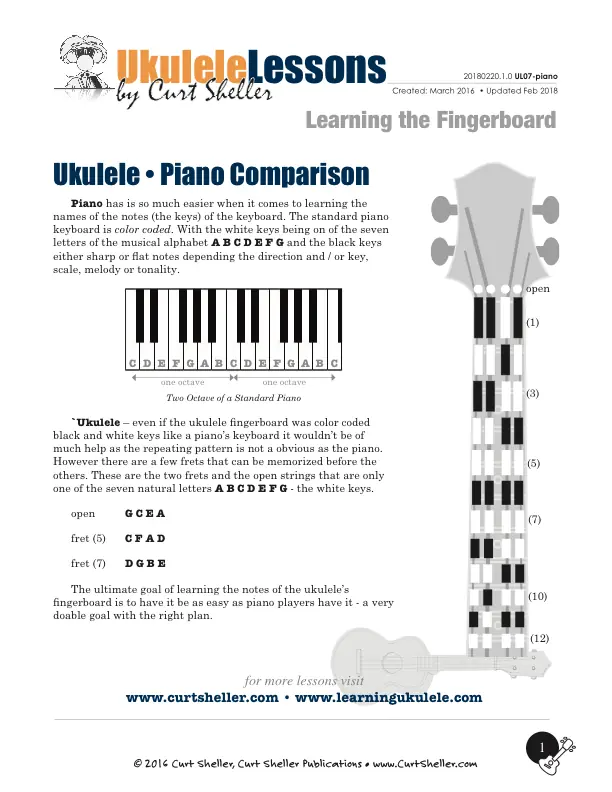
Piano has is so much easier when it comes to learning the names of the notes (the keys) of the keyboard. The standard piano keyboard is color coded. With the white keys being one of the seven letters of the musical alphabet "A B C D E F G" and the black keys either sharp or flat notes depending the direction and / or key, scale, melody or tonality.