
Published:
2005-01-02
Updated:
2026-03-18
Learning Ukulele with Curt
What is the Difference Between a Scale and a Mode?
The terms "scale" and "mode" are often used interchangeably, but strictly speaking, there is a significant difference between them in music theory. Although they may share the same set of notes, a scale and a mode or modal scale are not the same thing. It's important to note that a scale and a mode can contain the same notes.
Author(s): Curt Sheller, Chuck Anderson Publisher: Curt Sheller Publications, Anderson Music Publications Code: UL110
Main Category: Scales Main Instrument: Any
Categories: Chords, Scales, Theory, Modal, TmpPagyCatDebug
2026-08-23
Show Series Lessons
Series Home
The terms "scale" and "mode" are often used interchangeably, but strictly speaking, there is a significant difference between them in music theory. Although they may share the same set of notes, a scale and a mode or modal scale are not the same thing. It's important to note that a scale and a mode can contain the same notes. This started out as a reply to a on-line posting and question. I realized a lot of players don't know the difference between a scale and a mode or scale mode. So, I thought I'd spin out a little Internet lesson and post it. So here is my take on the Scale and Mode thingy.
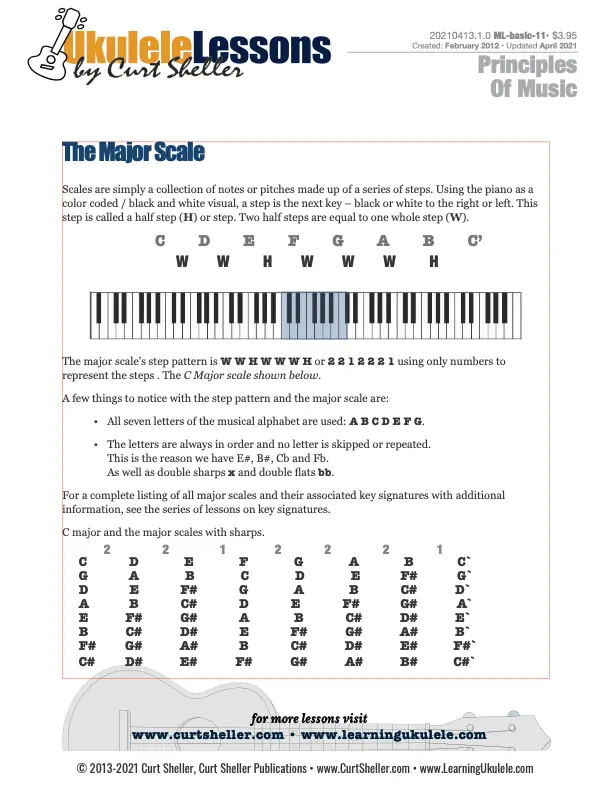
To provide a clearer understanding, let's consider the example of the G Major Scale [ G A B C D E F♯ G` ] as our context.
The notes ( G A B C D E F♯ G` ) represent and ARE the G Major Scale . These notes can be used to form any of the modal scales with names that sound like ancient Greek modes, such as Dorian, Phrygian, Lydian, Mixolydian, Aeolian, Locrian, and Ionian, as long as all the notes remain the same.
It's crucial to recognize that simply starting on a different scale degree does not define one mode from another. In order to fully understand and explain music, it's best to explore it within its specific context.
- A Dorian: A B C D E F# G A`
- B Phrygian: B C D E F# G A B`
- C Lydian: C D E F# G A B C`
- D Mixolydian: D E F# G A B C D` — Dominant*
- E Aeolian: F# G A B C D E` — Natural Minor*
- F# Locrian: F# G A B C D E F#`
- G Ionian: G A B C D E F# G` — Major*
*Traditional names.
When studying modes, a common source of confusion arises from using the same major scale as the foundation for learning. However, for our current purposes, utilizing the major scale will indeed aid in clarifying the distinction between a scale and a mode. In fact, it offers the advantage of exploring seven modes within the framework of a single major scale.
By starting the major scale on different scale degrees, we can derive unique modes, each with its own distinctive sound and character. This allows us to obtain seven distinct modes from a single major scale. This approach provides a practical and comprehensive way to grasp the concept of modes and understand how they differ from a scale.
Therefore, despite the potential confusion that may arise, using the major scale as a basis for studying modes serves as an effective tool for illustrating the differences between scales and modes while also offering the added benefit of exploring multiple modes within a single framework (the major scale).
Using the G Major Scale ( G A B C D E F# G` ) for comparison.
- Dorian — A B C D E F# G A` is frequently called a minor scale. As it is a minor scale type with a minor 3rd and minor 7th.
- Phrygian — B C D E F# G A B` is also a minor scale. I don't know of any other common name for Phrygian. I'm sure there are some.
- Lydian — C D E F# G A B C` , is a major scale.
- Mixolydian — D E F# G A B C D` is often referred to as the Dominant scale and is a major scale type.
- Aeolian — E F# G A B C D E` this is the same as the Natural Minor scale.
- Locrian — F# G A B C D E F#` a diminished scale type. No other common names that I'm aware of.
- Ionian — G A B C D E F# G` , this is the common Major Scale.
Indeed, the Dorian, Aeolian, and Mixolydian modes are commonly used in contemporary music. These modes have distinct characteristics that contribute to their unique sound and are often employed by musicians and composers.
For example, the song Moondance incorporates elements of both the Dorian mode and the Natural Minor or Aeolian mode. The Dorian mode, with its characteristic major sixth interval, provides a smooth and jazzy quality to certain sections of the song. On the other hand, the Natural Minor or Aeolian mode contributes a melancholic and introspective vibe to other parts of the composition. The combination of these two modes enhances the overall texture and mood of the piece.
Another well-known song, Sweet Home Alabama,
is predominantly based on the Mixolydian mode. The Mixolydian mode, characterized by its major scale with a flattened seventh degree, imparts a distinct southern rock and blues flavor to the song. This mode is commonly used in many popular rock and blues compositions to create a laid-back and groovy atmosphere. This is one of the songs that is more often than not mis-identified as being in a major key. The niggest clue that it is not in a major key is there is no
V I
resolution.
By incorporating modes into their musical compositions, artists can harness the unique tonal qualities and expressive possibilities they offer, adding depth and variety to music.
Melodically as Single Notes
The characteristic sound of each mode is derived from its unique scale step, which, when emphasized in a melody or improvised solo, defines the mode. This emphasis on a specific scale step creates what is referred to as a scale mode
or simply a mode.
This distinction forms the primary difference between the traditional major scale, key, and tonality, and the traditional tonic (
I
) and dominant (
V
) harmony.
By focusing on a particular scale step within a mode, musicians can evoke the distinct sonic qualities associated with that mode. This emphasis shapes the melodic and harmonic elements, contributing to the mode's characteristic sound and feel. In contrast, traditional major scale, key, and tonality rely on different principles, emphasizing a fixed Tonic ( I ) and Dominant ( V ) harmony as their defining elements.
Understanding and utilizing these unique scale steps in modes allows musicians to explore a broader tonal palette and create music with diverse flavors and emotions, extending beyond the conventions of traditional major scales and keys.
The Characteristic Scale Steps for the modes are (based on the G Major Scale):
- Dorian: A B C D E F# G A' , characteristic scale step is F#, the sixth scale degree.
- Phrygian: B C D E F# G A B' , characteristic scale step is C, the second scale degree.
- Lydian: C D E F# G A B C' , characteristic scale step is F#, the fourth scale degree.
- Mixolydian: D E F# G A B C D' , characteristic scale step is C, the seventh scale degree.
- Aeolian: E F# G A B C D E' , characteristic scale step is G, the third scale degree.
- Locrian: F# G A B C D E F#' , characteristic scale step is C, the fifth scale degree.
- Ionian: G A B C D E F# G` , characteristic scale step is G, the first scale degree.
Even more to confuse you. Using triads, a three note chord, each mode has the same chords. Using our G Major Scale
they are: G, Am, Bm, C, D, Em, and F#dim chords in its chord collection
.
Harmonically (as Chords)
Just as each mode has a characteristic scale step for the mode. Each mode has characteristic chords. The primary, secondary, and diminished chords of each mode help define their modal sound.
It's the characteristic scale step that identifies the primary and secondary chords for each mode. The primary chords of any one of the modes are the I chord of the mode and the major and minor triads that contain the characteristic scale step.
A Dorian:
An example using A Dorian:
- A B C D E F♯ G A'
- 1 2 3 4 5 6 7 8 , the scale degrees
- I, II, III, IV, V, VI, VII , their chord functions
The Dorian mode is defined by its characteristic scale step, which is the sixth degree of the mode. In the case of A Dorian, this would be F♯. The primary chords associated with the Dorian mode include the I chord of the mode, as well as major and minor triads derived from the mode. In the key of A Dorian, these chords are Am , Bm , and D . The Bm chord consists of the notes B , D , and F♯ , while the D chord is comprised of the notes D , F♯ , and A . Both of these chords contain the characteristic scale step of the Dorian mode, namely the sixth degree, F♯.
It's important to note that the one ( I ) chord within the mode is NOT required to have the characteristic scale step. In the case of the Dorian mode the I chord does include the sixth degree of the mode.
Primary Chords
- Am (A C E), the I chord
- Bm (B D F♯) the II chord
- D (D F♯ A) the IV chord
Secondary Chords
The C , Em , and G are secondary chords of the mode and the F#dim is the lone diminished chord.
OK, one more to show that the G Ionian mode is different that the G Major scale.
The Ionian Mode is NOT the Traditional Major Key
The characteristic scale step for Ionian is the one ( I ) - G. So the primary chords are the I chord of the mode and the major and minor triads: G , C , and Em :
- G (G B D) the I chord
- C (C E G) the IV chord
- Em (E G B) the VI chord
In the traditional key of G major the I , IV , and V chords are the primary chords. The tonic, subdominant and dominant chords.
Alright, one more example. D Mixolydian: D E F# G A B C D` . The characteristic scale step in Mixolydian is the seventh scale degree, C. The primary chords are the I , V , and VII . D , Am , and C .
D Mixolydian 12-Bar Blues
||  D   |  C   |  D  |  D  |

 |  G   |  G  |  D  |  D  |

 |  Am  |  C  |  D  |  Am ||


||  I   |  VII  |  I  |  I  |

 |  IV  |  IV   |  I  |  I  |

 |  V   |  VII  |  I  |  V  ||
NOTE: The Roman Numerals for modes are always just I II II IV V VI VII
Each mode contains notes and chords common to a corresponding, related major scale. So it is easy to inadvertently slip into a mode's related major scale. When that happens, you have lost the mode and have actually modulated into a major key. This can occur melodically or harmonically or both. Basically avoid or handle with care the D to G , as that is the V to I dominant to tonic resolution in our G Major example and is characteristic to major keys.
One of the keys to all this mode or modal stuff is that the harmonic function of a chord, its I , II , III , IV , V , VI , VII is different in each mode for each chord. Here is how the Am chord functions harmonically in each mode:
- Am in A Dorian is a I chord.
- Am in B Phrygian is a VII chord.
- Am in C Lydian is a VI chord.
- Am in D Mixolydian is a V chord.
- Am in E Aeolian is a IV chord.
- Am in F♯ Locrian is a III chord.
- Am in G Ionian is a II chord.
Their harmonic function is completely different from mode to mode. Just as a G in the Key of C is different than a G in the Key of G , or G in the Key of D in traditional Tonic/Dominant harmony.
With printed music only using key signatures for major and their relative minor keys. It's this harmonic knowledge that allows you to determine if a song is in a major key or a mode. You might not need this to just play chords but to embellish the chords and improvise, it's a definite plus.
As always, you should only name things in it's harmonic context. In music there isn't a lot that can be named out of context.
Bottom Line Is!
If you are NOT emphasizing that characteristic scale step of the mode in the chords, melody, and or improv — you just playing in a major or minor key.
My Mystical, NOT So Secret Mantra
for Figuring Out The Chords for ANY Mode, ANY Key
Here is a helpful and mystical technique that you can use to determine the chords of any mode derived from a major scale. Here's the key to unlocking it. Just use the information that you would use for the Major/Ionian scale to derive the chords for the mode.
For Triads in the major scale — the order of chord types are as follows: major, minor, minor, major, major, minor, diminished.
For Four-part 7th Chords in the major scale, the order of chord types is: major 7th, minor 7th, minor 7th, major 7th, 7th, minor 7th, half-diminished 7th (not minor 7th flat 5 as that is a minor key).
This mnemonic tool allows you to easily recall the chords associated with major scales and their related modes. By starting at a different point in the sequence, you can derive the chords for any mode. With this approach, you don't need to memorize an overwhelming amount of information. This tool, combined with your knowledge of the Major Scale , provides you with the means to determine the chords for any mode.


End of Lesson - Thanks, Hope You Enjoyed It!
Related Lessons, Videos, Lesson Series, Songs, Books & Reference Charts, Resources & Assets, Workshops are below.
QUICKSTART Scale and Arpeggio Series
The QUICKSTART — Scale and Arpeggio Fingerings Series is a concise, well-organized series of books, lessons, and workshops ideal for any guitar, ukulele, or bass player beginning to explore “improvisation”. Unlike so many other instructional materials on the market, The QUICKSTART — Scale and Arpeggio Fingerings Series keeps a sharp focus on the essential scales and arpeggios, their fingerings and their related chords. All material is covered in every key.