
Published:
2011-09-11
Updated:
2023-06-09
Learning Ukulele with Curt
Key Signatures - C Major and A Minor
In music, it is important to learn and recognize the key signature for C Major and A Minor. These two keys have corresponding major and natural minor scales, along with basic ukulele chords that can be used with each scale. The key of C Major, also known as the learning key, is particularly easy to memorize and start using.
Author(s): Curt Sheller Publisher: Curt Sheller Publications Code: UL44
Main Category: Theory Main Instrument: Any
Categories: Chords

2026-08-23
Show Series Lessons
Series Home
Number of Pages: 4
If you're a registered site member and have the correct permissions you can view ALL the pages of this PDF at a larger size using the LearningUkulele.com Online PDF Viewer (button below).
Download PDFThis Download IS part of your Gold Site Access and a FREE download. Thanks for supporting the site. — Curt
Each PDF file is a professionally prepared, formatted, high resolution file that prints out great. You'll need a PDF Reader or application capable of viewing PDF files to view the PDF.
NOTE: Download the current PDF file for the latest, complete, and most up-to-date version. As well as additional information not presented on-line.
In music, it is important to learn and recognize the key signature for C Major and A Minor. These two keys have corresponding major and natural minor scales, along with basic ukulele chords that can be used with each scale. The key of C Major, also known as the learning key, is particularly easy to memorize and start using.

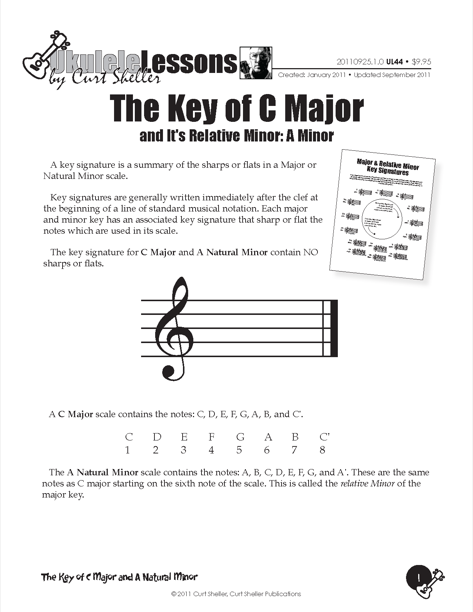
Key of C Major / A Minor (no sharps or flats)
C Major is a major scale based on the note C, consisting of the pitches C, D, E, F, G, A, and B. It has no flats (♭) or sharps (♯) in its key signature. The relative minor of C Major is A minor, while the parallel minor is C minor.
C Major is widely used in music and serves as the home key for many transposing instruments. For instance, a clarinet in B-flat, which sounds a B-flat major scale, is notated as playing a C major scale.
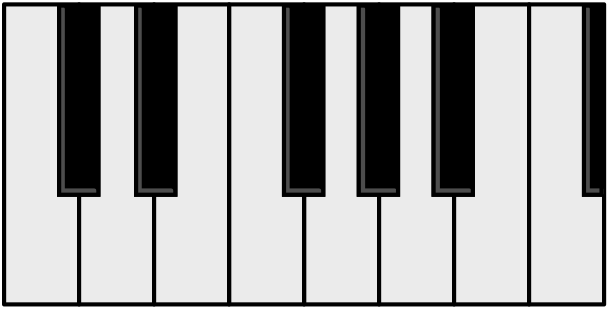
On the piano , the white keys correspond to the C major scale, although some electronic keyboards can be pitched to different keys.
Among brass instruments, the trumpet in C is more commonly used, and the contra-bass tuba is in C. A harp tuned to C major will have all its pedals in the middle position. A diatonic harmonic in C will have the C major scale available.
More Key Signatures - C Major and A Minor
content below, continue exploring...
More Key Signatures - C Major and A Minor
C Major is one of the most commonly used key signatures in music. Most transposing instruments playing in their home key are notated in C major; for example, a clarinet in B-flat sounding a B-flat major scale is notated as playing a C major scale. The white keys of the piano correspond to the C major scale (however, some electronic keyboards are pitched in B-flat). Among brass instruments, the more common trumpet is the trumpet in C, and the contra-bass tuba is in C. A harp tuned to C major has all its pedals in the middle position.
C Major is often thought of as the simplest key, owing to its lack of either sharps (♯) or flats (♭), and beginning piano students‘ very first pieces are usually very simple ones in this key, and the first scales and arpeggios that students learn are usually C-major based. However, going against this common practice, the composer Frédéric Chopin regarded this scale as the most difficult one to play with complete evenness, and he tended to give it last to his students. He regarded B major as the easiest scale to play on the piano, because the position of the black and white notes best fitted the natural positions of the fingers, and so he often had students start with this scale. A C-major scale lacks black keys, and thus does not fit the natural positions of the fingers very well.
Key Signature
A Key Signature is a collection of the natural, sharp, and, flat notes that appear in a piece, section, or part of music. Most commonly used with Diatonic Keys in Western music. Modal music will share the key signature from its inherent major key. And examples would be D Dorian using the C Major key signature. Basically the key signature of the major scale that is all the same notes of the modal scale.
Key Signatures can into use during the Common Practice Period of music.
The C Major Key Signature has no sharps or flats for: C D E F G A B'. This is the C Major Scale .
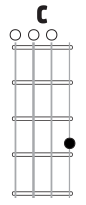
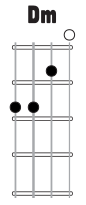
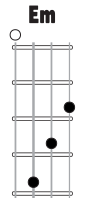
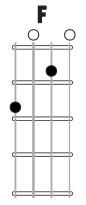
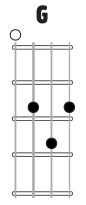
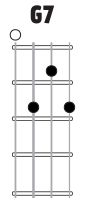
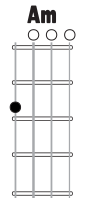
Basic Ukulele Chords for the Key of C
.svg)
Note: The °7 is a Diminished Seventh chord. This is the chord that is traditionally substituted for a diminished (dim) triad. The °7 chord shown here can be G#°7, Ab°7, D°7, F°7 or B°7. Any one of the notes can be the name of the the chord. Even double flat and double sharp Enharmonic Equivalents are possible. That is a a lot of possible names, all depending on the harmonic context of the chord.


End of Lesson - Thanks, Hope You Enjoyed It!
Related Lessons, Videos, Lesson Series, Songs, Books & Reference Charts, Resources & Assets, Workshops are below.