
Published:
2013-02-25
Updated:
2026-04-22
Learning Ukulele with Curt
Common Chord Progressions for the Key of C Major
Sometimes called the “learning key,” the key of C major is one of the easiest keys to memorize and begin using. C major (often just C or key of C) is a musical major scale based on C, with pitches C D E F G A B C. Its key signature has no flats or sharps. Its relative minor is A minor: A B C D E F G A B r, and its parallel minor is C minor: C D E F G Ab Bb C D Eb.
Author(s): Curt Sheller Publisher: Curt Sheller Publications Code: UL44c
Main Category: Theory Main Instrument: Ukulele
Categories: Chords, Scales, Theory, Major, Minor, Music Keys, Harmony

2026-08-23
Show Series Lessons
Series Home
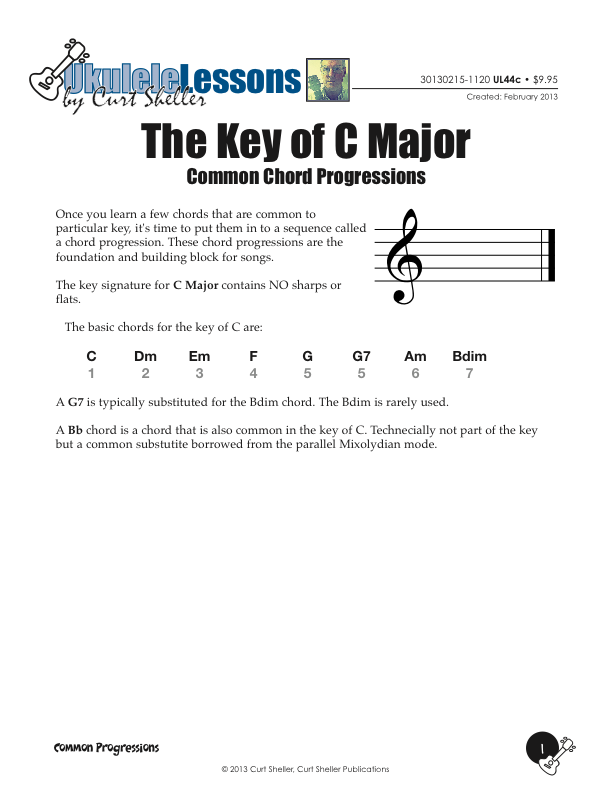
Number of Pages: 4
If you're a registered site member and have the correct permissions you can view ALL the pages of this PDF at a larger size using the LearningUkulele.com Online PDF Viewer (button below).
Download PDFThis Download is NOT part of your LearningUkulele.com & Learning Ukulele with Curt membership level.
Sign-up for Premium Site Access or Upgrade Your Plan to download this PDF or your can purchase a copy for download
Sign In for Access…Contact Us if there are any issues.
Sometimes called the “learning key,” the key of C major is one of the easiest keys to memorize and begin using. C major (often just C or key of C) is a musical major scale based on C, with pitches C D E F G A B C. Its key signature has no flats or sharps. Its relative minor is A minor: A B C D E F G A B r, and its parallel minor is C minor: C D E F G Ab Bb C D Eb.s of the fingers very well.
The key signature for C Major and A Minor contain NO sharps or flats.
C Major (often just C or key of C) is a musical major scale based on C, with pitches C, D, E, F, G, A, and B. Its key signature has no flats or sharps.
Its relative minor is A minor, and its parallel minor is C minor.
C Major is one of the most commonly used key signatures in music. Most transposing instruments playing in their home key are notated in C major; for example, a clarinet in B-flat sounding a B-flat major scale is notated as playing a C major scale. The white keys of the piano correspond to the C major scale (however, some electronic keyboards are pitched in B-flat). Among brass instruments, the more common trumpet is the trumpet in C, and the contra-bass tuba is in C. A harp tuned to C major has all its pedals in the middle position.
C major is often thought of as the simplest key, owing to its lack of either sharps or flats, and beginning piano students’ very first pieces are usually very simple ones in this key, and the first scales and arpeggios that students learn are usually C-major ones. However, going against this common practice, the composer Frédéric Chopin regarded this scale as the most difficult one to play with complete evenness, and he tended to give it last to his students. He regarded B major as the easiest scale to play on the piano, because the position of the black and white notes best fitted the natural positions of the fingers, and so he often had students start with this scale. A C-major scale lacks black keys, and thus does not fit the natural positions of the fingers very well.


End of Lesson - Thanks, Hope You Enjoyed It!
Related Lessons, Videos, Lesson Series, Songs, Books & Reference Charts, Resources & Assets, Workshops are below.