
Published:
2005-09-01
Updated:
2022-08-24
Learning Ukulele with Curt
Enharmonic Equivalents
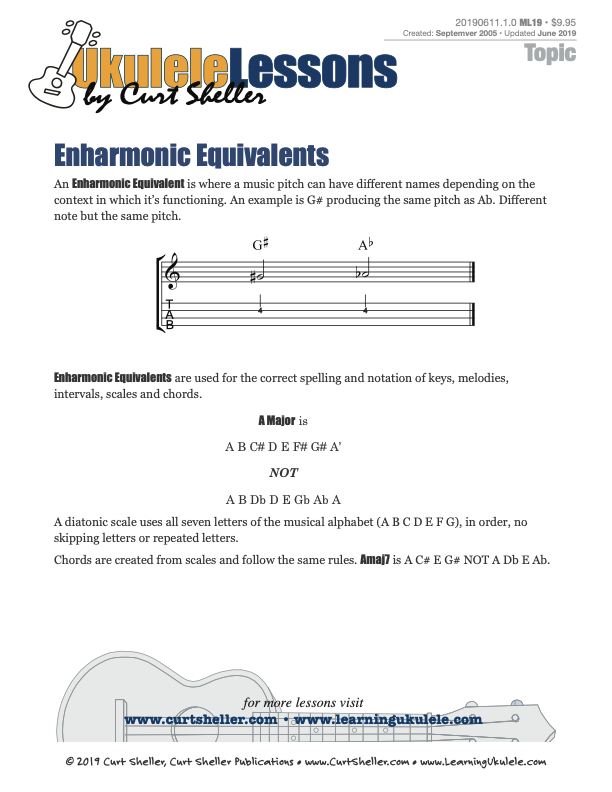
An "Enharmonic Equivalent" is where a musical pitch can have different names depending on the context in which it is functioning. An example is G# produces the same pitch as Ab but have different standard notations when written in music.
Author(s): Curt Sheller Publisher: Curt Sheller Publications Code: ML-basic-19
Main Category: Theory Main Instrument: Any
Categories: Chords
2026-08-23
Show Series Lessons
Series Home
Number of Pages: 2
If you're a registered site member and have the correct permissions you can view ALL the pages of this PDF at a larger size using the LearningUkulele.com Online PDF Viewer (button below).
Download PDFThis Download IS part of your Gold Site Access and a FREE download. Thanks for supporting the site. — Curt
Each PDF file is a professionally prepared, formatted, high resolution file that prints out great. You'll need a PDF Reader or application capable of viewing PDF files to view the PDF.
NOTE: Download the current PDF file for the latest, complete, and most up-to-date version. As well as additional information not presented on-line.
An Enharmonic Equivalent is where a musical pitch can have different names depending on the context in which it is functioning. An example is G# produces the same pitch as Ab.
Enharmonic equivalents, same pitch — different name, will sound the same but are notated differently using standard music notation.
Enharmonic Equivalents are used for the correct spelling of scales and chords.

Sharps ♯ to Flats ♭
- A♯ <=> B♭
- B♯ <=> C♭/strong>
- C♯ <=> D♭
- D♯ <=> E♭
- E♯ <=> F♭/strong>
- F♯ <=> G♭
- G♯ <=> A♭
Flats ♭ to Sharps ♯
- A♭ <=> G♯
- B♭ <=> A♯
- C♭ <=> B♯/strong>
- D♭ <=> C♯
- E♭ <=> D♯
- F♭ <=> E♯/strong>
- G♭ <=> F♯
So Yes, there is an E♯, B♯, C♭, and F♭.
More Enharmonic Equivalents
content below, continue exploring...
More Enharmonic Equivalents
The Piano
The piano provides a great graphical representation of the natural notes ( A B C D E F G ) their sharps and flats. ALL the white keys are the natural notes.
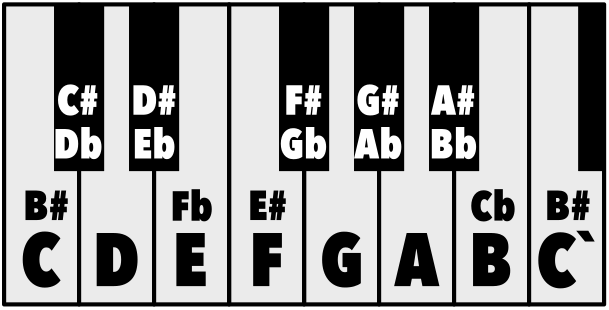
Note: Although a lot less common than the above sharp and flat equivalents, there are also double sharps, double flats. And although very, very rare even triple sharps and flats These would be called Enharmonic Equivalents as well.
Often in the quest to have something played correctly and not knowing the final musician's musicial level that would play a piece. It is safer to use a more common Enharmonic equivalent.
Chord Spelling
The notes of ALL chords can be determined from their corresponding major scale.
Using the C, C♯, and C♭ Major scales as examples. The chord tomes for the major triads are the 1st, 3rd, and 5th scale degrees of their corresponding scales.
C
Major Scale: C D E F G A B C`. The C major triad is C E G.
C♯
Major Scale: C♯ D♯ E♯ F♯ G♯ A♯ B♯ C♯`. The C♯; major triad is C♯ E♯ G♯.
C♭
Major Scale: C♭ D♭ E♭ F♭ G♭; A♭ B♭ C♭`. The C♭ major triad is C♭ E♭ G♭.
As you see, the letter E is the 3rd and can never be the 4th. E♯ is not the same name as F — same pitch, yes — name, No.


End of Lesson - Thanks, Hope You Enjoyed It!
Related Lessons, Videos, Lesson Series, Songs, Books & Reference Charts, Resources & Assets, Workshops are below.