
Published:
2013-02-01
Updated:
2024-12-02
Learning Ukulele with Curt
Whole Steps and Half Steps Explained
The distance between any two notes can be defined by steps - half steps, whole steps, semi-tones, whole tones. From this series of steps you can get the names of the notes of ANY of the fifteen major scales.
Author(s): Curt Sheller Publisher: Curt Sheller Publications Code: ML-basic-10
Main Category: Theory Main Instrument: Any
Categories: Chords, Theory, Major, Harmony

2026-08-23
Show Series Lessons
Series Home
Number of Pages: 2
If you're a registered site member and have the correct permissions you can view ALL the pages of this PDF at a larger size using the LearningUkulele.com Online PDF Viewer (button below).
Download PDFThis Download is NOT part of your LearningUkulele.com & Learning Ukulele with Curt membership level.
Sign-up for Premium Site Access or Upgrade Your Plan to download this PDF or your can purchase a copy for download
Sign In for Access…Contact Us if there are any issues.
The distance between any two notes can be defined by steps - half steps, whole steps, semi-tones, whole tones. From this series of steps you can get the names of the notes of ANY of the fifteen major scales.
Half Steps, Whole Steps, Semitones, Whole Tones
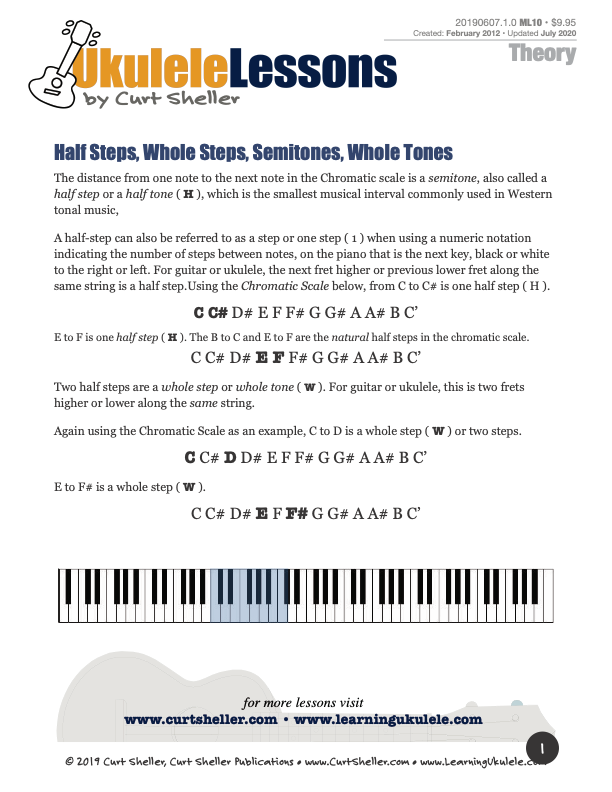
The distance from one note to the next note in the Chromatic scale is a semitone, also called a half step or a half tone ( H ), is the smallest musical interval commonly used in Western tonal music, A half-step can also be referred to as a step or one step ( 1 ) when using a numeric notation indicating the number of steps between notes. On piano that is the next key, black or white to the right or left. The next key or note to the right is a 1/2 step higher. The next key or note to the left is a 1/2 step lower. For an instrument like guitar or ukulele the next fret higher or lower is a 1/2 step.
Using the Chromatic Scale , all twelve notes in one octave starting from C. The notes C to C# is one half step ( H or 1 ).
C C# D D# E F F# G G# A A# B C’
E to F is one half step ( H ).
C C# D D# E F F# G G# A A# B C’
Two half steps are a whole step or whole tone ( W or 2 ). This can also be referred to as two steps ( 2 ). For guitar or ukulele this is two frets higher or lower along the same string.
C C# D D# E F F# G G# A A# B C’
Scales are made up of a series whole steps and half steps forming a step pattern.
The Major Scale step pattern is:
- W W H W W W H or
- 2 2 1 2 2 2 1
And, on to the Six Essential Scales .


End of Lesson - Thanks, Hope You Enjoyed It!
Related Lessons, Videos, Lesson Series, Songs, Books & Reference Charts, Resources & Assets, Workshops are below.