Published:
2007-03-15
Updated:
2018-11-26
Learning Ukulele with Curt
Chord Spelling - An Alternate Approach
An alternate approach to determining the chord tones of any chord. Bottom-line is, it's the notes that make the chord, not the shape. A C chord is C, E, G - NOT this or that shape.
Author(s): Curt Sheller Publisher: Curt Sheller Publications Code: ML02
Main Category: Chords Main Instrument: Any
Categories: Chords

2026-08-23
RelatedLessonAssets
Show Series Lessons
Series Home
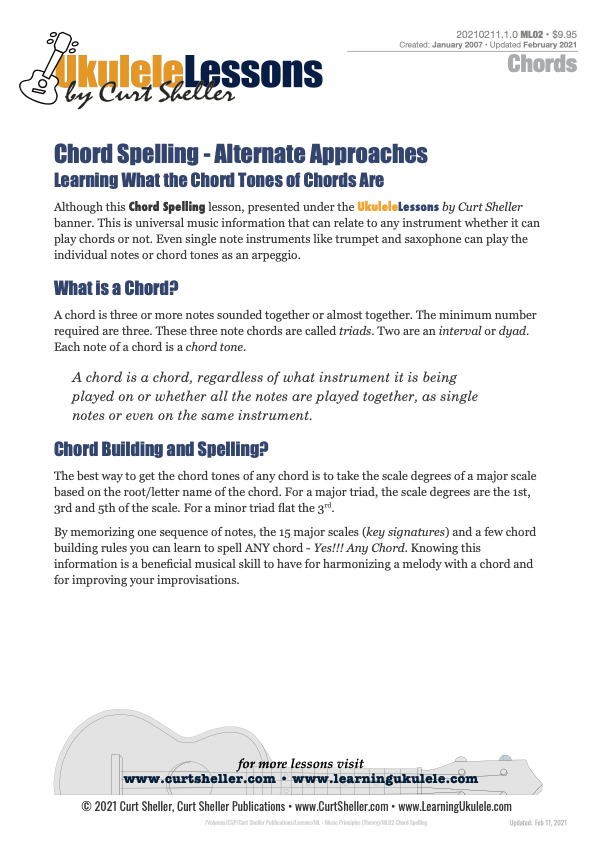
Number of Pages: 8
If you're a registered site member and have the correct permissions you can view ALL the pages of this PDF at a larger size using the LearningUkulele.com Online PDF Viewer (button below).
Download PDFThis Download is NOT part of your LearningUkulele.com & Learning Ukulele with Curt membership level.
Sign-up for Premium Site Access or Upgrade Your Plan to download this PDF or your can purchase a copy for download
Sign In for Access…Contact Us if there are any issues.
The quickest and most directly way to determine the chord tones of any chord are to use the scale degrees of its corresponding major scale.
For a major triad, the chord tones are the 1st, 3rd and 5th scale degrees of a major scale starting on the root of the chord you're using to determine the chord tones. For a minor triad, you simply flat the 3rd.
A C or C major chord the 1st, 3rd, and 5th of the C major scale (C D E F G A B C) are the C, E, and G. For C minor (Cm) it's C, Eb, and G.
By memorizing one sequence of notes, your major scales and a few chord building rules we can learn the notes, to spell ANY chord.
Traditional Chord Spelling/Building Approach
The traditional approach , which is the way to go, is to learn the notes of individual chords based from the major scale of the root of the chord. For Cm11 the root is C, so the major scale is C major . For Bb7 the root is Bb and the major scale is Bb major .
By memorizing one sequence of notes, the major scales, i.e., key signatures) and a few chord building rules you can learn to spell ANY chord. The directions are actually built into the chord's name. This is a beneficial skill to have for harmonizing a melody with a chord and for improving your improvisations.
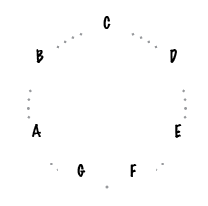
More Chord Spelling - An Alternate Approach
content below, continue exploring...
More Chord Spelling - An Alternate Approach
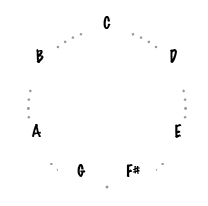
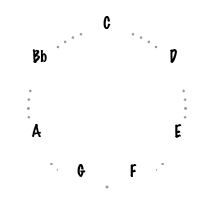
FACE and Every Good Boy Does Fine
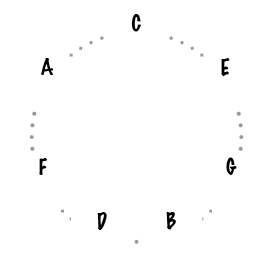
You finally get to put your elementary school music class to practical use.
If you remember the names of the lines and spaces of the music staff you can spell any chord with a few of the tools in this lesson.


End of Lesson - Thanks, Hope You Enjoyed It!
Related Lessons, Videos, Lesson Series, Songs, Books & Reference Charts, Resources & Assets, Workshops are below.