
Published:
2011-01-06
Updated:
2023-05-11
Learning Ukulele with Curt
Practice Cycles and Sequences
Sequences and cycles for practicing scales, intervals, melodic sequences and arpeggios.
Author(s): Curt Sheller Publisher: Curt Sheller Publications Code: UL31seq
Main Category: Practice Main Instrument: Any
Categories: Chords, Practice, Technique, Melody

2026-08-23
Show Series Lessons
Series Home
Number of Pages: 6
If you're a registered site member and have the correct permissions you can view ALL the pages of this PDF at a larger size using the LearningUkulele.com Online PDF Viewer (button below).
Download PDFThis Download IS part of your Gold Site Access and a FREE download. Thanks for supporting the site. — Curt
Each PDF file is a professionally prepared, formatted, high resolution file that prints out great. You'll need a PDF Reader or application capable of viewing PDF files to view the PDF.
NOTE: Download the current PDF file for the latest, complete, and most up-to-date version. As well as additional information not presented on-line.
Sequences and cycles for practicing scales, intervals, melodic sequences and arpeggios.
These sequences also help in learning where any interval is of a given note, the chord tones of chords and aides in memorizing scales.
These cycles are based on intervals. An interval is a distance between two notes. You get this distance by counting the lines and spaces between the two notes, including both notes. The interval between C and E is a third.
An interval can be expressed generically. Such as, E is the third of C and specifically by including the interval type, E is the major third of…
Cycle of Thirds
With Thirds being the overwhelming interval used to create chords, we can use the Cycle of Thirds for quick access when learning the spell chords.
Looking at the cycle of thirds all chords built in thirds are going to be Some Sort of…
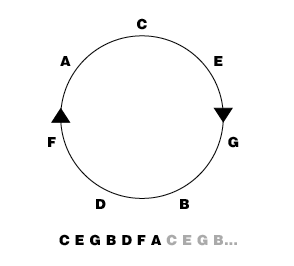
Example of ANY C major, minor, diminished or augmented triad.
- C: C E G
- Cm: C E♭ G
- Cdim: C E♭ G♭
- Caug: C E G♯
- C♭: C♭ E♭ G♭
- C♭m: C♭ E♭ G
- C♭dim: C♭ E♭♭ G♭♭
- C♭aug: C♭ E♭ G
- C: C♯ E♯ G♯
- Cm: C♯ E G♯
- Cdim: C♯ E G
- Caug: C♯ E♯ Gx (double sharp)
NOTE: — All some sort of the letters, C E G. Generically speaking, the First, Third, and Fifth of their corresponding major scale, based on the root of the chord. Hence, the need for double flats and double sharps — the letter MUST remain some sort of: C E G.


End of Lesson - Thanks, Hope You Enjoyed It!
Related Lessons, Videos, Lesson Series, Songs, Books & Reference Charts, Resources & Assets, Workshops are below.