
Published:
2005-01-02
Updated:
2026-03-18
Learning Ukulele with Curt
The Trouble with TAB
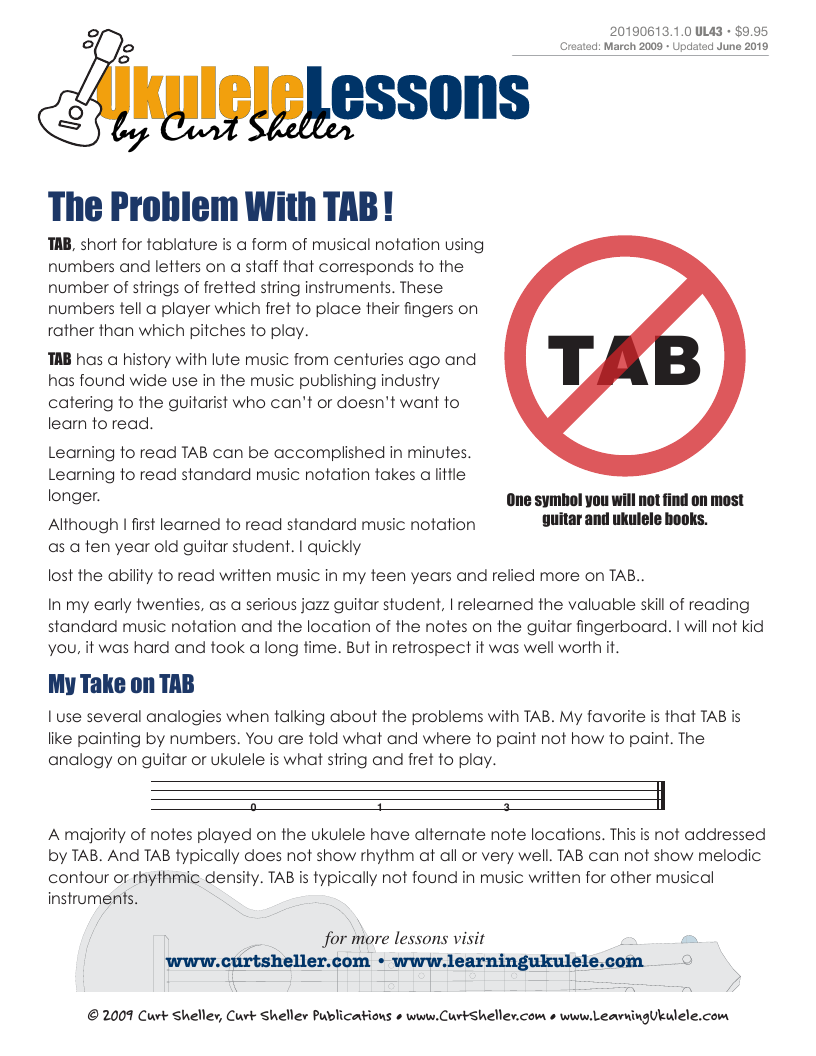
TAB, short for tablature is a form of musical notation using numbers and letters on a staff that corresponds to the number of strings of a fretted string instrument. These numbers tell a player which fret to place their fingers on the fingerboard. TAB has a history with lute music from centuries ago and has found wide use in the music publishing industry, catering to the guitarist who can't or doesn't want to learn to read.
Author(s): Curt Sheller Publisher: Curt Sheller Publications Code: UL43
Main Category: Reading Main Instrument: Ukulele
Categories: Chords
2026-08-23
Number of Pages: 6
If you're a registered site member and have the correct permissions you can view ALL the pages of this PDF at a larger size using the LearningUkulele.com Online PDF Viewer (button below).
Download PDFThis Download IS part of your Gold Site Access and a FREE download. Thanks for supporting the site. — Curt
Each PDF file is a professionally prepared, formatted, high resolution file that prints out great. You'll need a PDF Reader or application capable of viewing PDF files to view the PDF.
NOTE: Download the current PDF file for the latest, complete, and most up-to-date version. As well as additional information not presented on-line.
TAB, short for tablature is a form of musical notation using numbers and letters on a staff that corresponds to the number of strings of a fretted string instrument. These numbers tell a player which fret to place their fingers on rather than which pitches to play.
TAB has a history with lute music from centuries ago and has found wide use in the music publishing industry catering to the guitarist who can't or don't want to learn to read. TAB doesn't exist in mainstream music, primarily by some music magazines and on the Internet.
Learning to read TAB can be accomplished in minutes. Learning to read standard music notation takes a lot of dedicated work and is well worth the effort.
Today's TAB was initially adapted in the guitar world as way to give wider access to people that where not traditionally trained musicians that could read music. Think Rock'n'roll, the FOlk Boom, and British Invasion of the early 50s and 60s and the guitar
. A way of playing an instrument without the actually knowing the names of the notes that your where playing or have to read tradition music notation. Played single notes using TAB and chord using chord grids. You did the where
and didn't care the what
or musical why
. You didn't need to know the meaning — didn't actually care.
Initially, TAB did not incorporate any rhythmic notation. You had to know the song to even have a chance of playing it. So there goes one of the biggest reasons for using TAB. Not wanting to read standard music notation.
One of the biggest drawbacks for TAB is it has to show only one of a note's possible note locations on the guitar or ukulele. For six-string guitar in standard tuning, all but the lowest five notes on string six, the lowest-pitched string (the open string and frets 1, 2, 3, and 4), have at least one, if not multiple, note locations. If it is a TAB of a particular artist's recording, they tend to show where that actual artist played it.
A second drawback for TAB is you are locked out of a wide, wide selection of published music written in standard music notation. You are stuck in the guitar or ukulele world and have no access to this wide selection of music.
A third drawback is your communication is limited to a small circle of musicians
if you can't communicate with fellow musicians in musical
terms.
I think anything that separates guitar players (ed. ukulele players also) from the rest of the music world is bad. Tablature is a certain secret code only for a guitar player. So you have guitar players who can read tablature and not music.
— Peter Bernstein
More The Trouble with TAB
content below, continue exploring...
More The Trouble with TAB
A good analogy to learning music is learning language, as music is a language. If you are a tourist and are only visiting a different country that does not speak your native language. You might just learn a tiny bit of the language just to get by or really hope that they know a tiny bit of your language. However, if you are going to stay for an extended time or actually leave there for a while, you might want to learn their language to have a chance of enjoying anything beyond the tourist
areas — this IS music and musicians.
Contrary to popular believe and the Internet. TAB is not lyrics with chords. Just the name TAB, short for tablature (countable). (late 16th cent.: from French, probably from Italian tavolatura, from tavolare ‘set to music’.
). It was strictly for telly you where to place you finger(s) using numbers.
Links & Resources
You only need a few links to drive home the point that learning to read standard music notation is a good idea.
These should be MUST viewing. Adam Neely , is one the most articulate musicians that can explain what is going on with music.
- Why You Shouldn't Use Tab (and it's not why you might think!) by Adam Neely
- Should You Learn to Read Sheet Music? by Adam Neely
TAB, does have its place and is just one tool that can be used to help with learning music. It is not a replacement for learning to read standard music notation. TAB is great for beginners and a way to indicate exactly what strings and fret to play a given note. A good way to get beginners interested early.
End of Lesson - Thanks, Hope You Enjoyed It!
Related Lessons, Videos, Lesson Series, Songs, Books & Reference Charts, Resources & Assets, Workshops are below.