
Published:
2013-07-16
Updated:
2023-07-10
Learning Ukulele with Curt
A Practical Approach to Exploring Scales
On ukulele there aren't many positions where you can play a one octave scale from the root to octave. An instrument like the guitar with the additional lower strings five and six allows one to play a one octave scale in multiple positions in the basic 4-fret, 4-finger position. On ukulele there might be one or two depending on the scale and the key - and whether your using a low string four tuning. This lesson offers a practical approach to practicing your scales on ukulele.
Author(s): Curt Sheller Publisher: Curt Sheller Publications Code: UL04p
Main Category: Scales Main Instrument: Any
Categories: Chords, Scales, Theory, Guitar, Tuning

2026-08-23
On ukulele there aren't many positions where you can play a one octave scale from the root to octave.
Playing a one octave scale from the root to the octave on the ukulele is limited in terms of available positions. Unlike the guitar, which has additional lower strings (five and six), allowing for multiple positions to play a one octave scale within the basic 4-fret, 4-finger position. On the ukulele, depending on the scale, key, and tuning (whether you're using a low string four tuning), there might be only one or two positions available.
To improve your proficiency in single note playing, here are a few practice techniques to consider when playing scales. Ideally, you should strive to play any phrase, lick, riff, or melody, starting from any finger, within any octave, and on any string. Acquiring this level of versatility demands dedicated effort, but it's a worthwhile long-term objective.
- Ascending lowest note to the highest note of the scale position. This is where knowing the notes of the fingerboard really is beneficial.
- Descend from the highest note to the lowest note within the scale position.
- Vary the rhythm by using both long and short notes.
- Explore in ALL 15 keys. There are no common keys for scales, scales can start on any root — any key.
- Explore the most common intervals of 2nds, 3rds, and 6ths. And, ultimately, all intervals.
Every Finger, Every String
Getting your fingers to listen and obey your inner ear and thoughts is akin to wrangling a group of unruly cats. They simply refuse to cooperate and follow instructions as desired. It demands an abundance of patience and unwavering determination.
Back in the early stages of learning and practicing, many players, myself included, often neglected the exploration of playing melodies, scales, licks, or riffs starting from any finger on any string. It's not that we were oblivious to the benefits; it simply appeared to be an overwhelming task, particularly on a guitar boasting six strings. Nevertheless, I managed to surmount these obstacles and achieve substantial progress with my studies with Chuck Anderson. On the ukulele, which offers a mere three or four strings, the effort required is noticeably reduced. I encourage you to at least try this approach with melodies, as there is great value in doing so. It helps strengthen the connection between your inner ear and your hands.
Frank Vignola says: Learn 200 songs — the melodies, and you'll have no problem learning to improvise.
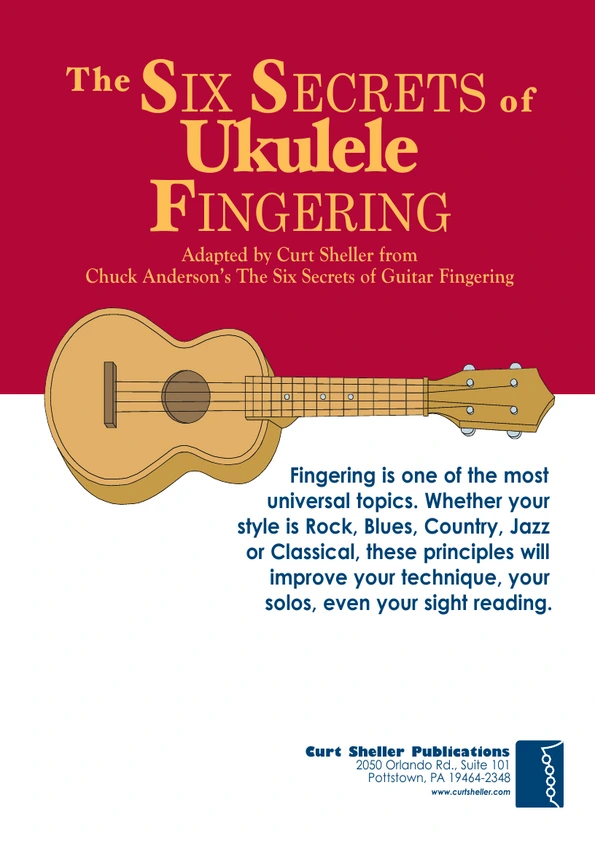
Finally, you need to be able to play starting on any note, on any string and starting on any finger. This is where my book The Six Secrets of Ukulele Fingering comes into play. It's more of an exploration and discover, and NOT the memorizing of any additional new patterns. It's navigating the various possible pathways available on the fingerboard that really open up the fingerboard.
Think of fingering as a series of pathways. When you learn to connect these pathways, there are benefits not only to technique, but also to creativity. All fingering on the ukulele can be reduced to 6 principles of motion. Each principle has physical and musical characteristics that you can use to improve your playing.


End of Lesson - Thanks, Hope You Enjoyed It!
Related Lessons, Videos, Lesson Series, Songs, Books & Reference Charts, Resources & Assets, Workshops are below.