
Published:
2013-07-08
Updated:
2022-12-09
Learning Ukulele with Curt
Improvising Using Major Triads Plus One Note
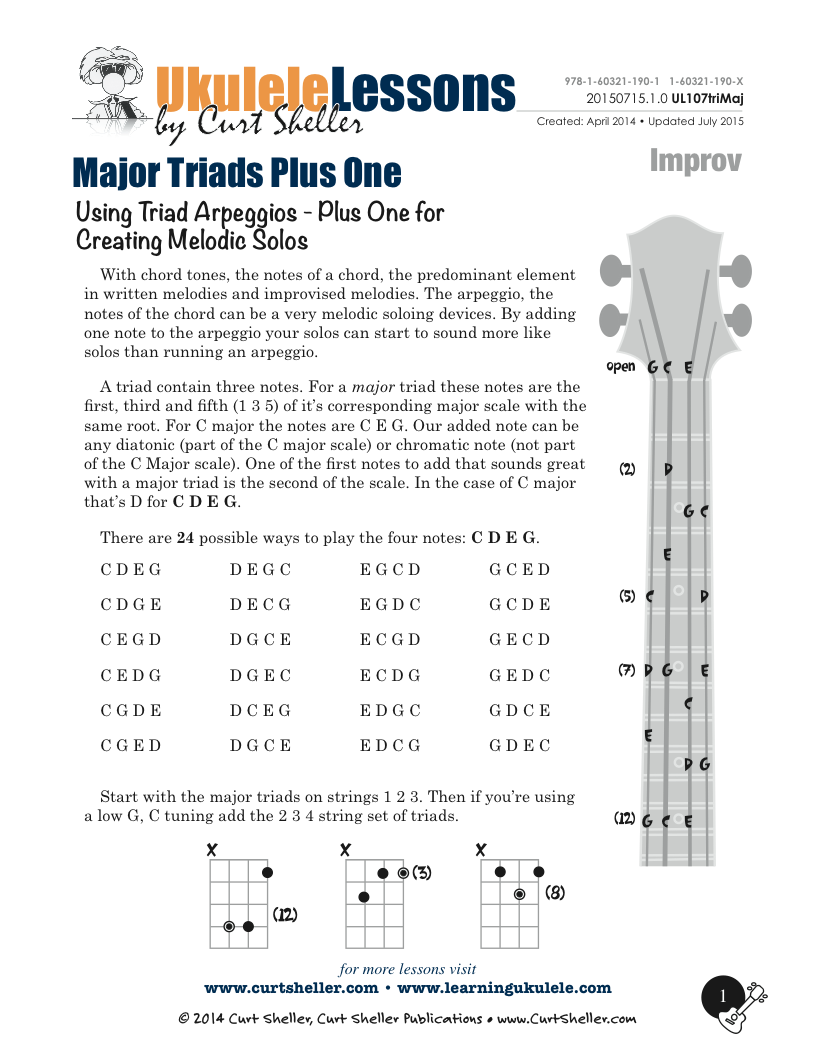
Using Major Triad Arpeggios - Plus One for Creating Melodic Solos. With chord tones, the notes of a chord playing a predominant role in writing melodies and in improvised melodies. The triad plus one additional note is a great melodic device for creating melodies - either written or improvised.
Author(s): Curt Sheller Publisher: Curt Sheller Publications Code: UL107triMaj
Main Category: Improvisation Main Instrument: Ukulele
Categories: Chords, Improvisation, Melody, Triads, Major

2026-08-23
Number of Pages: 10
If you're a registered site member and have the correct permissions you can view ALL the pages of this PDF at a larger size using the LearningUkulele.com Online PDF Viewer (button below).
Download PDFThis Download is NOT part of your LearningUkulele.com & Learning Ukulele with Curt membership level.
Sign-up for Premium Site Access or Upgrade Your Plan to download this PDF or your can purchase a copy for download
Sign In for Access…Contact Us if there are any issues.
With chord tones, the notes of a chord playing a predominant role in writing melodies and in improvised melodies. The triad plus one additional note is a great melodic device for creating melodies - either written or improvised.
A triad contains three notes. A triad is the foundation of our western harmony, the chords, and chord progressions. A triad is at the heart of our more contemporary 4-part, 5-part, and beyond chords. A triad IS the chord tones / arpeggio of a chord and main component of improvisation – outlining a chord.
For a Major triad, these notes are the first, third, and fifth (1 3 5) of it's corresponding major scale with the same root.
Major Triad
For C major triad/chord, the notes are C E G. Our added note can be any diatonic note( part of the C major scale ) or chromatic note ( not part of the C Major scale ).
One of the first notes to add that sounds great with a major triad is the second of the scale. In the case of C major, that's D for C D E G. This gives us the 1 2 3 5 of a major scale and will works over major, maj7, 6 and 7 chords.
NOTE: This Major Triad, Plus One, is the same first four notes of the Major Pentatonic scale based on the chord's root.
More Improvising Using Major Triads Plus One Note
content below, continue exploring...
More Improvising Using Major Triads Plus One Note
C Major Plus One
There are 24 possible ways to play the four notes: C D E G.
C D E G   D E G C   E G C D   G C E D
C D G E   D E C G   E G D C   G C D E
C E G D   D G C E   E C G D   G E C D
C E D G   D G E C   E C D G   G E D C
C G D E   D C E G   E D G C   G D C E
C G E D   D G C E   E D C G   G D E C
1 2 3 5
1 2 3 5   2 3 5 1   3 5 1 2   5 1 3 2
1 2 5 3   2 3 1 5   3 5 2 1   5 1 2 3
1 3 5 2   2 5 1 3   3 1 5 2   5 3 1 2
1 3 2 5   2 5 3 1   3 1 2 5   5 3 2 1
1 5 2 3   2 1 3 5   3 2 5 1   5 2 1 3
1 5 3 2   2 5 1 3   3 2 1 5   5 2 3 1

Every Finger, Every String — Explore these starting on any finger any string.
Using the fingering principles from my book The Six Secrets of Ukulele Fingering allows you to explore scales, arpeggios, intervals and sequences starting on every finger-every string, creating multiple pathways through any single note passage.
Lessons
- Every Finger, Every String | The benefits of being able to play melodies, lick, riffs starting on any finger on any string.


End of Lesson - Thanks, Hope You Enjoyed It!
Related Lessons, Videos, Lesson Series, Songs, Books & Reference Charts, Resources & Assets, Workshops are below.