
Published:
2013-04-07
Updated:
2020-02-13
Learning Ukulele with Curt
Major & Relative Minor Key Signatures
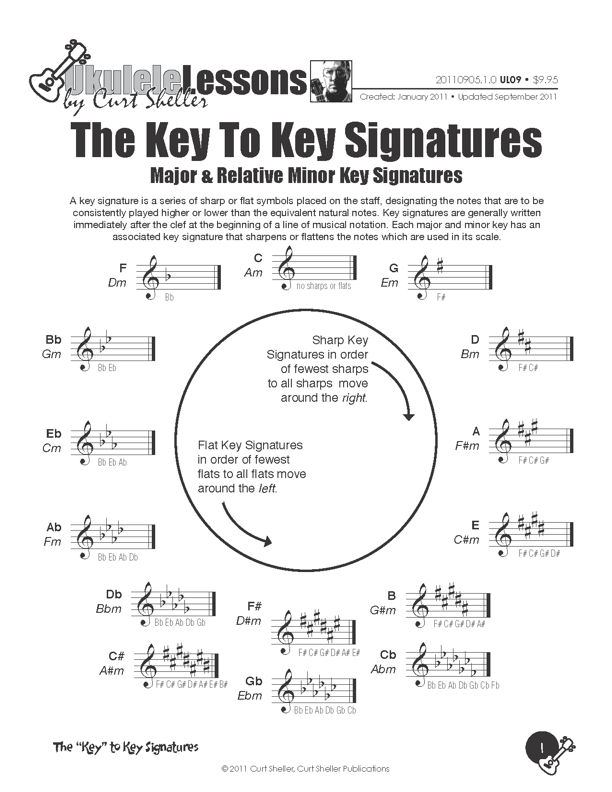
A "Key Signature" is a series of sharp or flat symbols placed on the staff, designating the notes that are to be consistently played higher or lower than the equivalent natural notes. Key signatures are generally written immediately after the clef at the beginning of a line of musical notation. Each major and minor key has an associated key signature that sharpens or flattens the notes which are used in its scale.
Author(s): Curt Sheller Publisher: Curt Sheller Publications Code: UL09
Main Category: Theory Main Instrument: Any
Categories: Chords, Scales, Theory, Major, Minor, Harmony, Beginner, Notation

2026-08-23
Number of Pages: 2
If you're a registered site member and have the correct permissions you can view ALL the pages of this PDF at a larger size using the LearningUkulele.com Online PDF Viewer (button below).
Download PDFThis Download is NOT part of your LearningUkulele.com & Learning Ukulele with Curt membership level.
Sign-up for Premium Site Access or Upgrade Your Plan to download this PDF or your can purchase a copy for download
Sign In for Access…Contact Us if there are any issues.
A "Key Signature" is a series of sharp or flat symbols placed on the staff, designating the notes that are to be consistently played higher or lower than the equivalent natural notes. Key signatures are generally written immediately after the clef at the beginning of a line of musical notation. Each major and minor key has an associated key signature that sharpens or flattens the notes which are used in its scale.
In principle, any piece can be written with any key signature, using accidentals to correct any notes where it shouldn't apply. The purpose of the key signature is to minimize the number of such accidentals required to notate the music. The sequence of sharps or flats in key signatures is generally rigid in modern music notation. For example, if a key signature has only one sharp, it must be an F sharp.
The effect of a key signature continues throughout a piece or movement, unless explicitly canceled by another key signature. For example, if a five-sharp key signature is placed at the beginning of a piece, every A in the piece in any octave will be played as A sharp, unless preceded by an accidental.
- This Key Signature circle is sometimes called the circle or cycle of fifths or fourths.
- A sharp (♯) or flat is called an accidental.
- Accidentals are not mixed in the major or minor key signatures.
- Each successive key signature around the circle includes the previous key signature's accidentals.
- The last sharp (♯) in a key signature is the letter right before the name of the major key. Example: The last sharp (♯) in G major key signature is F. (A B C D E F G A). The last sharp in E major key signature is D. (A B C D E F G A B)
- The second to last flat (♭) for all flat keys except F is the key.
- The order of sharps (♯) move in Perfect Fifths . The order of flats (♭) in move in Perfect Fourths .
- The primary chords, the I , IV , and V chords of major keys are the chords to the left and right of the key signature. The IV chord is to the left along the circle and the chord is to the right along the circle.


End of Lesson - Thanks, Hope You Enjoyed It!
Related Lessons, Videos, Lesson Series, Songs, Books & Reference Charts, Resources & Assets, Workshops are below.