
Published:
2008-01-02
Updated:
2015-04-23
Learning Ukulele with Curt
Using Triads on `Ukulele
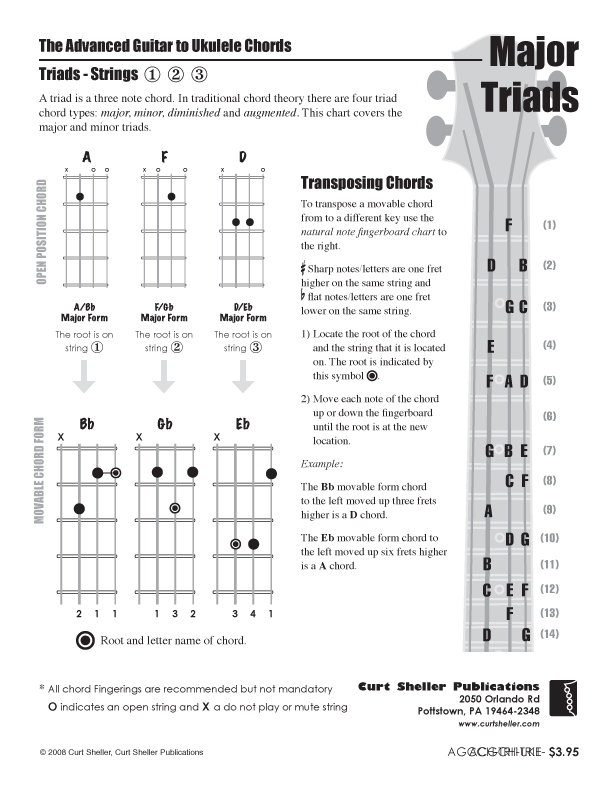
In music or music theory, a triad is a three-note chord (or, more generally, any set of three notes, pitches, or tones). Triads can be used harmonically, as chords and melodically, as single notes. These lessons explore both. Using triads as chords like any other chord and using triads as a basis for creating melodies and improvising.
Author(s): Curt Sheller Publisher: Curt Sheller Publications Code: UL120
Main Category: Triads Main Instrument: Ukulele
Categories: Chords, Theory, Intervals, Melody, Triads, Major, Minor, Diminished, Augmented

2026-08-23
Number of Pages: 2
If you're a registered site member and have the correct permissions you can view ALL the pages of this PDF at a larger size using the LearningUkulele.com Online PDF Viewer (button below).
Download PDFThis Download IS part of your Gold Site Access and a FREE download. Thanks for supporting the site. — Curt
Each PDF file is a professionally prepared, formatted, high resolution file that prints out great. You'll need a PDF Reader or application capable of viewing PDF files to view the PDF.
NOTE: Download the current PDF file for the latest, complete, and most up-to-date version. As well as additional information not presented on-line.
Triads can be used harmonically, as chords and melodically, as single notes.
Triads are a great way to get started with creating solos and improvising.
Triad - In music or music theory, a triad is a three-note chord (or, more generally, any set of three notes, pitches, or tones). Because the term originated during the "common practice" period in Western European art music (approximately from 1600 to 1900), it is most commonly associated with tertian diatonic chords having a tonal function. When such a chord is voiced in thirds, its members, ascending from lowest pitched tone to highest, are called: the Root, the Third (whose interval is a major third or minor third above the root) and the Fifth (whose interval is a major or minor third above the third, and a diminished, perfect, or augmented fifth above the root).
These lessons explore both. Using triads as chords like any other chord and using triads as a basis for creating melodies and improvising.
Other Triads
From the Major and Minor triads you can derive the Diminished, Augmented, add and sus triads.
For Diminished triads you lower the fifth of a minor triad one half step or one fret.
For Augmented triads you raise the fifth of a major triad one half step or one fret.
For add triads, as the name implies, you need to add a note. Any note can be added but the most typical is an add 2 or add 9. For an add2 triad you raise the root of a major or minor triad a whole step or two frets. Or, optionally lower the third of a major triad two frets or the thrid of a minor triad one fret.
For sus triads, the sus means suspension. Traditionally the sus referred to suspending the third of a chord by raising the third of a major chord two frets sor the third of a minor chord one fret.
For a sus 2 chord, a more contemporary chord you raise the root of a major or minor triad two frets. Optionally you can lower the third of a major triad two frets or the third of a minor chord three frets.
This is a lot to remember for the add and sus chords. So with getting to the actually notes or spelling of chords and really knowing the notes of the fingerboard. You are closer to getting a handle on these more contemporary chords.
More Using Triads on `Ukulele
content below, continue exploring...
More Using Triads on `Ukulele
WIP
A Work In Progress
👷 🚧 🏗️
End of Lesson - Thanks, Hope You Enjoyed It!
Related Lessons, Videos, Lesson Series, Songs, Books & Reference Charts, Resources & Assets, Workshops are below.