Published:
2003-01-01
Updated:
2023-06-09
Learning Ukulele with Curt
Key Signatures - Gb Major
In this lesson series, we explore the key of Gb Major and its relative minor key, Ebm, including their primary and secondary chords, as well as a selection of common chord progressions.
Main Category: Theory Main Instrument: Any

6 August 2026
RelatedSeriesAssets
In this lesson series, we explore the key of Gb Major and its relative minor key, Ebm, including their primary and secondary chords, as well as a selection of common chord progressions.
This LessonSERIES cover the Key of G♭ Major and it's Relative Minor Key, E♭m.
Key Signatures
In the context of musical notation, a key signature is a representation of the sharps or flats that are present in a major or its corresponding natural minor scale. Key signatures can occur at other points in a score, especially after a double barline, but they are usually found right after the clef at the start of a musical staff.
While it is possible to construct key signatures using various combinations of sharp (♯) and flat (♭) symbols, the most commonly encountered ones consist of approximately a dozen diatonic major key signatures. These widely used key signatures are assumed in much of the musical repertoire. When a piece is scored using a single diatonic key signature without any accidentals, it encompasses notes from a maximum of seven of the twelve pitch classes. The particular seven pitch classes employed are determined by the specific key signature in use.
In this LessonSERIES , we delve into the intricacies of each major and relative minor key, exploring their primary and secondary chords, as well as providing examples of common chord progressions associated with each key. By mastering these concepts, you will gain a comprehensive understanding of key signatures and their role in music theory and composition.
4 lessons in the Key Signatures - Gb Major LessonSERIES :
Key Signatures - G Flat Major and E Flat Minor
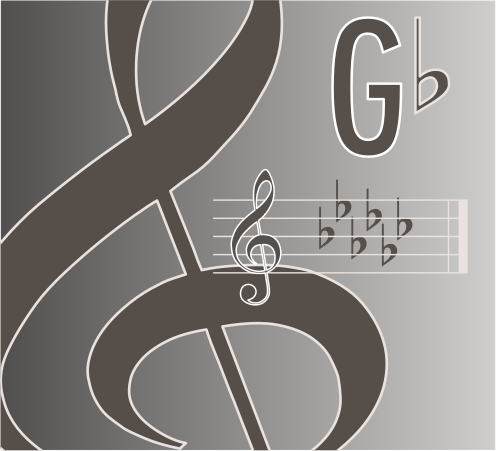
Gb major is a major scale based on G flat, consisting of the pitches Gb, Ab, Bb, Cb, Db, Eb, and F. Its key signature has six flats: Bb, Eb, Ab, Db, Gb and Cb.
Its relative minor is E flat minor, and its parallel minor is G flat minor, usually replaced by F-sharp minor, since G flat minor, which would have nine flats, is not normally used.
The enharmonic equivalent key to Gb is F#, containing the same pitches but different names.
Series Info
Theory
Any
296 visits