
Published:
2011-10-01
Updated:
2025-04-19
Learning Ukulele with Curt
Giant Steps
Giant Steps is a jazz composition by John Coltrane, first appearing as the first track on the album of the same name (1960). The composition is a milestone in jazz, given the difficulty of improvising its rapid progression of chord changes that progress through three keys, shifted by major thirds, creating an augmented triad. The song title comes from the relatively giant leaps between the roots of consecutive chords.
Author(s): Publisher: Code: UL408
Main Category: Arpeggios Main Instrument: Any

2026-08-19
If you're a registered site member and have the correct permissions you can view ALL the pages of this PDF or Samples pages at a larger size using the LearningUkulele.com Online PDF Viewer.
This Download is NOT part of your LearningUkulele.com & Learning Ukulele with Curt membership level.
Sign-up for Premium Site Access or Upgrade Your Plan to download this PDF or your can purchase a copy for download
Sign In for Access…Contact Us if there are any issues.
Giant Steps is a jazz composition by John Coltrane, first appearing as the first track on the album of the same name (1960). The composition is a milestone in jazz, given the difficulty of improvising its rapid progression of chord changes that progress through three keys, shifted by major thirds, creating an augmented triad. The song title comes from the relatively giant leaps between the roots of consecutive chords.
Giant Steps celebrated its 60th anniversary in 2020.
Solo Melody & Chord Performance by Curt Sheller – Your LearningUkulele.com Kumu
In jazz harmony, the Coltrane changes (Coltrane Matrix or cycle, also known as chromatic third relations and multi-tonic changes) are a harmonic progression variation using substitute chords over common jazz chord progressions.
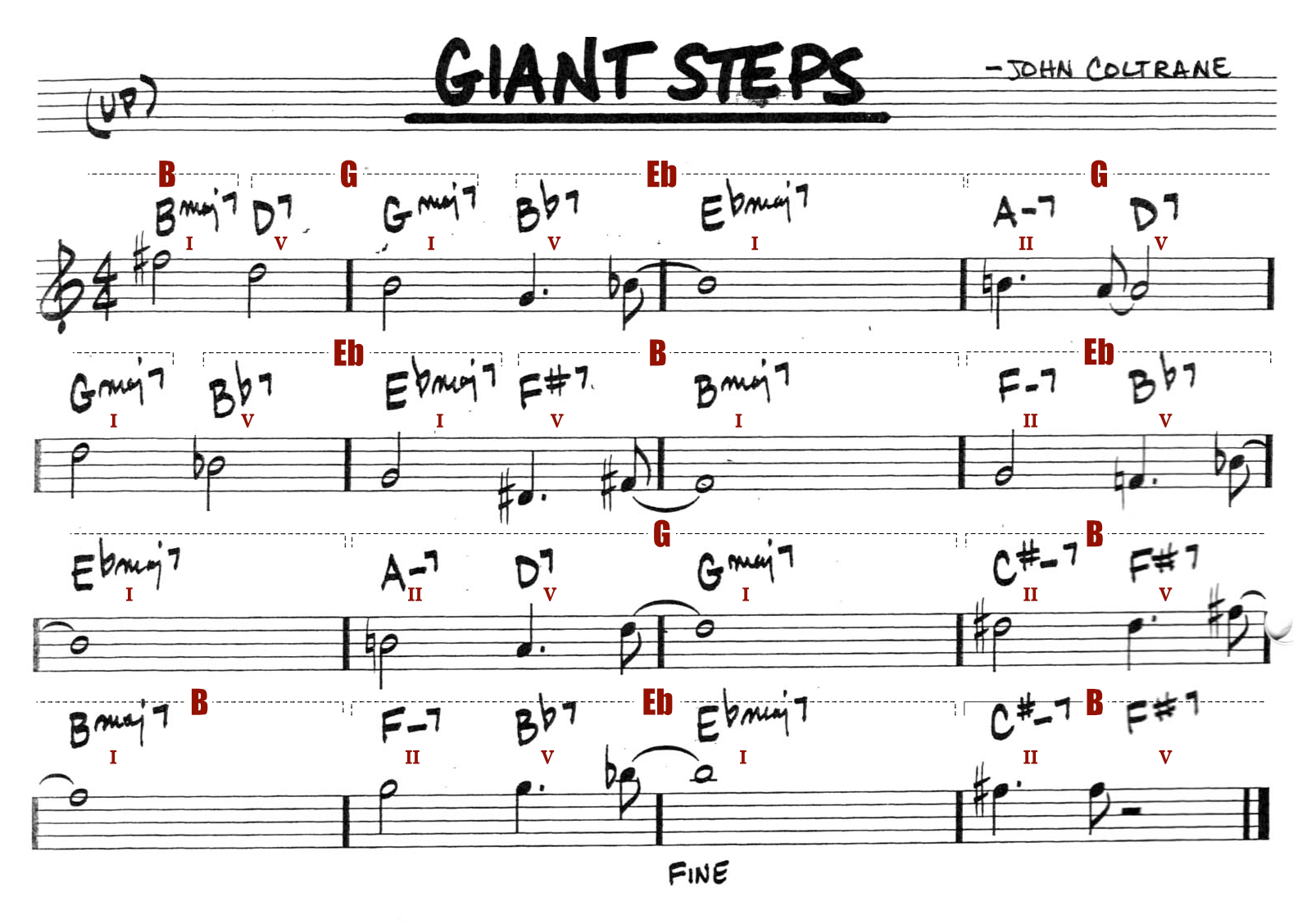
B D7 G Bb7 Eb Am D7 G Bb7 Eb F#7 B . . .
Giant Steps is in the
Real Book - Volume 1
— Sixth Edition book.
More Giant Steps
content below, continue exploring...
More Giant Steps
The Philadelphia Jazz guitar great Jimmy Bruno
said (paraphrasing) Giant Steps is a song, like a test you know you should have studied for.
Melody
The song title comes from the relatively giant leaps between the roots of consecutive chords. From a transcription, one can easily infer that many of these are upward leaps of minor thirds, but they can just as easily be inverted as descending major sixths, the latter approach best accentuating the disconcerting nature of the progression.
John Coltrane was a big fan of the ukulele and wrote this song on the ukulele. A great song to play on the `uke. OK - maybe he wasn't a fan and/or wrote it on `uke, but this is a cool song to attempt on the ukulele.
This is not a song typically associated with the ukulele. And, all the reason to play it. It definitely gets a reaction from fellow musicians familiar with the song. Chord-wise it is really not that hard to play. Tempo wise it's a bear to solo over — and I'm still working on that one.
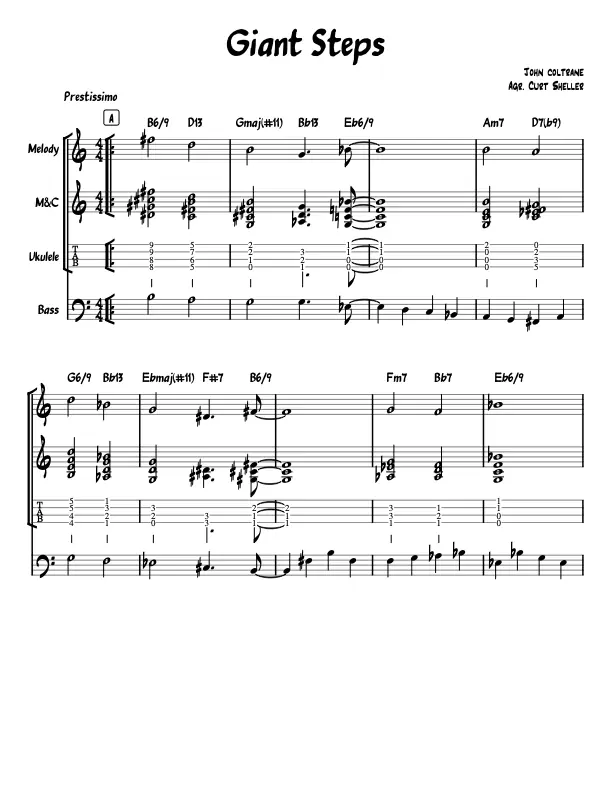
Here is my take arranged for low "G" C tuning.
If you run out of frets on a smaller size ukulele for the Eb6/9 in measure 15 then lower it one octave to 0 0 1 1. Even measures 14 and 15 can be played one octave lower and still sound fine.
Video Links
- John Coltrane
- Piano class: Giant Steps with Barry Harris
- The Most Feared Song In Jazz, Explained
- Soloing On Giant Steps Made Easy! Coltrane Changes Demystified - Rick Beato
- WidipediA: Coltrane Changes
Solo Tips
Take it SLOW!!!—really, only practice improvising over the changes at a comfortable tempo. And, really know the changes – the Chords ( see the Roadmap below ) ). The tricking sections are the Major Thirds, V I modulations. The first is B G Eb , an Augmented triad with each tonic chord approached with it's V, the dominant chord. The next Major Thirds, V I modulation is connected with it's II V for G Eb B . Then it's a bunch of II V I common progressions modulation back to the key sof the songs: B Major. All the chords are all 4-part chords. I only show the basic harmony, the triads and 7th chords.
B D7 G Bb7 Eb Am D7 G Bb7 Eb F#7 B
The II V I cells after the first eight bars are also keys centers separated by major thirds, an augmented triad for: Eb G B. Then a turn-back to the top.
The Harmonic Rhythm
This the frequency of the chord changes.
| 2 2 | 2 2 | 4 | 2 2 | 2 2 | 2 2 | 4 | 2 2 | 4 | 2 2 | 4 | 2 2 | 4 | 2 2 | 4 | 2 2 |