Published:
2008-09-23
Updated:
2021-12-08

Learning Ukulele with Curt

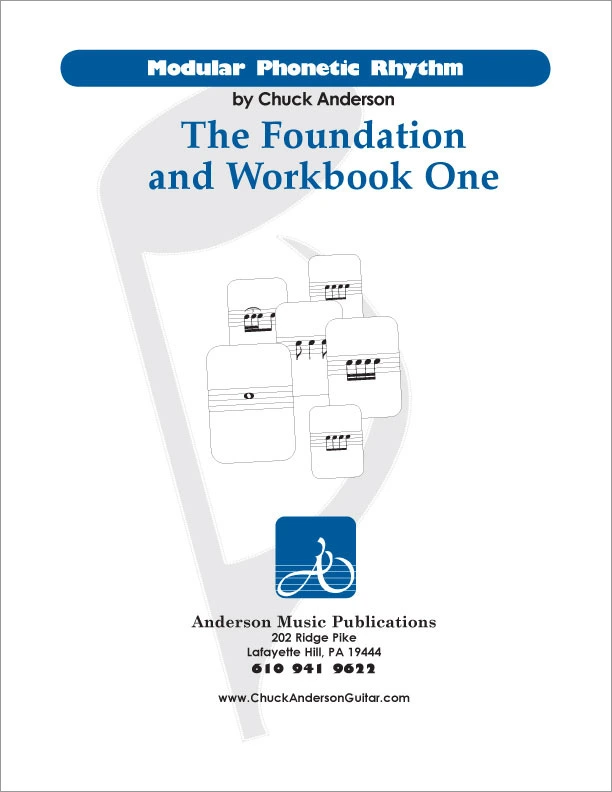
Modular Phonetic Rhythm, The Foundation and Workbook 1

Modular Phonetic Rhythm represents a significant advance in the teaching and application of rhythm. Eliminating many inefficient aspects of rhythm education, Modular Phonetic Rhythm streamlines the traditional educational approach, resulting in a reflexive reaction to rhythm.

Author(s): Chuck Anderson Publisher: Code: MPRS-FW1

Main Category: Rhythm Main Instrument: Music

Categories: Rhythm

Louis-Martin/Curt-2020-FFUF

24 June 2026

RelatedBookAssets

However, if you'd like to support the site even more ❤️ you can buy the PDF.

After purchasing a PDF a download link or PDF link will be sent to you.

Modular Phonetic Rhythm, The Foundation and Workbook 1

Product Info

  • Product Code: MPRS-FW1
  • Author(s): Chuck Anderson
  • Publisher(s):
  • Published: 23 September 2008
  • Updated: 8 December 2021
  • ISBN-13: NA
  • Size*: ANSI A
  • Pages: 74
  • Hard Copy Price: $29.00
  • PDF Price: $15.00

Regarding Book, Lesson and Charts Paper Sizes
• click to Hide more info • click to Show more info

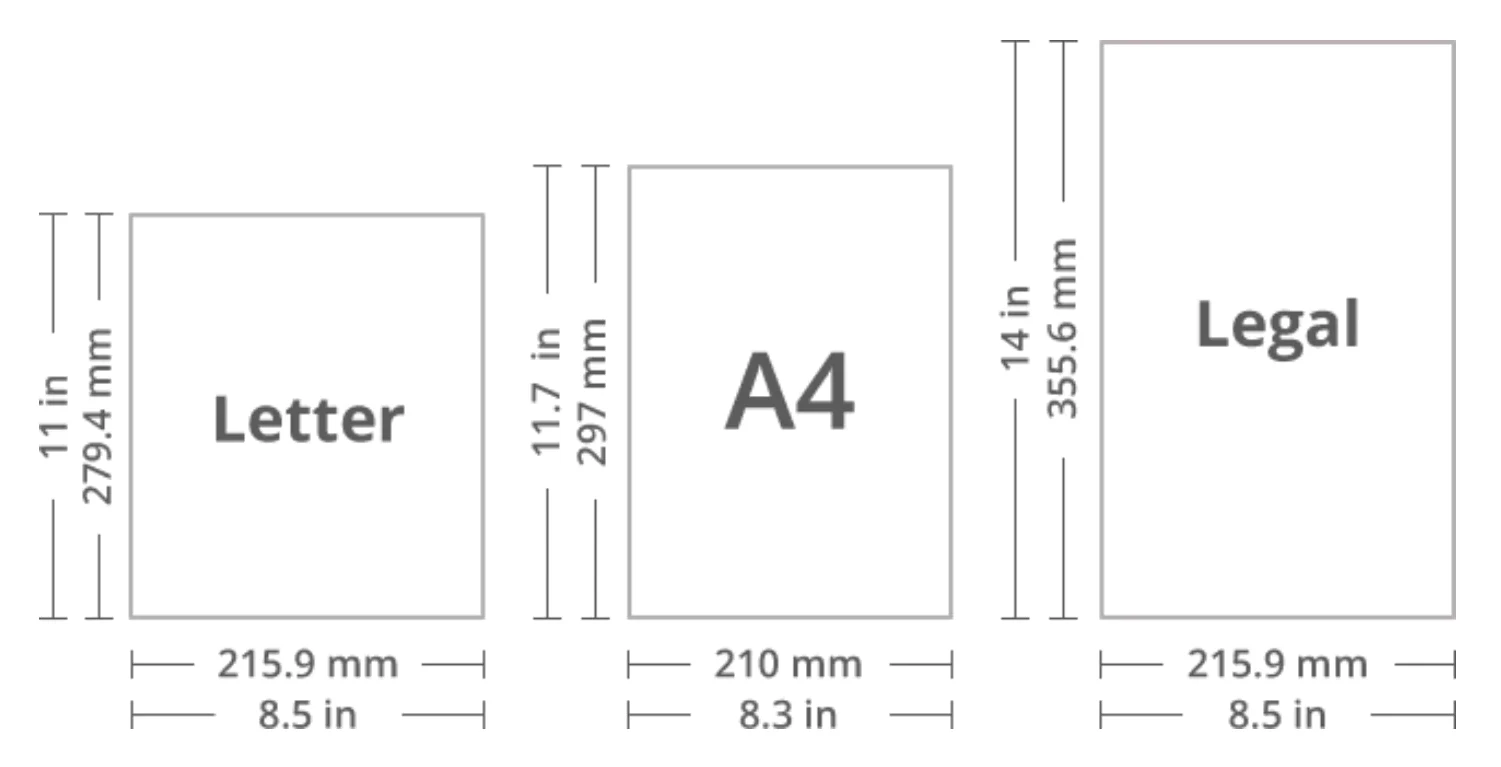
Starting 2020 LearningUkulele.com & Learning Ukulele with Curt moved to A4 paper sizes for all new books and new editions of books, lessons, and charts.
A4-Letter Reference

The A Series was adopted in Europe in the 19th century, and is currently used all around the world, apart from in the USA and Canada.

• Decoding Printer Paper Sizes: A4 vs Letter vs Legal. which is Standard?

NOTE: Printing A4 to US Letter Size: As the sizes are relatively close, simple select Scale to Fit and the A4 size will print out fine.

Modular Phonetic Rhythm represents a significant advance in the teaching and application of rhythm. Eliminating many inefficient aspects of rhythm education, Modular Phonetic Rhythm streamlines the traditional educational approach, resulting in a reflexive reaction to rhythm.

More Modular Phonetic Rhythm, The Foundation and Workbook 1 content below, continue exploring...


More Modular Phonetic Rhythm, The Foundation and Workbook 1


Evolution in Music Education

The difficulty in the study of rhythm has always been its abstract nature - and its mathematical implications. Contrary to popular opinion, being good at math does not guarantee or even indicate the potential for musical proficiency. My observations over the years have supported the theory that musical tendencies are often the outgrowth of communication skills, such as language. Music engineers often show high aptitude in math but not necessarily musicians.

Rhythm has traditionally been taught as a function of math, particularly fractions. Though accurate, this approach has missed one of the most fundamental facts of rhythm. Rhythm is a language and is, as such, phonetic not mathematical. The average student exposed to the math orientation of rhythm has rarely absorbed the essence of rhythm and rarely even becomes proficient at reading rhythm. This often becomes a lifetime barrier to the developing musician.

There is a strong correlation between the ability to spell and strong fundamentals in phonics. Phonetic skills allow us to “sound out” words, even words that we’ve never seen before! We understand the principle of sound as it applies to phonetic combinations. The "sight" of the letter combination triggers a reflexive "sound"; reaction. If rhythm could be broken down into phonetic units, then rhythm would become an easily recognized aural language.

Using the word umbrella as a model, we count 8 letters but only 3 syllables. If we attempt to pronounce this word as 8 sounds u-m-b-r-e-l-l-a, the sound is one of a speech impediment. But if we pronounce it as 3 syllables, we get um-brel-la. This is considerably easier to pronounce as 3 sounds rather than 8 sounds. Modular Phonetic Rhythm approaches rhythm with this syllable orientation.

As in most large systems, the fundamentals are surprisingly limited but the combinations and applications are seemingly endless. Consider how many numbers we have, yet they are all based on the numbers 0, 1, 2, 3, 4, 5, 6, 7, 8, 9 How many words are there in the English language and yet we only have 26 letters in our alphabet!

Modular Phonetic Rhythm is based on 26 basic rhythm syllables. These rhythm syllables vary from 1 note to 6 notes and from 1 beat to 4 beats. It is divided into 4 levels based on the subdivision of the beat. Ties and rests are approached as extensions or displacements respectively.


UL126-UKESTRUM1-12-8

12/8 Strum

The 12/8 Strum has application in Blues, Broadway, and 50’s Ballads.

UL126-UKESTRUM1-Introduction

A Guide to Ukulele Strums Introduction

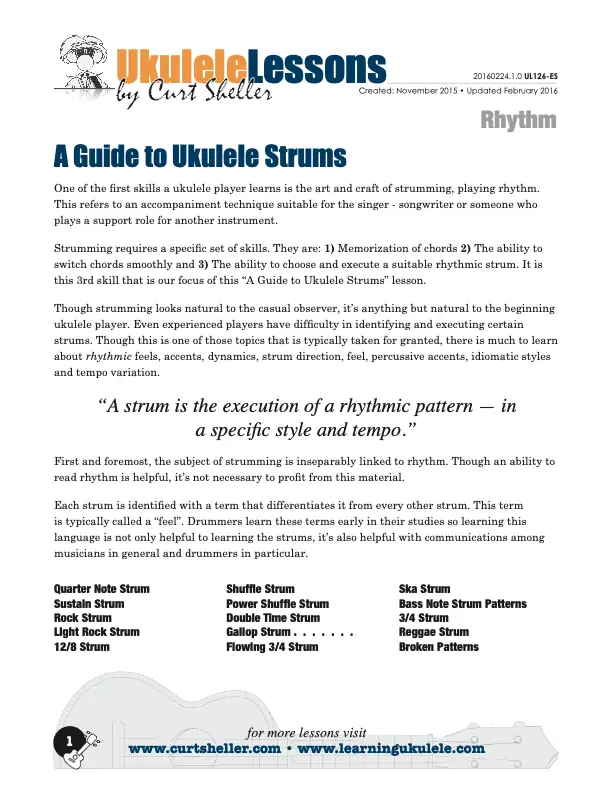
One of the first skills a ukulele player learns is the art and craft of strumming, playing rhythm. This refers to an accompaniment technique suitable for the singer, singer - songwriter or someone who plays a support role for another instrument.

UL125b-I-VI-II-V

Basic I VI II V Introduction in Key of C

A common variation of the** I V **chord progression and introduction: C Am Dm G

UL125c-Basie

Basie Ending

The Count Basie ending is one of the most recognizable endings in classic jazz. It is simple, effective and one ending that all gigging jazz musicians must know.

UL125c

Classic Endings for `Ukulele

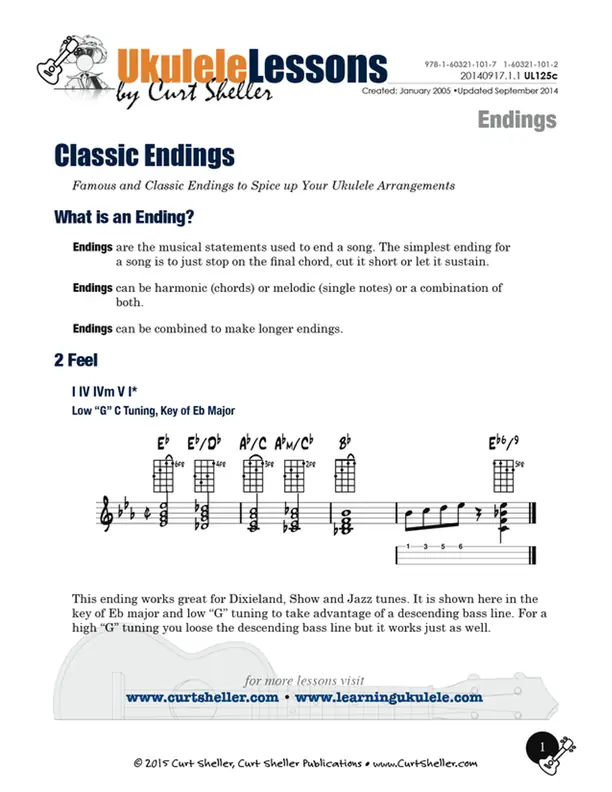
Two Feel, bVImaj7 bIImaj7, Basie Ending, Single, Double and Triple Tags, Chromatic, Take 'A' Train Ending, Shave and a Hair Cut, Lawrence Welk Ending. These are common classic songs ending that are used over and over in the standard song repertoire.

ML20

Counting Triplets

Time to chime in and reveal how simple it is to learn to play triplets and triplet based strums. Counting triplets is as simple as counting anything else. Simply use the counting system we all learned early on - use numbers.

UL125b

Creating Introductions and Turnarounds for `Ukulele

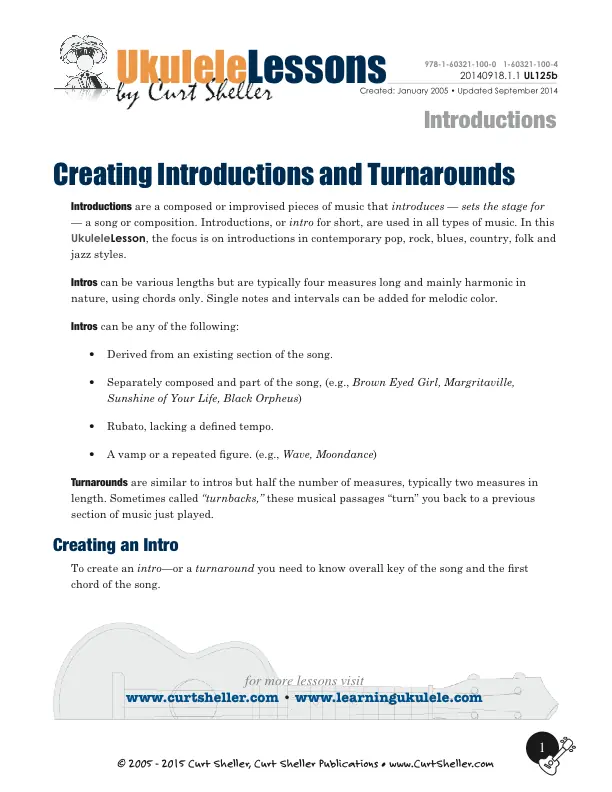
Introductions are a composed or improvised pieces of music that introduce - sets the stage for - a song or composition. Introductions, or intro for short, are used in all types of music. In this lesson, the focus is on introductions in contemporary pop, rock, blues, country, folk and jazz styles.

UL125b-Intro-I-V

Creating Intros, Basic I V on C Major

A basic I V introduction in the key of C major: C to G or G7. The Tonic to Dominant.

UL126-UKESTRUM1-Double-Time

Double Time Strum

The Double Time Strum has application in R&B, Funk, and Disco.

UL126-ES

Essential `Ukulele Strums - A Guide to `Ukulele Strums

One of the first skills a ukulele player learns is the art and craft of strumming, playing rhythm. This refers to an accompaniment technique suitable for the singer - songwriter or someone who plays a support role for another instrument.

UL126-LII21

Four Famous Core `Ukulele Strums - Pattern Two

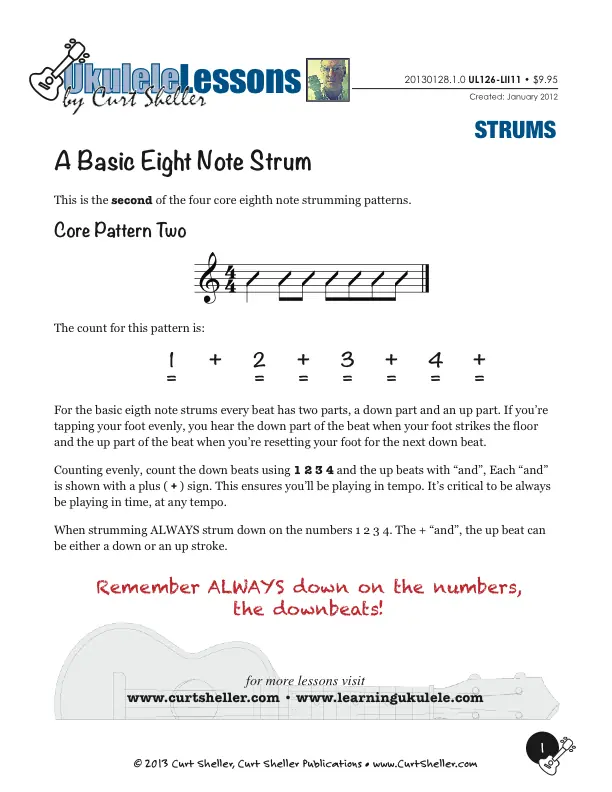
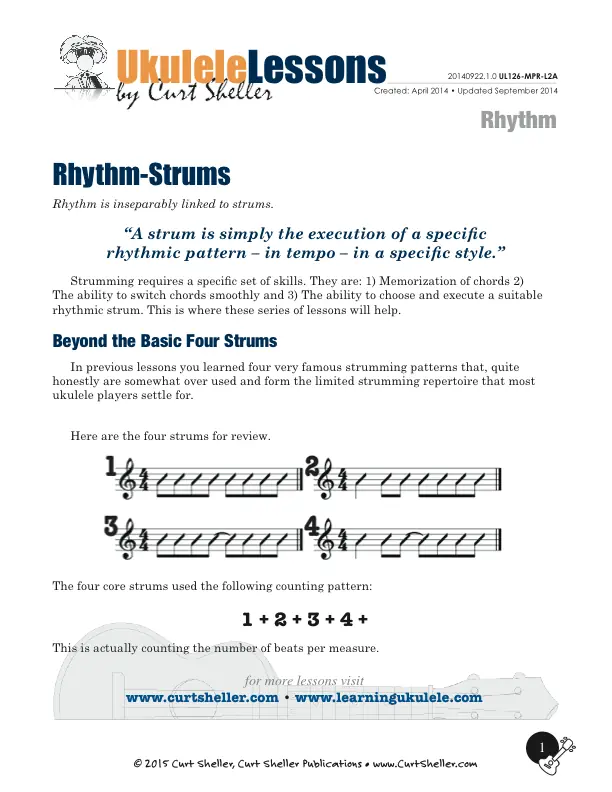
For ukulele and guitar there are four core, basic strums that will get you started. This is the second of the four core patterns.

UL126-LII21T

Four Famous Core `Ukulele Strums - Pattern - Pattern Four

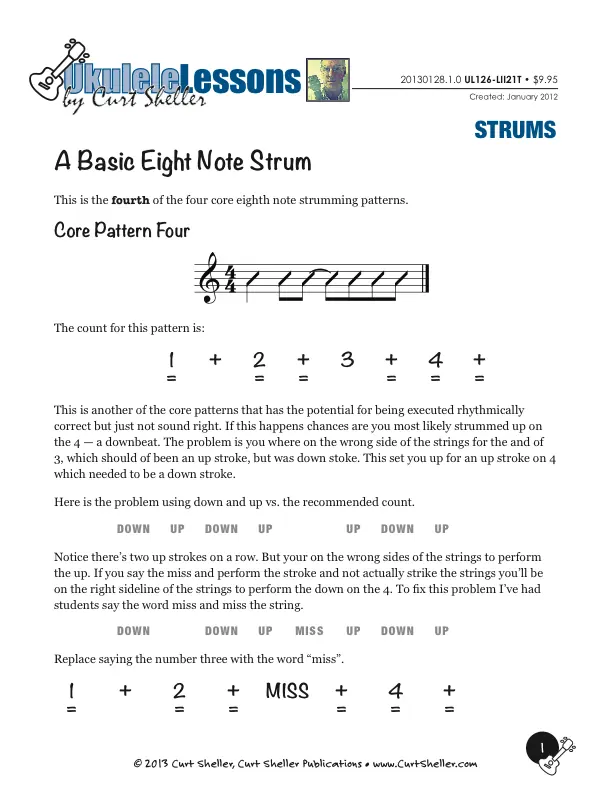
For ukulele, there are four core, basic strums that will get you started. This is the fourth of the four core patterns. This is the famous Island Strum that you will hear a lot in the Ukulele community.

UL126-LII11T

Four Famous Core `Ukulele Strums - Pattern - Pattern Three

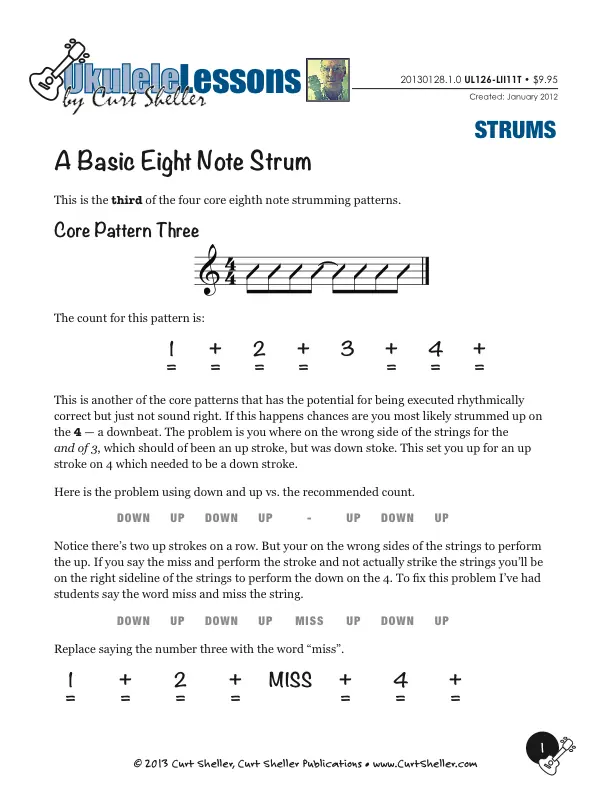
For ukulele there are four core, basic strums that will get you started. This is the third of the four core patterns.

UL126-LIIa

Four Famous Core `Ukulele Strums - Pattern - Review

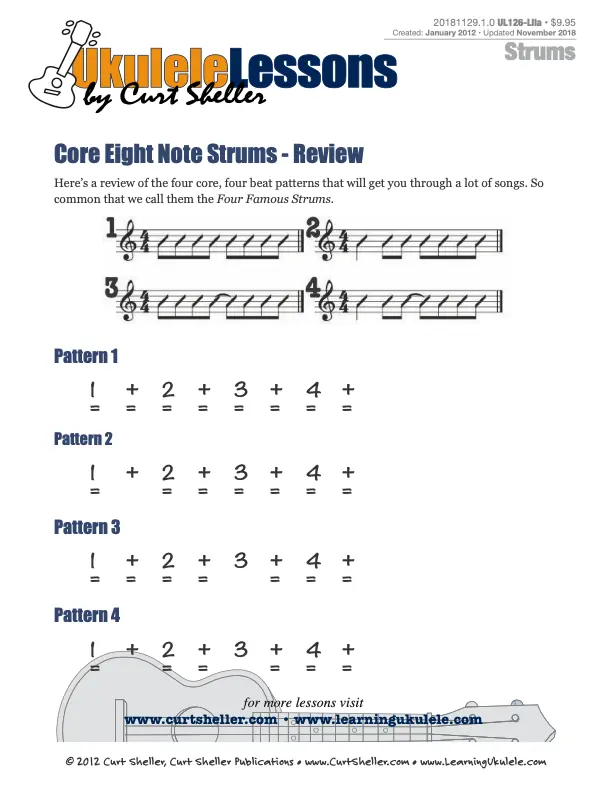
Review of the four core ukulele strums.

UL126-LII11

Four Famous Core `Ukulele Strums - Pattern One

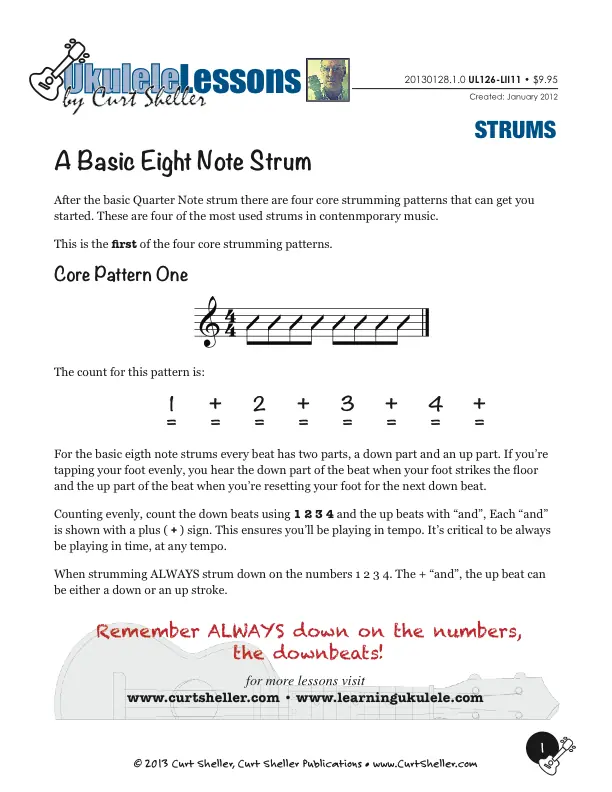
For ukulele there are four core, basic strums that will get you started. This is the first of the four core patterns.

UL126-UKESTRUM1-Gallop

Gallop Strum

The Gallop Strum has application in Metal, Country, and Tex Mex.

ULB01-wk-7

Getting Started with Ukulele - Lesson Seven

For Lesson Seven we’ll add and build on the lesson and material from lesson six.

UL125b-I-Idim7-II-V

I Idim7 II V Introduction in Key of C

"I Idim7 II V in key of C" — A classic introduction and chord progression utilized in show tunes and old-time music.

ULIMPROV-I

Improvisation - Improv - Solos - "Take It!"

Improvisation or “improv” is the art of creating solos, licks and riffs and are one of the parts of creating music that gives beginners and intermediate players trouble.

UL126-bd

Learning the Bo Diddley Strum

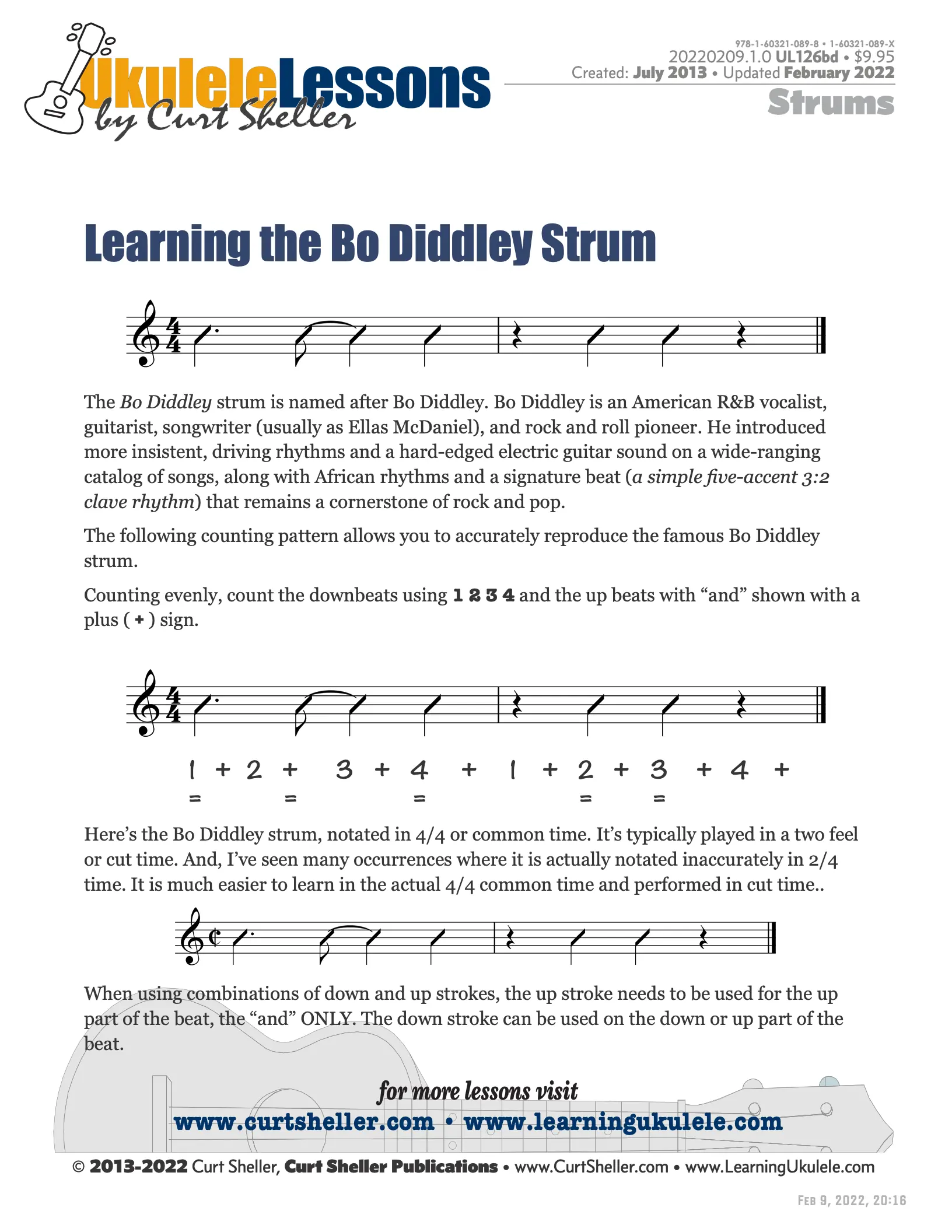
The Bo Diddley strum is named after Bo Diddley. Bo Diddley is an American R&B vocalist, guitarist, songwriter ( usually as Ellas McDaniel ), and rock and roll pioneer. He introduced more insistent, driving rhythms and a hard-edged electric guitar sound on a wide-ranging catalog of songs, along with African rhythms and a signature beat (a simple five-accent clave rhythm) that remains a cornerstone of rock and pop.
MPR22-IIT-Barline

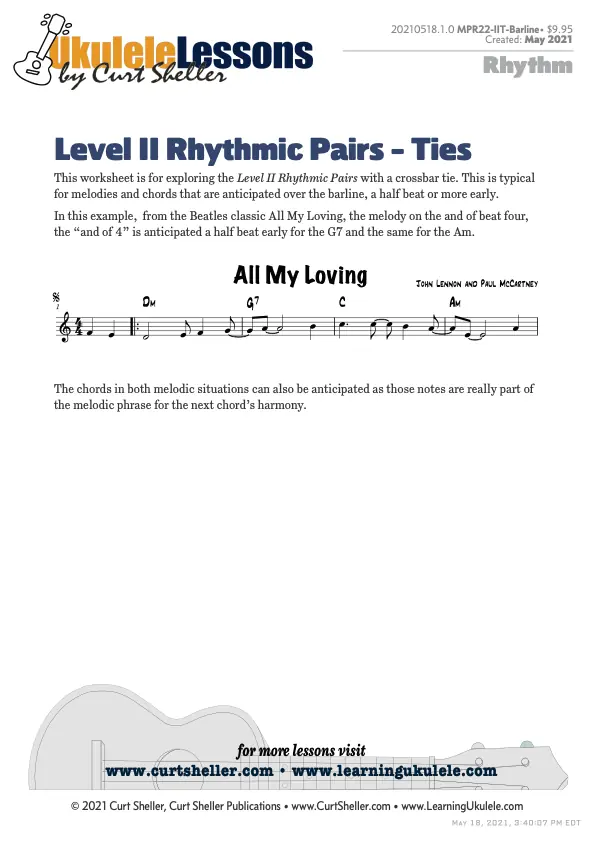
Level II Rhythmic Pairs - Anticipation, Crossbar Line

This worksheet is for exploring the Level II Rhythmic Pairs with a crossbar tie. This is typical for melodies and chords that are anticipated over the barline, a half beat or more early.

UL125a

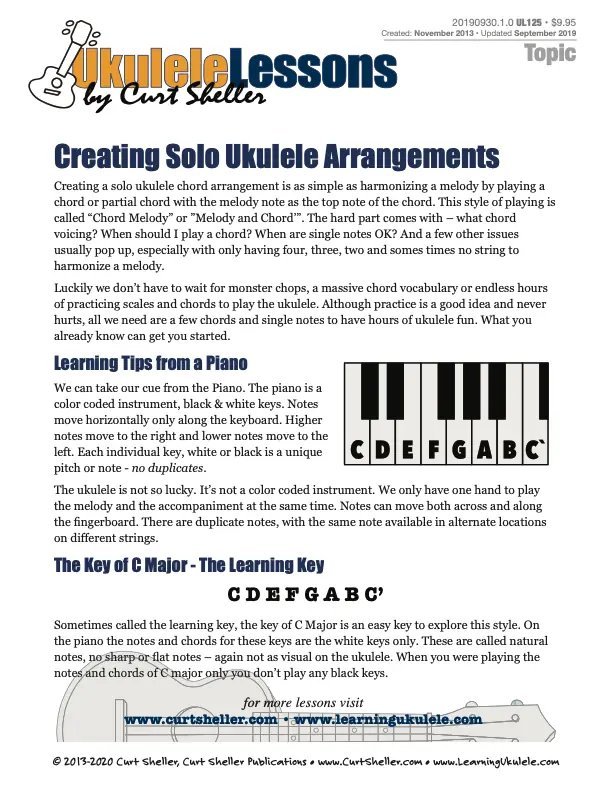
Melody and Chord Tips

Creating "Melody and Chord Arrangements", in theory are as simple as harmonizing the melody with a chord. Which is playing a chord that has the melody note as the top note of the chord voicing. In practice it is a little more involved, but not much more.

MPR20

Modular Phonetic Rhythm

"Modular Phonetic Rhythm" by Chuck Anderson represents a significant advance in the teaching and application of rhythm. Eliminating many inefficient aspects of rhythm education, Modular Phonetic Rhythm streamlines the traditional educational approach, resulting in a reflexive reaction to rhythm. This approach is applicable to all ages and to all styles of music.
MPR21

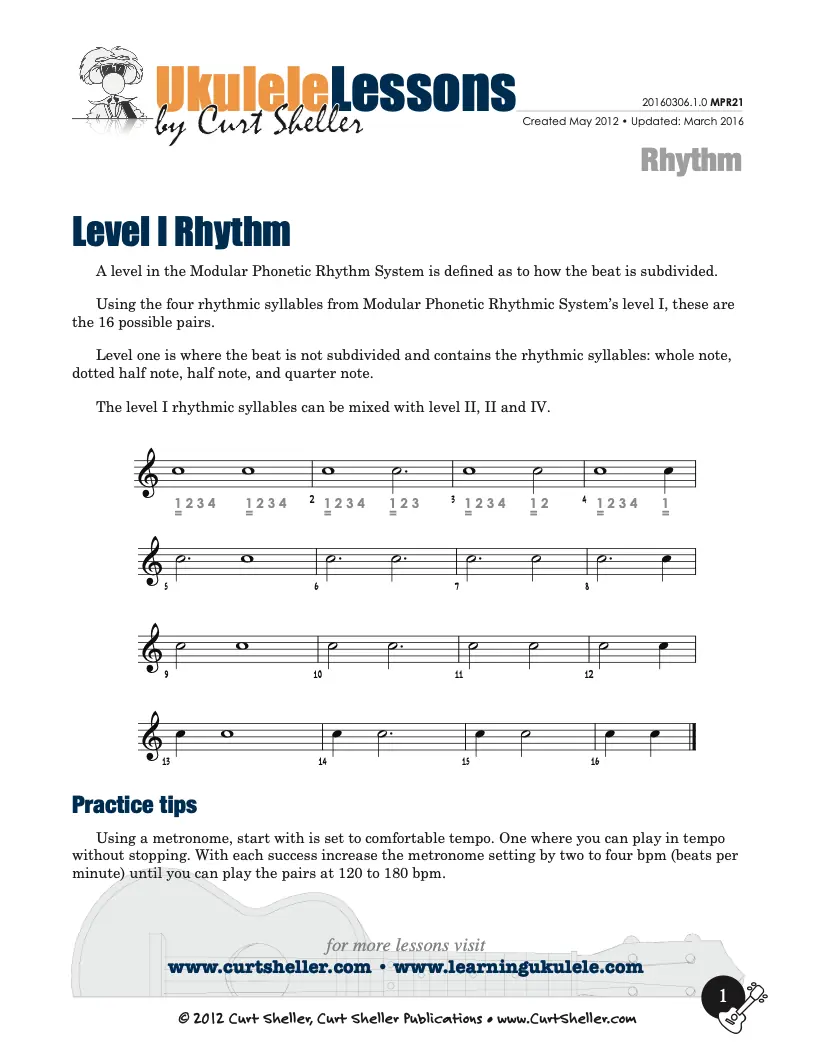
Modular Phonetic Rhythm, Level I Pairs Worksheet

Develop your ukulele strums vocabulary and sharpen your reading chops with the "Level I, Modular Phonetic Rhythmic Syllables — Pairs Worksheet".

MPR22

Modular Phonetic Rhythm, Level II Pairs Worksheet

Develop your ukulele strums vocabulary and sharpen your reading chops with the "Level II, Modular Phonetic Rhythmic Syllables — Pairs Worksheet".

MPR23

Modular Phonetic Rhythm, Level III Pairs Worksheet

Level III rhythmic syllable pairs for developing your ukulele strums vocabulary and sharpen your reading chops.

MPR24

Modular Phonetic Rhythm, Level IV Pairs Worksheet

Level IV rhythmic syllable pairs for developing your ukulele strums vocabulary and sharpen your reading chops.

UL06r

Playing by Ear - Rhythm

Playing "Rhythm by Ear" is all about getting your ear to recognize the sound of rhythms . And just like melodies, train the fingers, and the hands to follow your inner ear and play these rhythms on demand.

UL126-LI4

Quarter Note Strum

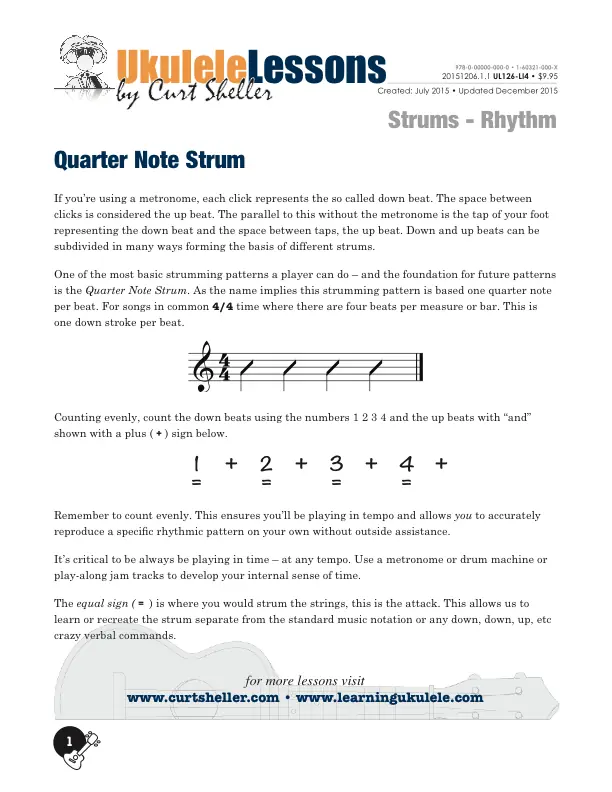
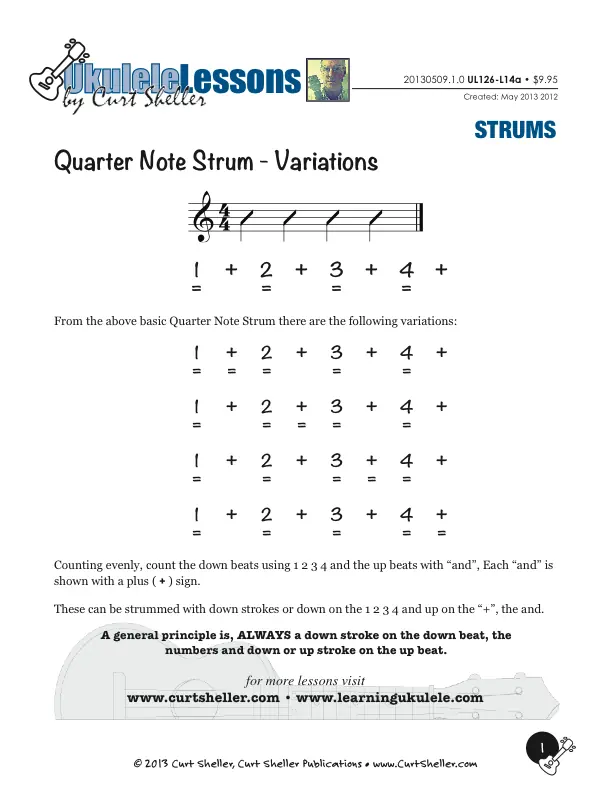
Chords and music are organized into bars or measures with the most common number of beats per bar or measure being four. One of the most basic strumming patterns and the foundation for ALL future strumming is the "Quarter Note Strum". As the name implies this strumming pattern is one quarter note per beat.
UL126-LI4a

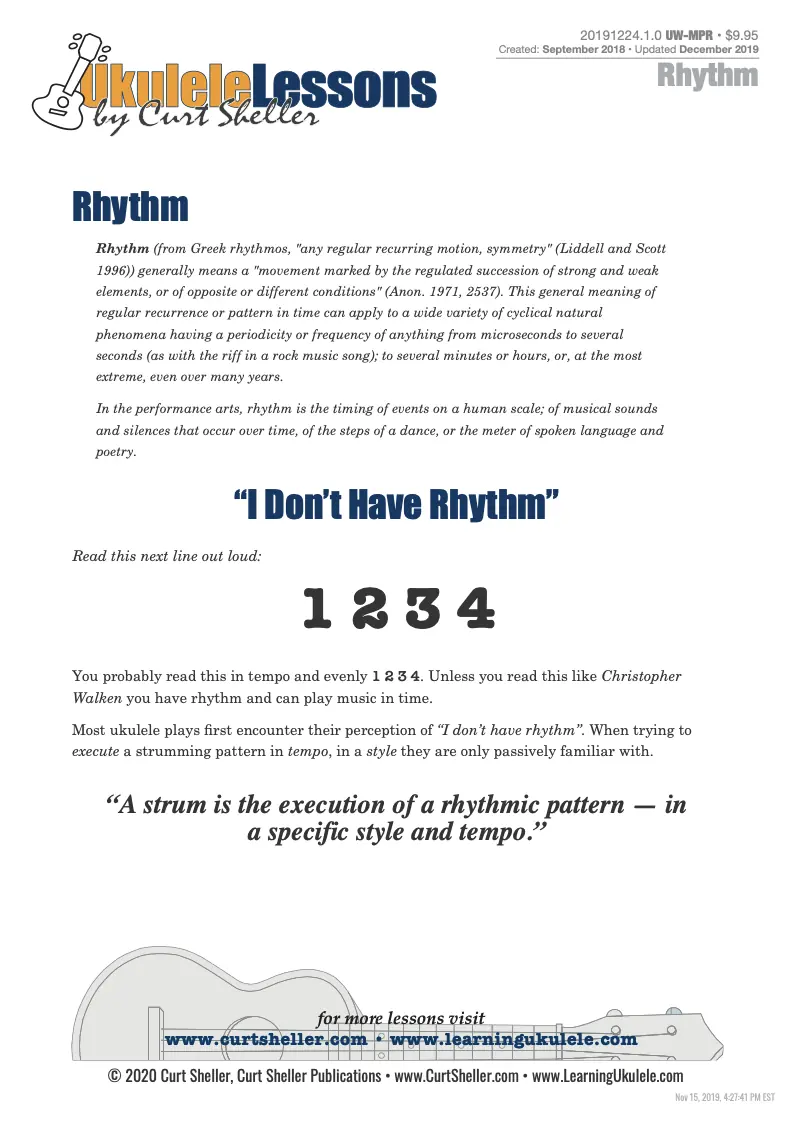
Quarter Note Strum - Variations

Building on the basic Quarter Note Strum lessons, here are four variations to get you started.

UW-MPR-Rhythm

Rhythm - Avoid at Your Own Peril

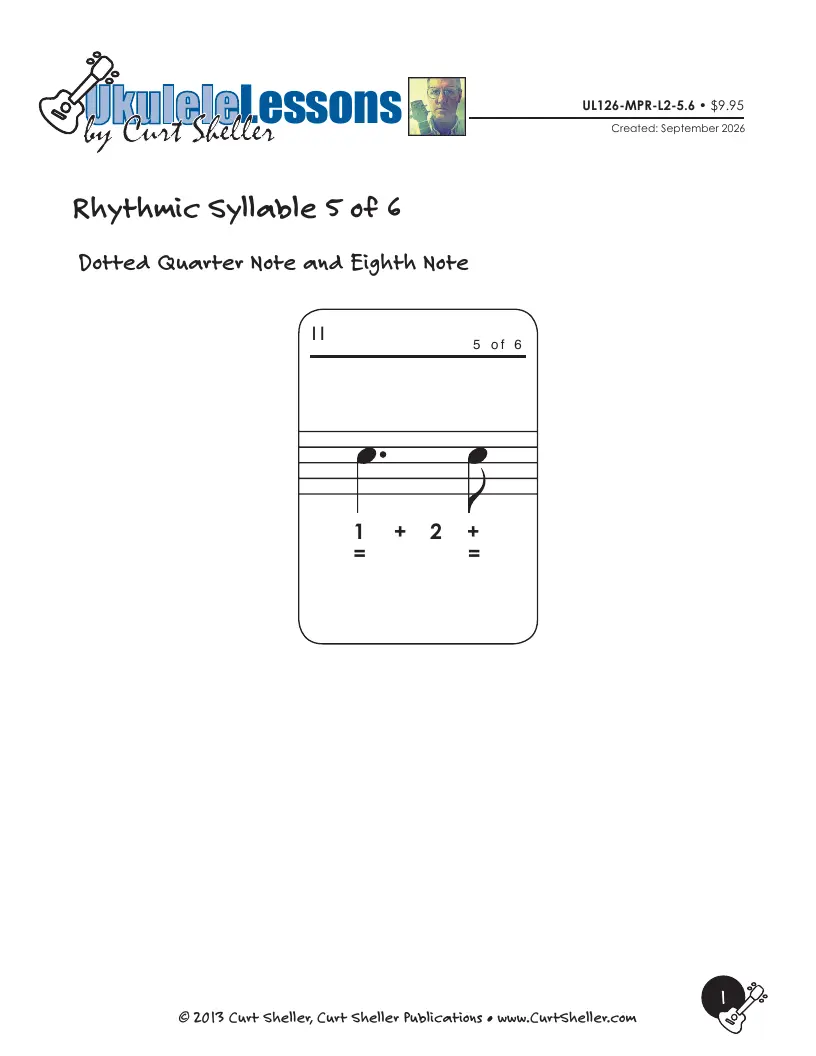
The often neglected and taken for granted subject of Rhythm. Music is Melody, Harmony and Rhythm. We are drawn, initially to music by melody at a very early age, with the instrument of our voice. With ukulele you typically learn chords - the harmony and never really dive into learning rhythm. Unless you're a drummer we take rhythm for granted.

UL126-MPR-L2-6-of-6

Rhythm and Strums Level II Rhythmic Pairs - Lesson Five

Level II Rhythmic Syllables 6 of 6 from the Modular Phonetic Rhythm, The Foundation and Workbook 1 book.

UL126-MPR-L2-5-of-6

Rhythm and Strums Level II Rhythmic Pairs - Lesson Four

Level II Rhythmic Syllables 5 of 6 from the Modular Phonetic Rhythm, The Foundation and Workbook 1 book.

UL126-MPR-L2A

Rhythm and Strums Level II Rhythmic Pairs - Lesson One

Level II Rhythmic Syllables 1 of 6 and 2 of 6 from the Modular Phonetic Rhythm, The Foundation and Workbook 1 book.

UL126-MPR-L2-4-of-6

Rhythm and Strums Level II Rhythmic Pairs - Lesson Three

Level II Rhythmic Syllables 4 of 6 from the Modular Phonetic Rhythm, The Foundation and Workbook 1 book.

UL126-MPR-L2-3-of-6

Rhythm and Strums Level II Rhythmic Pairs - Lesson Two

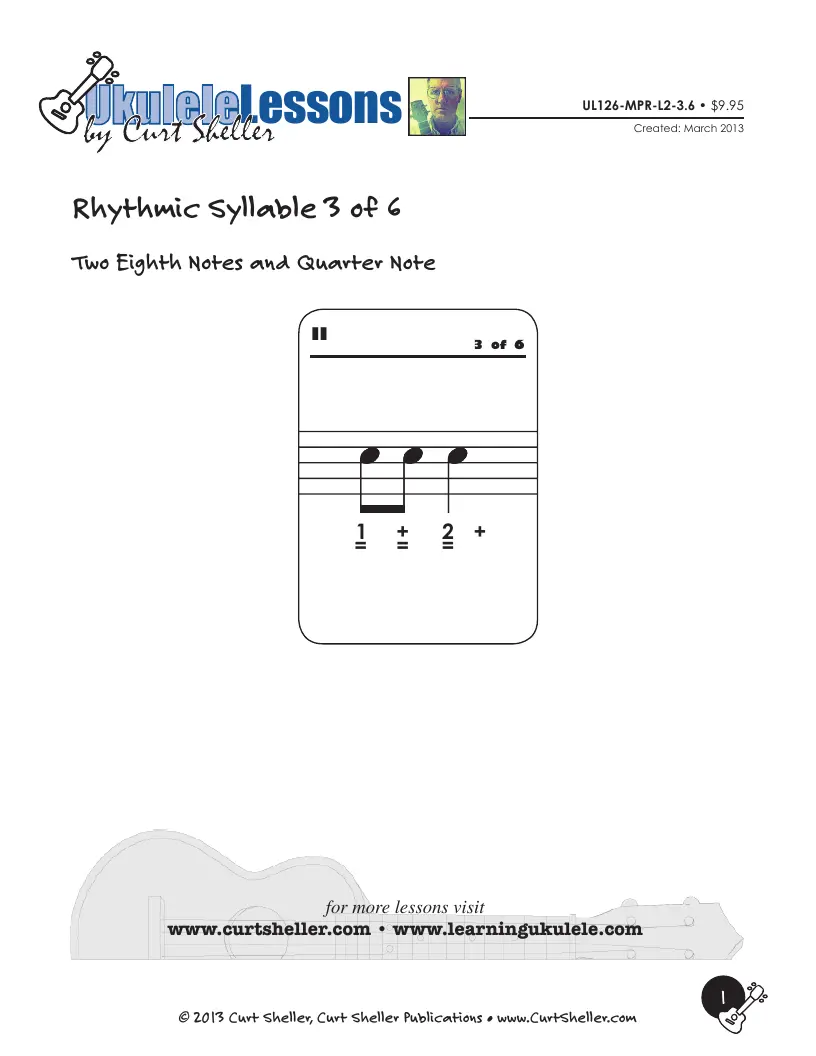
Level II Rhythmic Syllables 3 of 6 from the Modular Phonetic Rhythm, The Foundation and Workbook 1 book.

UL126-UKESTRUM1-Rock-Heavy

Rock Heavy Strum

The Rock Heavy Strum has application in Rock, Hard Rock, and Pop.

UL126-UKESTRUM1-Rock-Light

Rock Light

The Rock Light Strum has applications in Light Rock, Pop, and Country.

UL126-UKESTRUM1-Shuffle

Shuffle Strum

The Shuffle Strum has applications in Blues, Jazz, and Country.

UL126-UKESTRUM1-Ska

Ska Strum

The Ska Strum has applications in Ska, Reggae, and Cut Time.

UL126a

Sustained Strums

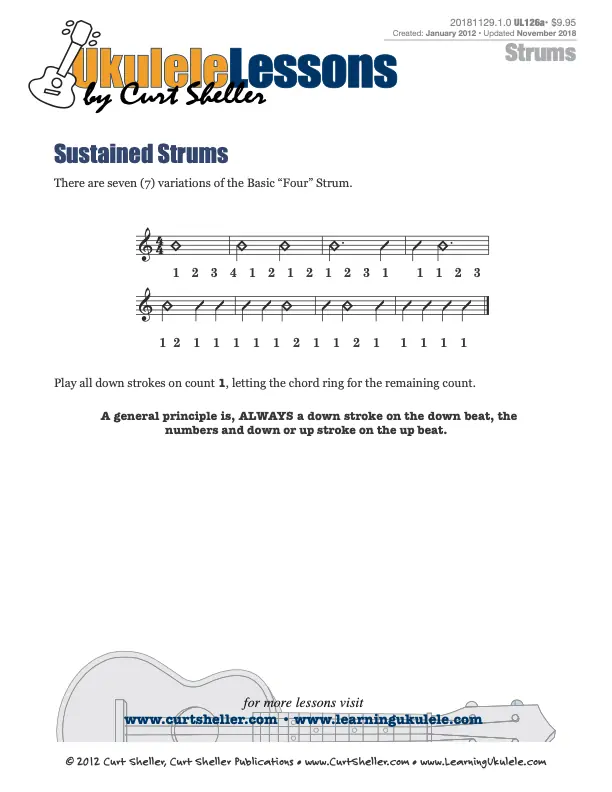
There are seven (7) variations of the Basic “Four” beat strum.

UL-Swing-01

Swing

Just what is "Swing". This lesson will have you playing Traditional Swing, Hard Swing. As well as how it applies to various styles.

UL125b-Hawaiian-Turnaround

The Hawaiian Turnaround in key C

The I II7 V7, the "Hawaiian Turnaround" in key C Major. A classic chord progression utilized in Hawaiian tunes.

UL126-UMC

The Muted Strum

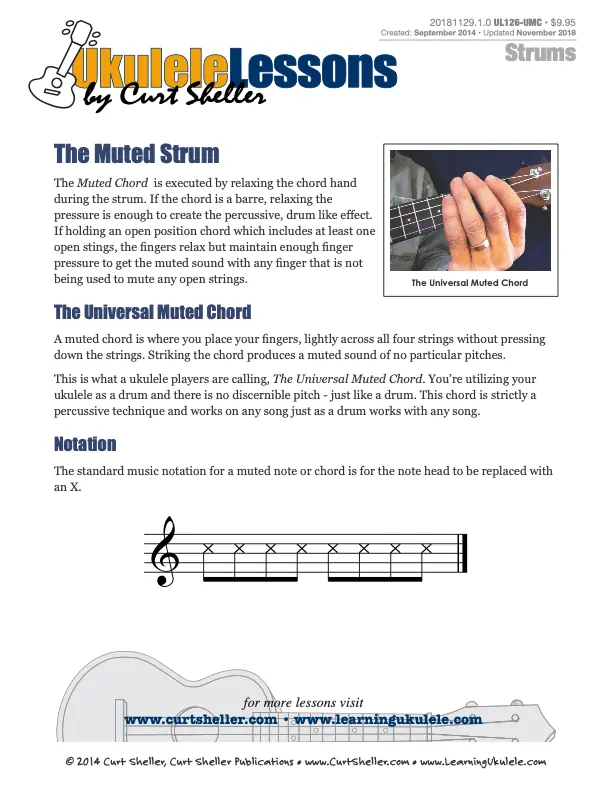
The muted strum is executed by relaxing the chord hand during the strum. If the chord is a barre, relaxing the pressure is enough to create the percussive, drum like effect. If holding an open chord, the fingers relax but maintain enough finger pressure to get the muted sound. This is what a few players are calling, The Universal Muted Chord. You're utilizing your ukulele as a percussive instrument and there is no discernible pitch - just like a drum. This chord works on any song just as a drum works with any song and does't care what the key is. This is a great chord to use when learning a new strum.

UL126-12-8

Triplet Based Strums - 12/8

A triplet, as the “tri” in the name implies, means three. It’s the subdivision of the beat into three even parts. Notice that I had used the word three for the number 3 in my writing. So, if I’m counting any beat which can be sub divided by three, it’s 1 2 3. No need to use words such as trip-o-let or one triplet, two triplet, etc to count.
UL126-LII61T

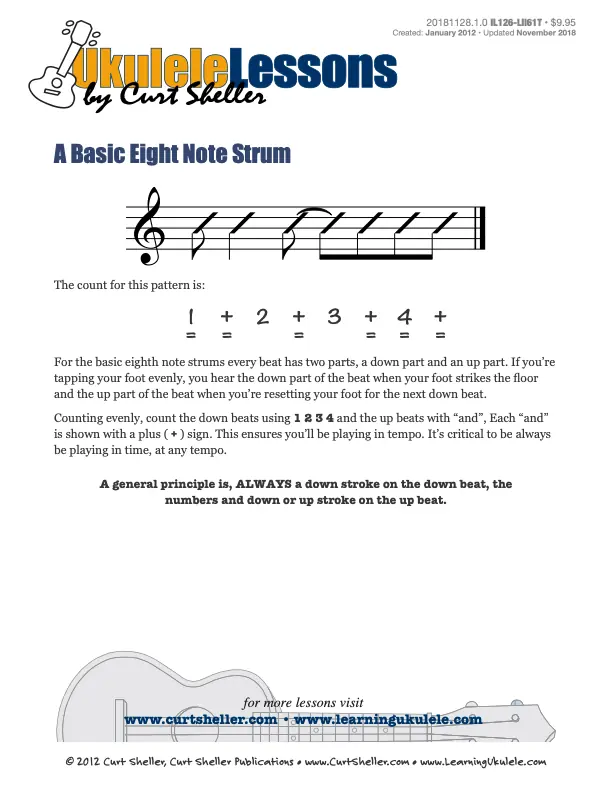
`Ukulele Struming Pattern 6.1T

Another one of the 72 possible strumming patterns based of the Modular Phonetic Rhythm systems level II rhythmic syllables.

UL126-LII41

`Ukulele Strums - Core Pattern 4.1

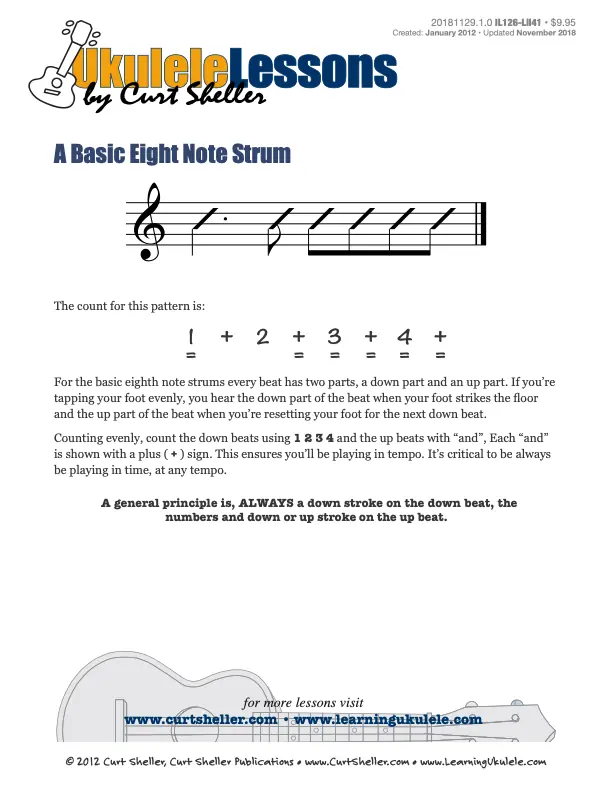
Another one of the 72 possible strumming patterns based of the Modular Phonetic Rhythm systems level II rhythmic syllables. A dotted quarter note and one eight note to four eight notes. Basically one rhythmic rhythmic syllable from the Modular Phonetic Rhythm tied to another syllable from the system.
UL126-LII41T

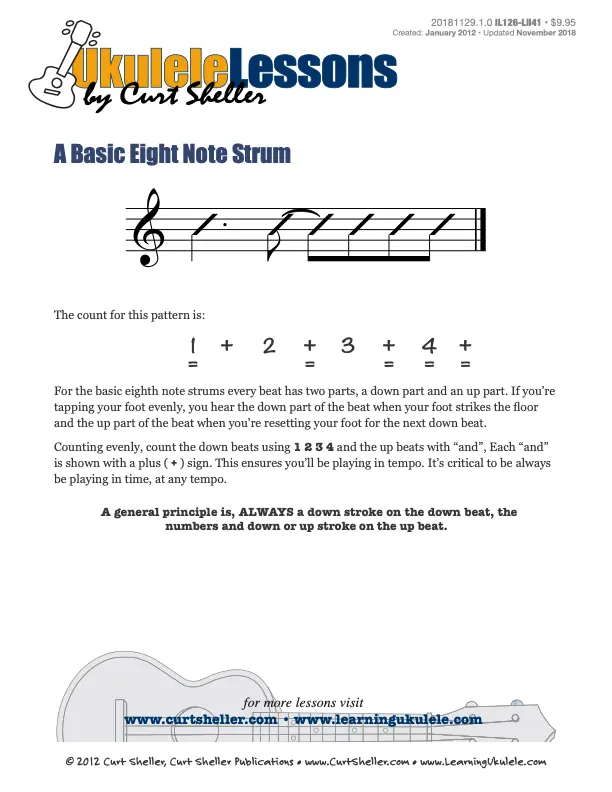
`Ukulele Strums - Core Pattern 4.1T

Another one of the 72 possible strumming patterns based of the Modular Phonetic Rhythm systems level II rhythmic syllables. The last pattern in this series with the end of the first rhythmic syllable tied to the beginning of the second rhythmic syllable.

UL126-LII61

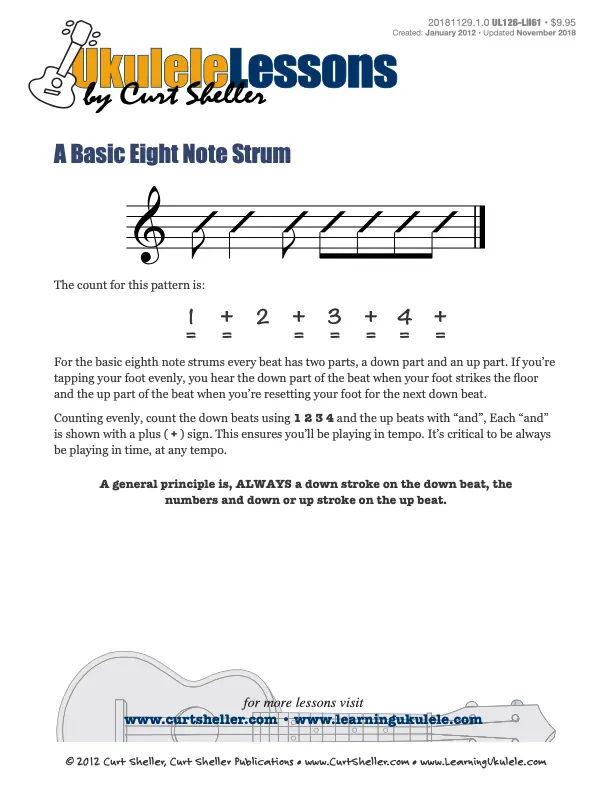
`Ukulele Strums - Core Pattern 6.1

Another one of the 72 possible strumming patterns based of the Modular Phonetic Rhythm system level II rhythmic syllables.

UL126

`Ukulele Strums - Getting Started

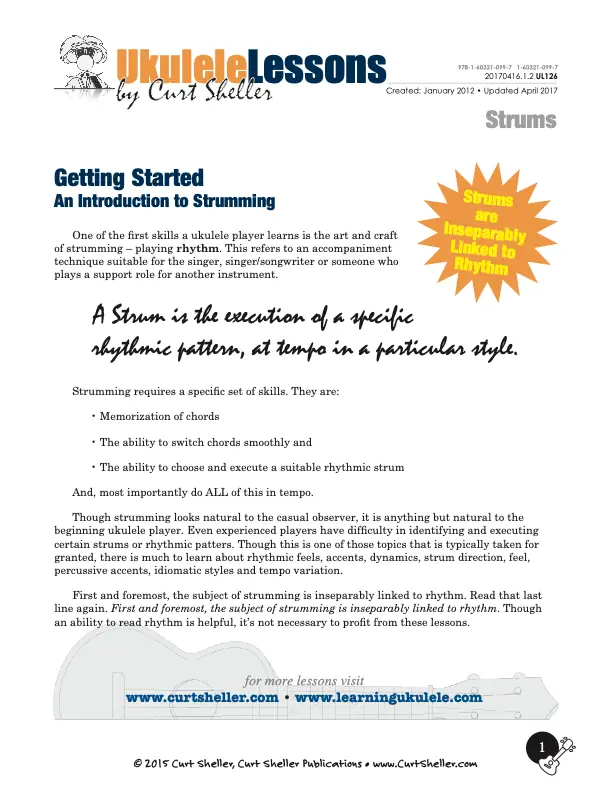
One of the first skills a ukulele player learns is the art and craft of strumming – playing rhythm. This refers to an accompaniment technique suitable for the singer, singer/songwriter or someone who plays a support role for another instrument.

UL126-MPR

`Ukulele Strums and The Modular Phonetic Rhythm System

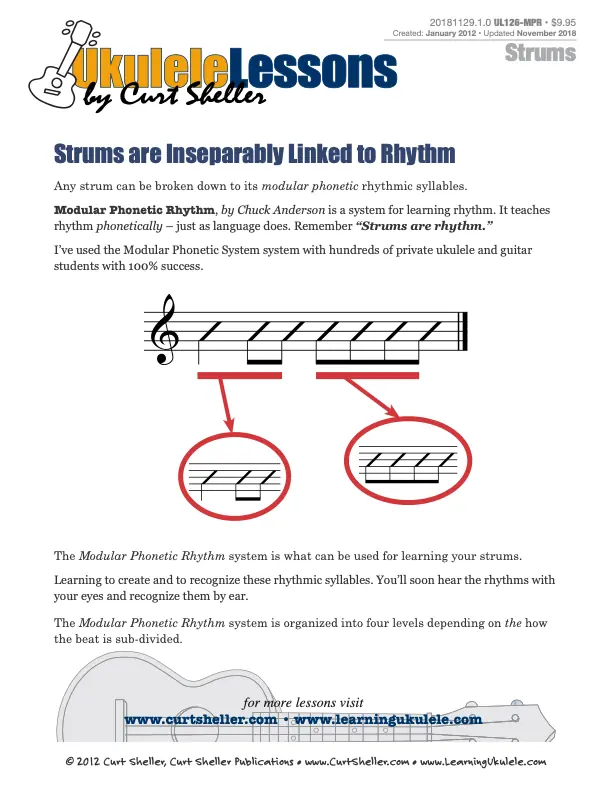
Strums are Inseparably Linked to Rhythm. Any strum can be broken down to its Modular Phonetic rhythmic syllables. Modular Phonetic Rhythm, by Chuck Anderson is a system for learning rhythm. It teaches rhythm phonetically - just as language does. Remember 'Strums ARE rhythm'