Published:
2013-06-24
Updated:
2014-12-26
Learning Ukulele with Curt
Four Finger, Single Note, Single String Gymnastic Variations
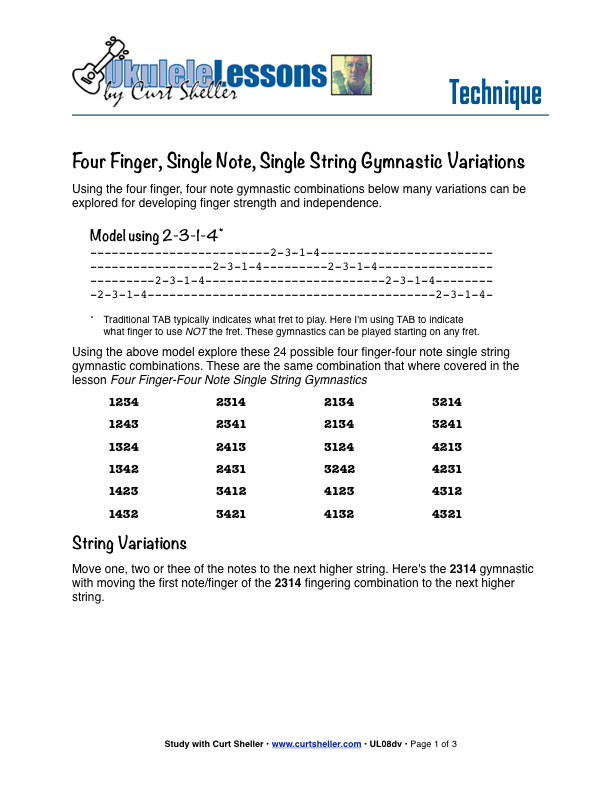
All the basic single string one, two, three and four finger gymnastics can be revisited and variations created by moving a note to higher strings. Rhythmic variation are also possible.
Author(s): Curt Sheller Publisher: Curt Sheller Publications Code: UL08-basic-4v
Main Category: Technique Main Instrument: Ukulele
Categories: Chords, Fingering, Technique, Gymnastics

2026-08-23
RelatedLessonAssets
Number of Pages: 3
If you're a registered site member and have the correct permissions you can view ALL the pages of this PDF at a larger size using the LearningUkulele.com Online PDF Viewer (button below).
Download PDFThis Download is NOT part of your LearningUkulele.com & Learning Ukulele with Curt membership level.
Sign-up for Premium Site Access or Upgrade Your Plan to download this PDF or your can purchase a copy for download
Sign In for Access…Contact Us if there are any issues.
All the basic single string one, two, three and four finger gymnastics can be revisited and variations created by moving a note to higher strings. Rhythmic variation are also possible.
This lesson takes the original four finger-four notes single string gymnastics and creates adjacent string variations.
Next Steps
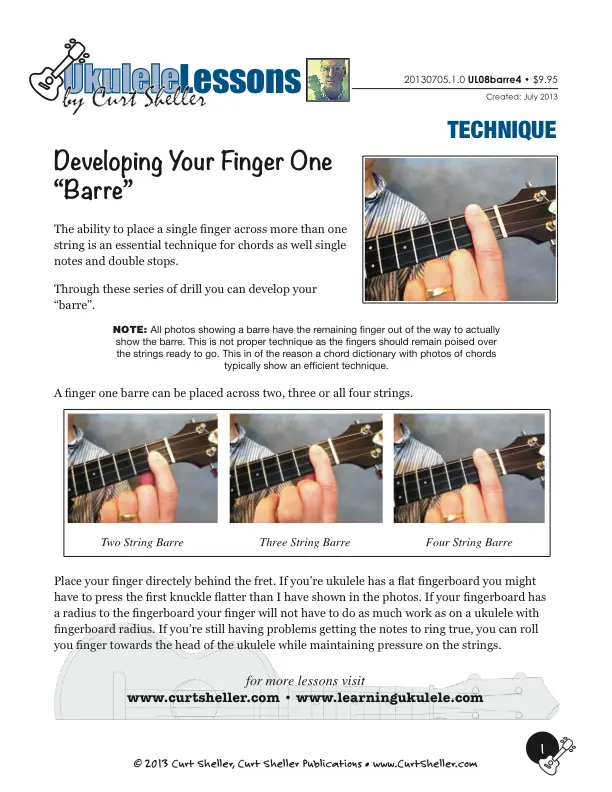
After the basic single note drills the next steps all depend on where you are in your development and any particular technique issues you might want to work on. Try the open string, pairs, barre, repeating note and chord drills.
More Four Finger, Single Note, Single String Gymnastic Variations
content below, continue exploring...
More Four Finger, Single Note, Single String Gymnastic Variations
Tips and Technique Suggestions
Common tips applicable to ALL finger drills.
As these drills don't really sound all that musical. They can be played while watching TV or riding a stationary bike. Their main goal is to get in a lot of reps and develop your chops. For a bit of musicality you can introduce a rhythmic component, simply by making some of the notes longer and some shorter.
However, even if done as part of another activity, you should focus on the drills.
- PLAY RIGHT BEHIND THE FRET, but not on it. Your finger should feel the fret but not be over the fret. This is the area that takes the least amount of pressing and pressure to get a good-sounding note. It allows you to come on and off notes quickly. Single notes right behind the frets are possible for ALL notes. For chords, get as close as possible if another adjacent finger on the same fret has taken that role.
- Keep your finger tips pointing to the strings when not being used. That IS their job, to play notes. Not point to the ceiling, floor, or walls. We want
Quiet Hands
and NOT fingerFlying
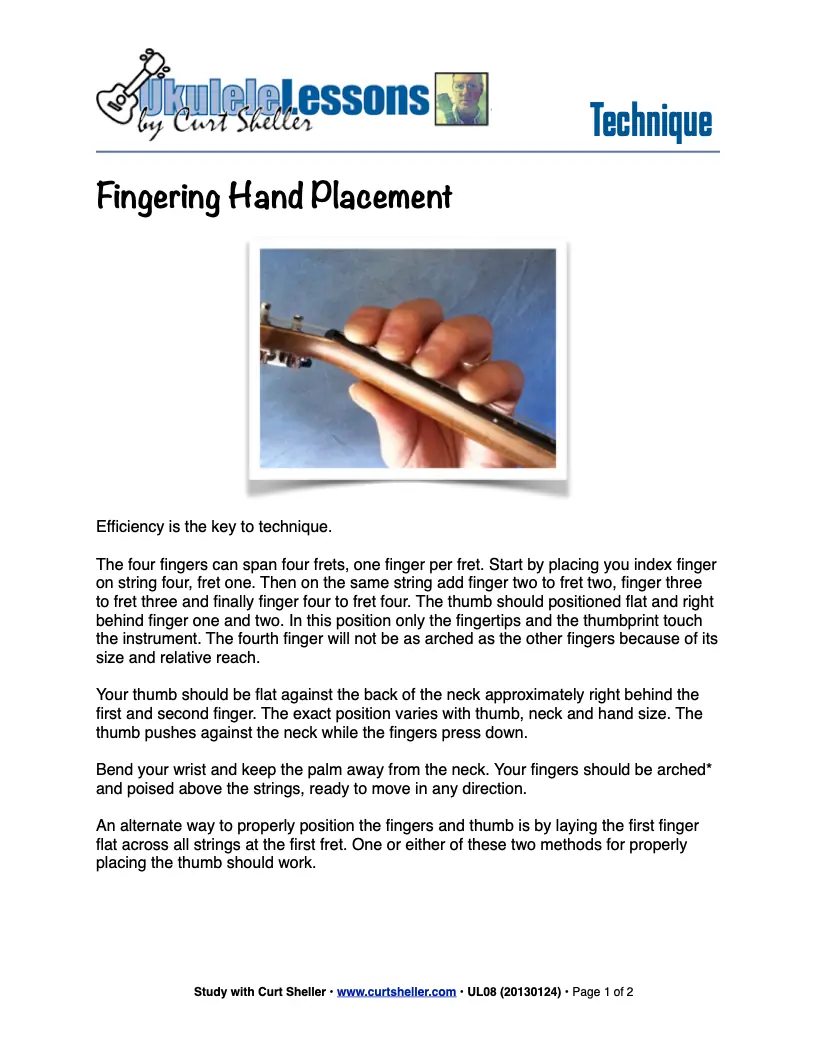
all over the place. - Keep your thumb in the position of strength and support — Behind the Neck! UkuleleLESSONS Proper Fretting Hand Placement
- Keep your fingers close to the strings, ready to go. Your fingers need to be over the frets and current string(s) that they are currently playing or going to play. Four fingers can cover four frets — stay in position ready to go.
- Always play in-control and accurate. This is easy to accomplish if you do the drills SLOW, accurate, and in-control.
Fast is nothing than, slow quicker.
- Say the finger combination that you are working on to insure the fingers are actually doing the drill you think you are doing.
- If the next note is higher and on the same string, keep the current finger down – No need to release the string just to press is down again.
- Do ALL drills Ascending (Nose to Toes) and Descending (Toes to Nose), the same drill. 1234 ascending and 4321 descending are different drills. There are 4 single fingers, 12 two finger combinations, 24 three finger combinations, and 24 four finger combinations.
- Start on different frets.
- Start on string one and play descending then ascending.
- Do a sub set of the strings. Get really good at strings one and two then add string three, etc. Build on a solid foundation.
- Try combinations of the 2, 3, and 4 finger drills. This one is hard to track if doing more the two different combinations at a time, so reading the combinations might be helpful.


End of Lesson - Thanks, Hope You Enjoyed It!
Related Lessons, Videos, Lesson Series, Songs, Books & Reference Charts, Resources & Assets, Workshops are below.


Six Secrets of Ukulele Fingering
Learn the six fingering principles to navigating the ukulele fingerboard. Fingering is one of the most universal topics. Whether your style is Rock, Blues, Country, Jazz or Classical, these principles will improve your technique, your solos, even your sight reading. Think of fingering as a series of pathways. When you learn to connect these pathways, there are benefits not only to technique but also to creativity.
Related Related Series
Related Related Series for Four Finger, Single Note, Single String Gymnastic Variations