Published:
2005-01-02
Updated:
2014-04-04
Learning Ukulele with Curt
Altered Seventh Chords on `Ukulele
Beyond basic open position chords, basic movable form chords, and a core set of 4-part chords. There are just too many chords shapes too memorize. Learning the principles of how chords are constructed and the ukulele fingerboard are the way to go. You can then create more advanced chords like 9#11, 7#5-9, 13b5, 7+9 on the fly as needed from your core set of chords.
Author(s): Curt Sheller Publisher: Curt Sheller Publications Code: UL42-7alt
Main Category: Chords Main Instrument: Ukulele
Categories: Chords, Fingerboard, Intermediate, Advanced, Core, Altered, Seventh, Movable, TmpPagyCatDebug

2026-08-23
RelatedLessonAssets
Number of Pages: 2
If you're a registered site member and have the correct permissions you can view ALL the pages of this PDF at a larger size using the LearningUkulele.com Online PDF Viewer (button below).
Download PDFThis Download is NOT part of your LearningUkulele.com & Learning Ukulele with Curt membership level.
Sign-up for Premium Site Access or Upgrade Your Plan to download this PDF or your can purchase a copy for download
Sign In for Access…Contact Us if there are any issues.
Beyond basic open position chords, basic movable form chords, and a core set of 4-part chords. There are just too many chords shapes too memorize. Learning the principles of how chords are constructed and the ukulele fingerboard are the way to go. You can then create more advanced chords like 9#11, 7#5-9, 13b5, 7+9 on the fly as needed from your core set of chords.
Your Core Seventh Chords
From these Four Core Seventh Chords you can build ALL, yes all your altered seventh chords. From these core seventh chords you can build ANY 4-part chord you will even need.
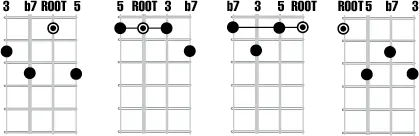
Memorize the locations of the Root, 3, 5 and b7 chord tones of these four chords. The b7 is typically not altered or changed as it is a critical tone of the chords and with the third gives a seventh chords its characteristic color and sound.
The “Big Six”
These ARE the main foundation 7th chords from which the Big Six Core Chords are based on and ALL other chords are derived from.
For ukulele I use the above four F7 chords and for guitar I use these as C7 as well as additional sets as there are quite a few more possible sets of fours strings on guitar.
For ukulele there's only one possible four string set to voice a 4-part chord on – strings 1, 2, 3 and 4.
For guitar there are 15 possible four string sets with five to seven, depending on you ultimate goal forming your core foundation. Us ukulele players have it a bit easy compared to guitar.
Ninth Chords
The technical name for a ninth is a Chord Extension Or Upper Partial .
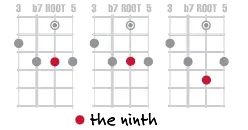
The Root will be used to create a ninth chord. Any chord can be a ninth by raising the root two frets. The seventh chord can have a flat nine or a sharp nine.
The Root is shown but not fingered or played as the ninth displaces the root of the chord.
Altered Fifths
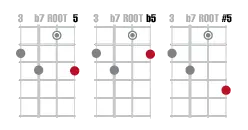
Learning to recognize the location of the fifth in chords, allows you to simply Raise Or Lower The Fifth to get the 7#5 or 7+5 and 7b5 or 7-5 chords.
Ninths & Fifths
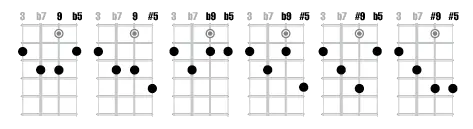
Multiple alterations and upper partials can be used together.
Learning Your Chords - What Came First? The Shape Or The Chord?
Thinking of your core chords in generic form is what allows you to create these altered and upper partial seventh chords on the fly.
Most players, myself included, first learned their chords without knowing what the notes where – didn't matter what the notes where. They weren't that many chords to learn to get started. Even the few movable form chords where still just a collection of shapes. But - getting beyond those basic chords is typically a struggle without some sort of system to organize your chords. There are just way too many chord shapes to memorize them all. Chord dictionaries, software, charts and such just won't do the trick.
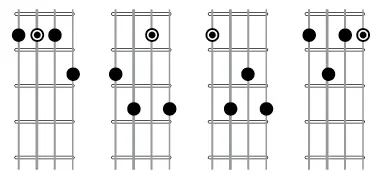
As these are Your Core Chords And Foundation , I organize the them by what string the root is on. This allows me to transpose them to any key up and down the fingerboard. If your really know the fingerboard, and I mean really know the fingerboard, then it's relatively easy. And, knowing the notes of the fingerboard is definitely worth the effort.
Then Learn the Names of the Notes
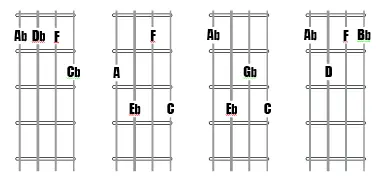
@svg('solid/arrow-circle-right', 'text-brand-500') Learn the Names of the Notes…
Finally, Each Particular Note's Function Within the Chord
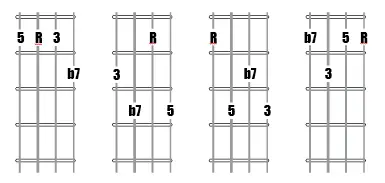
In C tuning, low or high G the chords shown at fret (1) are: Db7, F7, Ab7 and Bb7.
The chord tones are: 1 3 5 b7.
@svg('solid/arrow-circle-right', 'text-brand-500') Chord Tones…


End of Lesson - Thanks, Hope You Enjoyed It!
Related Lessons, Videos, Lesson Series, Songs, Books & Reference Charts, Resources & Assets, Workshops are below.
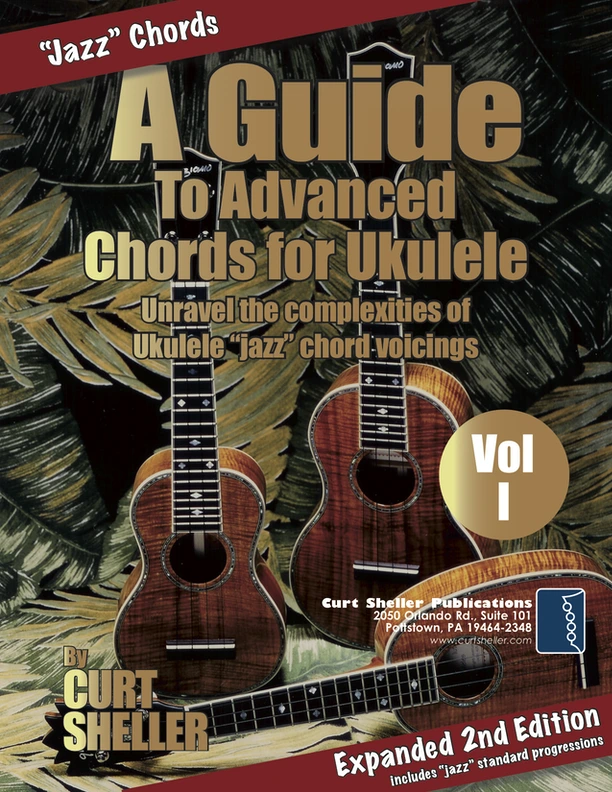
A Guide to Advanced Ukulele Chords - Volume I
Beyond learning basic Ukulele chords, most players struggle with advanced chords. Commonly called "jazz" chords, these more sophisticated voicings find a wide use in all forms of music. A Guide to Advanced Chords for Ukulele - presents a highly organized and efficient approach to the mysterious subject of advanced chords. Chord dictionaries are not the answer.
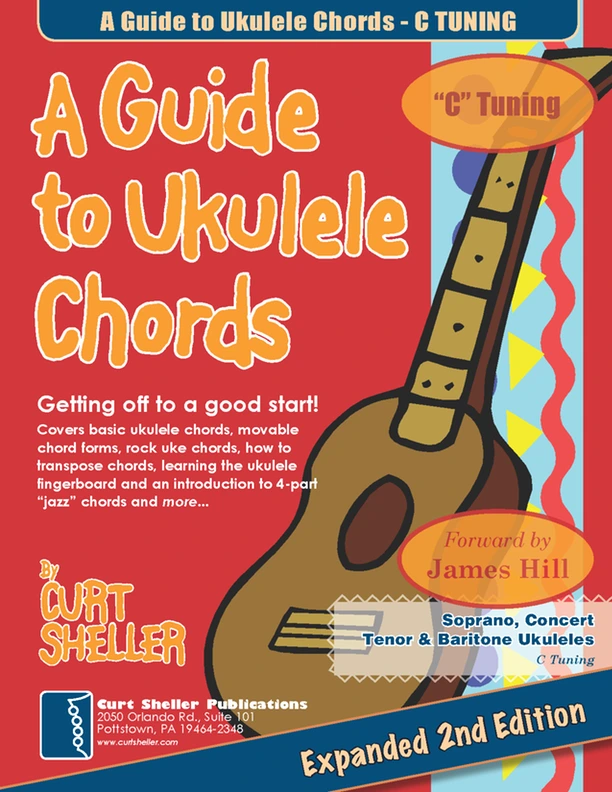
A Guide to Ukulele Chords, 2nd Edition
A Guide to Ukulele Chords, Second Edition is designed as a guide to ukulele chords. Covering the basic ukulele chords that ALL ukulele players SHOULD know. A Guide to Ukulele Chords covers movable chord forms, rock chords, how to transpose chords, learning the ukulele fingerboard and includes an introduction to 4-part, a.k.a jazz chords and more...
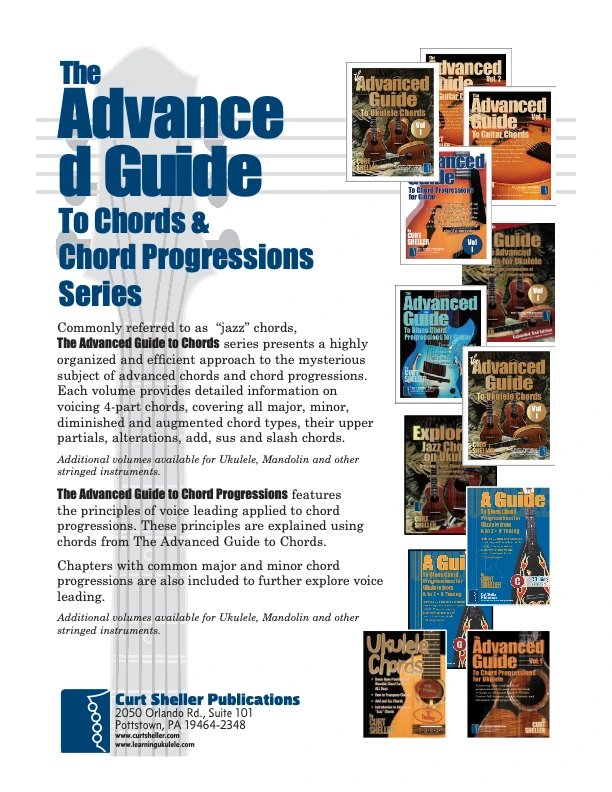
Advanced Guide to Chords and Progressions Series
The Advanced Guide to Chords series presents a highly organized and efficient approach to the mysterious subject of advanced chords and chord progressions. Each volume provides detailed information on voicing 4-part chords, covering all major, minor, diminished and augmented chord types, their upper partials, alterations, add, sus and slash chords.