
Published:
2014-09-26
Updated:
2017-10-21
Learning Ukulele with Curt
Chord Spelling - Triads
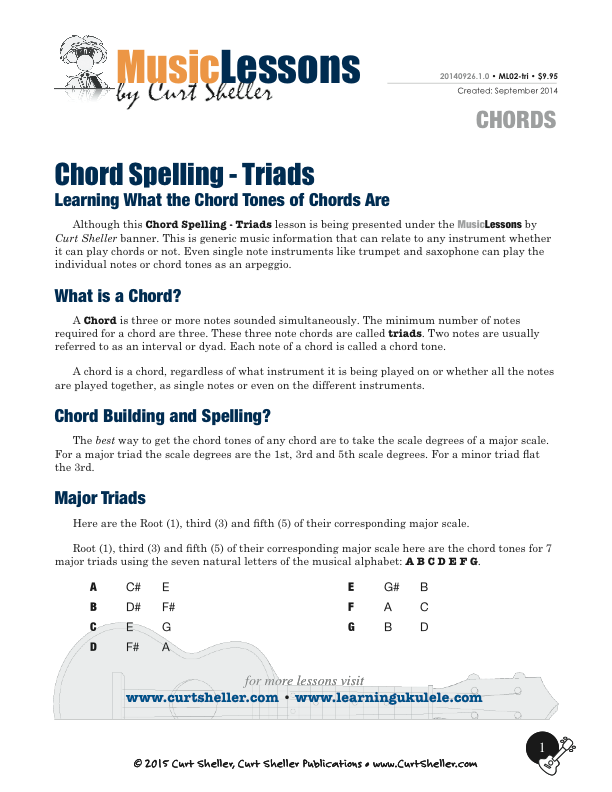
This lesson presents the traditional approach for learning the chord tones of chords with a little twist to make it a bit easier. A Chord is three or more notes sounded simultaneously - together or almost together. The minimum number of notes required for a chord are three. These three note chords are called triads. Two notes are usually referred to as an interval or dyad. Each note of a chord is called a chord tone.
Author(s): Curt Sheller Publisher: Curt Sheller Publications Code: ML-basic-02-tri
Main Category: Triads Main Instrument: Any
Categories: Chords

2026-08-23
Show Series Lessons
Series Home
Number of Pages: 6
If you're a registered site member and have the correct permissions you can view ALL the pages of this PDF at a larger size using the LearningUkulele.com Online PDF Viewer (button below).
Download PDFThis Download is NOT part of your LearningUkulele.com & Learning Ukulele with Curt membership level.
Sign-up for Premium Site Access or Upgrade Your Plan to download this PDF or your can purchase a copy for download
Sign In for Access…Contact Us if there are any issues.
This lesson presents the traditional approach for learning the chord tones of chords with a little twist to make it a bit easier.
The traditional definition of a Chord
is – (paraphrased) – three or more notes sounded together or almost together - think arpeggio
. The minimum number of notes required for a chord are three. These three note chords are called triads. Two notes are usually referred to as an interval or dyad. Each note of a chord is called a chord tone. Also, as a side note, these traditional triads, built in major and minor thirds are the ONLY chords given traditional chord names such as major, minor, diminished, augmented. Contemporary additions to theses names are the sus and add designations.
A chord is a chord, regardless of what instrument it is being played on or whether all the notes are played together, as single notes or even on the different instruments.
Chord Building and Spelling?
The best way to get the chord tones, the spelling of any chord are to take the scale degrees of a major scale, based on the root of the chord. For a major triad the scale degrees are the 1st, 3rd and 5th scale degrees of its corresponding major scale. For a minor triad flat the 3rd.
Here is a chart listing ALL 15 Major Scales and the chord building numeric formula for common chords.
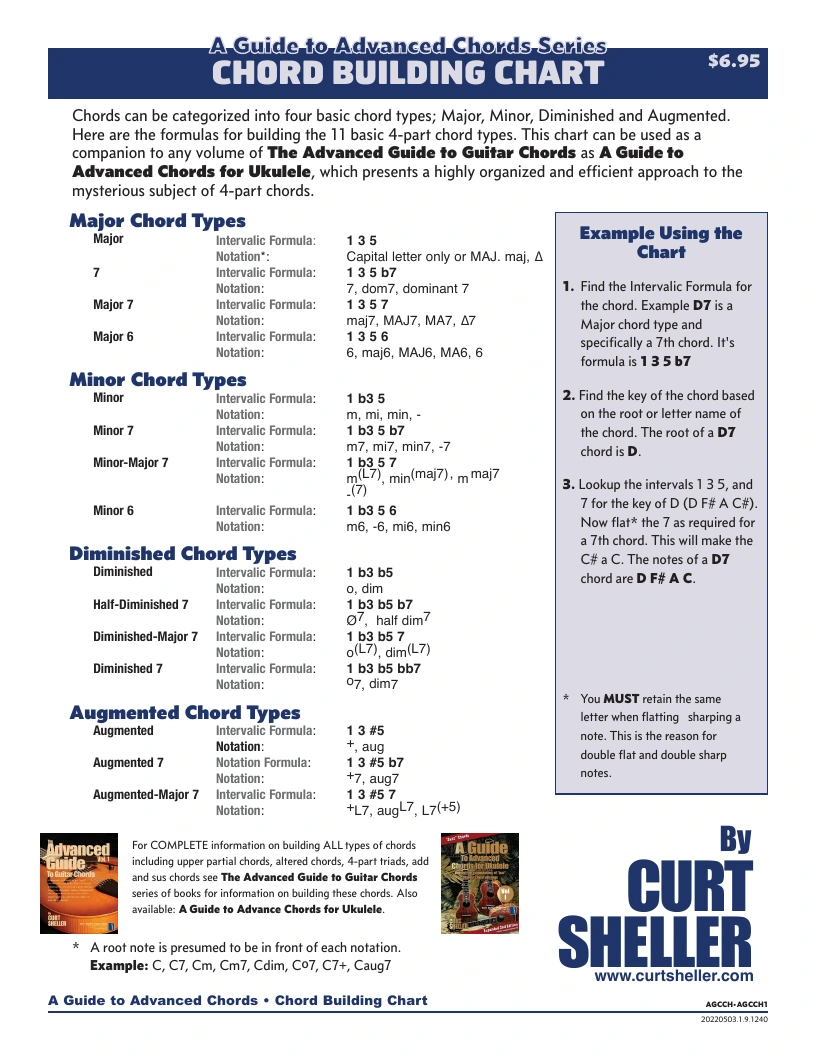
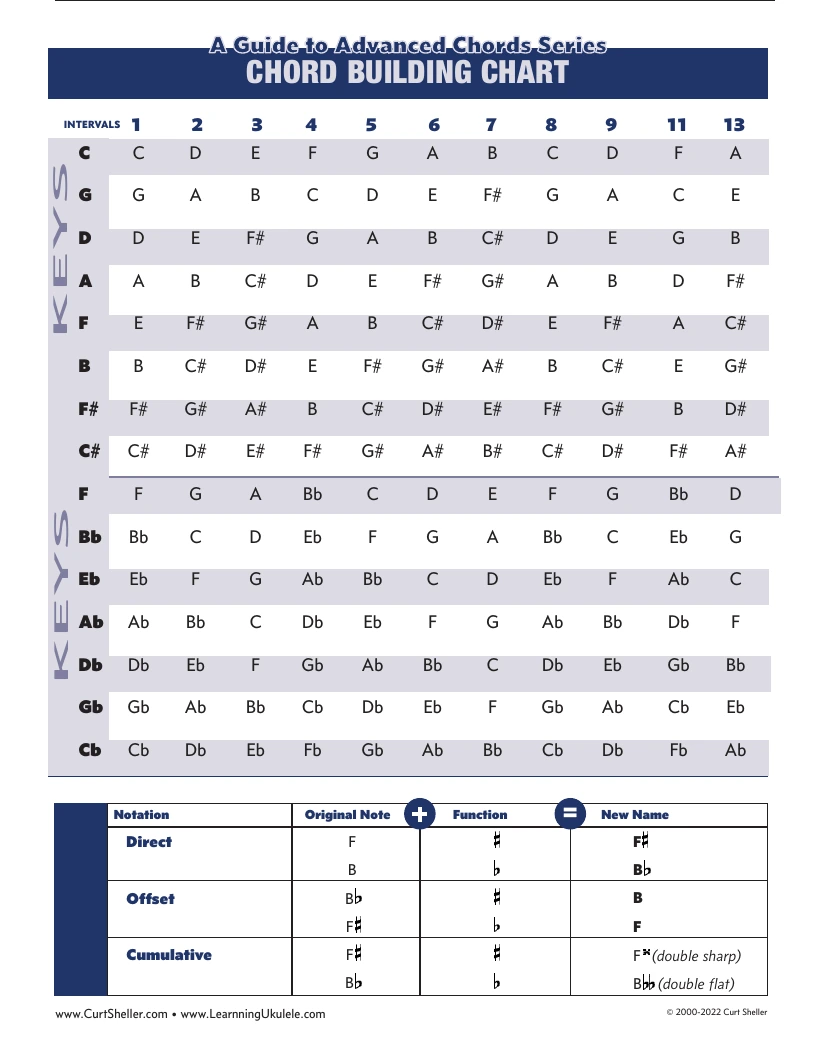
A Guide to Advanced Chords Series — Chord Building Chart
Visit the A Guide Advanced Guitar to Chords Series — Chord Building Chart page do view on-line or download and print out your copy.
Example for a C Root Chord(s)
C or C major are C E G, the 1st, 3rd, and 5th of the C Major scale: C D E F G A B C`.
Cm or C minor are C E♭ G, the 1st, ♭3rd, and 5th of the C Major scale: C D E F G A B C`.
C° or C diminished are C E♭ G♭, the 1st, ♭3rd, and ♭5th of the C Major scale: C D E F G A B C`.
C+ or C augmented are C E G♯, the 1st, 3rd, and ♯5th of the C Major scale: C D E F G A B C`.
NOTE: Any C chord, major, minor, diminished, or augmented, is always the letters C, E, and G. So if the chord is C♭ the letters are still C E G with flats: C♭ E♭ G♭. So C♭ is C♭ E♭ G♭, Cm is C♭ E♭♭ G♭. Can't change the letter
, if it already has a flat or sharp is just needs doubled: ♭♭ or x for a double ♯.


End of Lesson - Thanks, Hope You Enjoyed It!
Related Lessons, Videos, Lesson Series, Songs, Books & Reference Charts, Resources & Assets, Workshops are below.