
Published:
2011-10-17
Updated:
2011-10-17
Learning Ukulele with Curt
Fingerstyle on `Ukulele - Single and Multi String Exploration
Exploring fingerstyle on ukulele. This lesson covers the common terms used for identifing the fingers used. And, presents a series of single and multi-string exercises for exploring and developing the techniques needed for this style.
Author(s): Curt Sheller Publisher: Curt Sheller Publications Code: UL112a
Main Category: Chords Main Instrument: Ukulele
Categories: Chords, Fingerstyle

2026-08-23
Show Series Lessons
Series Home
Exploring fingerstyle on ukulele. This lesson covers the common terms used for identifing the fingers used. And, presents a series of single and multi-string exercises for exploring and developing the techniques needed for this style.
Common Names for Those Musical Digits

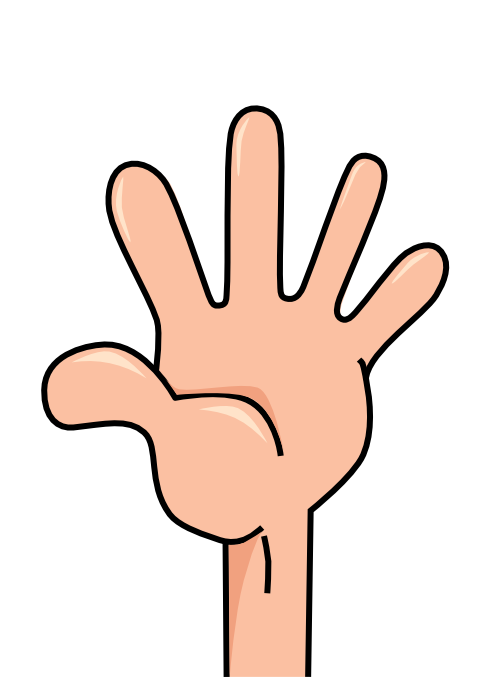
Here are the common fingering notations I've encounter over the course of my studying ukulele and guitar.
Fingering for chords and single notes for the fretting hand are typically expressed using Arabic numbers 1, 2, 3, 4, and T for Thumb.
The confusion comes with the plucking hand. You'll hear the Spanish and Portuguese names that come from the classical guitar world and the English names that are commonly used.

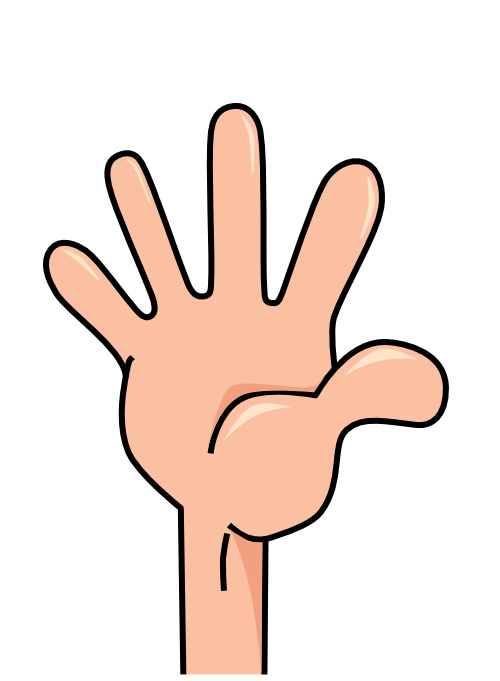
For the plucking hand, in fingerstyle, the Spanish, traditional classical names and what are commonly used, with English names shown below:
- Thumb ( t ), not really a finger but a digit. In classical guitar notation this is Pulgar, Pollex (p)
- Index ( i ) finger. In classical guitar notation Indice, Index (i)
- Middle ( m ) finger. In classical guitar notation Medio, Medius (m)
- Ring ( r ) finger. In classical guitar notation Anular, Aanularius (a)
- Pinky ( p ) finger. In classical guitar notation Mignolo (c, x or e)
Spanish: p i m a, English: t i m r
If you're studying traditional classical guitar repertoire and technique, the classical terms for the right hand are more common. For all else I recommend simply using the English terms or the terms in your native language and eliminate any translation.
Modern Classical Guitar , the repertoire and technique dates back to the mid nineteenth century ( 1800s ). And offers a wealth of information that can be adapted to the ukulele. Which is essentially a small classical guitar in it's construction and technique when played without picks.
When playing all four strings, each finger can handle their own string. On ukulele it's a simple finger-to-string assignment—from nose to toes, your thumb handles string ④, your index finger handles string ③, your middle finger handles string ②, and your ring finger handles string②. A simple one finger to one string assignment. For guitar, there are fifteen possible four-string/four-finger combinations; not all are practical, but all should be explored.
When only playing a three string set you can use the thumb, index, and middle fingers.
For playing string pairs any combination of t i m r is possible depending on the string involved and the musical context.
The final decision as to what fingering combination to use will be a musical one. But it is definitely worth exploring all possible combinations.
The Fingerpicking Series explores these fingering possibilities.
 So, one day I decided to finally get a handle on fingerstyle using my thumb and three fingers. I had developed my "travis" style fingerpicking, where you use your thumb, index and middle fingers. But not "legit" a.k.a. classical fingerstyle.
So, it was during a one hour drive home in a thunderstorm — more like a hurricane, that I practiced, t i m r on the open strings of my Fluke ukulele, which was lying on the passenger seat. No chords, only did t i m r for one hour plus. I focused on getting a clean sound, even volume and tone. Starting S L O W and only after many reps did I increase the tempo. I only did t i m r for the whole hour, no other combinations. I then practiced accenting one of the strings in the sequence. t i m r, t i m r, t i m r, t i m r
Multi String Combinations
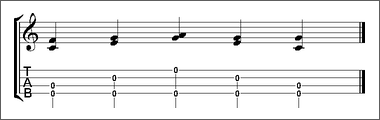
Two finger, multi string example starting on the thumb (t), C tuning with a high G string four.
Two Finger, Multi String Combinations
The two finger combinations can be done using any two fingers: t i, t m and t r. Al are possible for adjacent or non-adjacent strings.
There are only 12 possible two finger, multi string combinations. These are the same as the two finger, single string combinations. The difference here is to play the two strings together, harmonically.
When playing harmonically t i produces the same sound as i t.
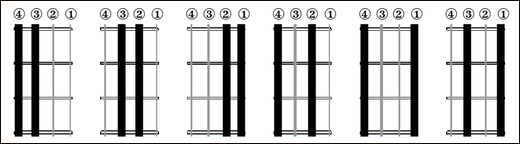
There are six (6) multi-string combinations using two fingers when playing both notes together.
Three Finger, Multi String Combinations
There where 24 possible three finger, single string combinations.
There are four (4) multi-string combinations using three fingers. Explore using different fingering combinations.
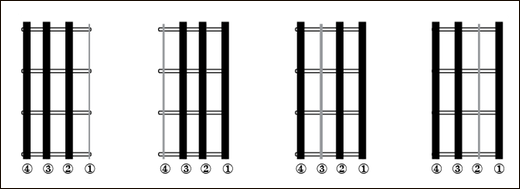
The Only Four Finger, Multi String Combination
There where 24 possible four finger, single string combinations.
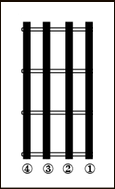
There is only one (1) four string-multi string combination and only one way of playing the four string if not using your pinky: t i m r


End of Lesson - Thanks, Hope You Enjoyed It!
Related Lessons, Videos, Lesson Series, Songs, Books & Reference Charts, Resources & Assets, Workshops are below.