Published:
2003-01-01
Updated:
2023-07-31

Learning Ukulele with Curt

Building Your Core Strums for Ukulele

Rhythm are in-separately linked to strums. Using the Modular Phonetic Rhythm System developed by Chuck Anderson this series of lessons start with the core four strums all ukulele players use and throughly digs in to the many variations possible.

Main Category: Strums Main Instrument: Ukulele

Louis-Martin/Curt-2020-FFUF

6 August 2026

Building Your Core Strums for Ukulele

Rhythm is in-separately linked to strums. Using the Modular Phonetic Rhythm System developed by Chuck Anderson this series of lessons start with the core four strums all ukulele players use and throughly digs in to the many variations possible.

As rhythm is in-separately linked with strums these lessons are suitable for any stringed instrument like guitar, banjo and mandolin capable of playing chords.

14 lessons in the Building Your Core Strums for Ukulele LessonSERIES :

    1

    `Ukulele Strums - Getting Started

    One of the first skills a ukulele player learns is the art and craft of strumming – playing rhythm. This refers to an accompaniment technique suitable for the singer, singer/songwriter or someone who plays a support role for another instrument.

    2

    The Muted Strum

    The muted strum is executed by relaxing the chord hand during the strum. If the chord is a barre, relaxing the pressure is enough to create the percussive, drum like effect. If holding an open chord, the fingers relax but maintain enough finger pressure to get the muted sound. This is what a few players are calling, The Universal Muted Chord. You're utilizing your ukulele as a percussive instrument and there is no discernible pitch - just like a drum. This chord works on any song just as a drum works with any song and does't care what the key is.

    3

    Quarter Note Strum

    Chords and music are organized into bars or measures with the most common number of beats per bar or measure being four. One of the most basic strumming patterns and the foundation for ALL future strumming is the "Quarter Note Strum". As the name implies this strumming pattern is one quarter note per beat.

    As the name implies this strumming pattern is one quarter note per beat. For songs in common "4/4" time where there are four beats per measure or bar. This is one down stroke per beat.

    4

    Quarter Note Strum - Variations

    Building on the basic Quarter Note Strum lessons, here are four variations to get you started.

    5

    Four Famous Core `Ukulele Strums - Pattern One

    For ukulele there are four core, basic strums that will get you started. This is the first of the four core patterns.

    6

    Four Famous Core `Ukulele Strums - Pattern - Pattern Two

    For ukulele and guitar there are four core, basic strums that will get you started. This is the second of the four core patterns.

    7

    Four Famous Core `Ukulele Strums - Pattern - Pattern Three

    For ukulele there are four core, basic strums that will get you started. This is the third of the four core patterns.

    8

    Four Famous Core `Ukulele Strums - Pattern - Pattern Four

    For ukulele, there are four core, basic strums that will get you started. This is the fourth of the four core patterns. This is the famous Island Strum that you will hear a lot in the Ukulele community.

    9

    Four Famous Core `Ukulele Strums - Pattern - Review

    Review of the four core ukulele strums.

    10

    `Ukulele Strums - Core Pattern 4.1

    Another one of the 72 possible strumming patterns based of the Modular Phonetic Rhythm systems level II rhythmic syllables.

    11

    `Ukulele Strums - Core Pattern 4.1T

    Another one of the 72 possible strumming patterns based of the Modular Phonetic Rhythm systems level II rhythmic syllables. The last pattern in this series with the end of the first rhythmic syllable tied to the beginning of the second rhythmic syllable.

    12

    `Ukulele Strums - Core Pattern 6.1

    Another one of the 72 possible strumming patterns based of the Modular Phonetic Rhythm systems level II rhythmic syllables.

    13

    `Ukulele Struming Pattern 6.1T

    Another one of the 72 possible strumming patterns based of the Modular Phonetic Rhythm systems level II rhythmic syllables.

    14

    Learning the Bo Diddley Strum

    The Bo Diddley strum is named after Bo Diddley. Bo Diddley is an American R&B vocalist, guitarist, songwriter ( usually as Ellas McDaniel ), and rock and roll pioneer. He introduced more insistent, driving rhythms and a hard-edged electric guitar sound on a wide-ranging catalog of songs, along with African rhythms and a signature beat (a simple five-accent clave rhythm) that remains a cornerstone of rock and pop.

    This pattern can be played in cut time but should be learned in common time. It is often notated in cut time, making if a bit harder for beginner and intermediate player to learn.

Series Info
ACGCH-UKEC-4part-7th.png

Strums

Ukulele

293 visits

UL126-MPR

Ukulele Strums - Getting Started

Strums are in-separately linked to rhythm. Using the Modular Phonetic Rhythm System developed by Chuck Anderson this series of lessons starts with the core four strums all ukulele players use, need to know and throughly digs into the many variations possible.

UL126-UKESTRUM1

A Guide to Ukulele Strums

Learn a variety of strums and rhythmic patterns in wide range of musical styles. A strum refers to an accompaniment technique suitable for the singer, singer - songwriter or someone who plays a support role for another instrument.

UL126-UKESTRUM1-12-8

12/8 Strum

The 12/8 Strum has application in Blues, Broadway, and 50’s Ballads.

UL125b-I-VI-II-V

Basic I VI II V Introduction in Key of C

A common variation of the** I V **chord progression and introduction: C Am Dm G

UL125c-Basie

Basie Ending

The Count Basie ending is one of the most recognizable endings in classic jazz. It is simple, effective and one ending that all gigging jazz musicians must know.

UL125c

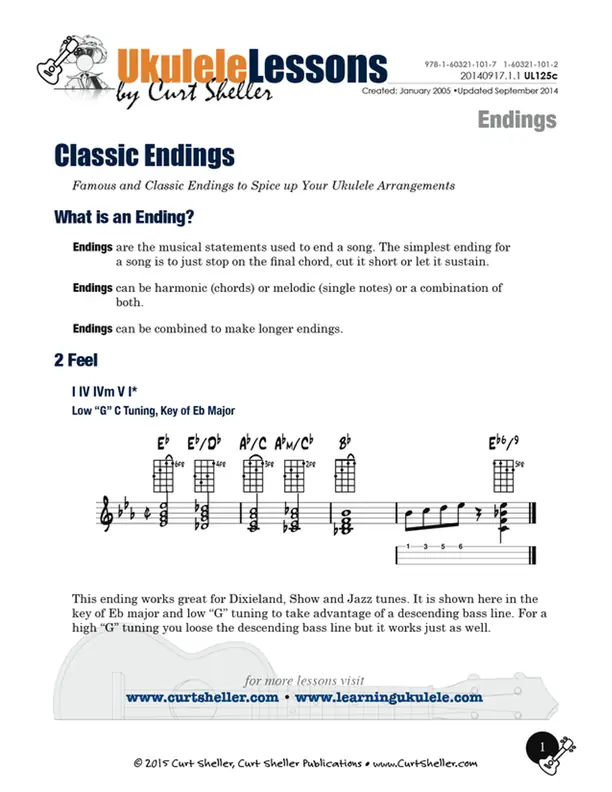
Classic Endings for `Ukulele

Two Feel, bVImaj7 bIImaj7, Basie Ending, Single, Double and Triple Tags, Chromatic, Take 'A' Train Ending, Shave and a Hair Cut, Lawrence Welk Ending. These are common classic songs ending that are used over and over in the standard song repertoire.

UL125b

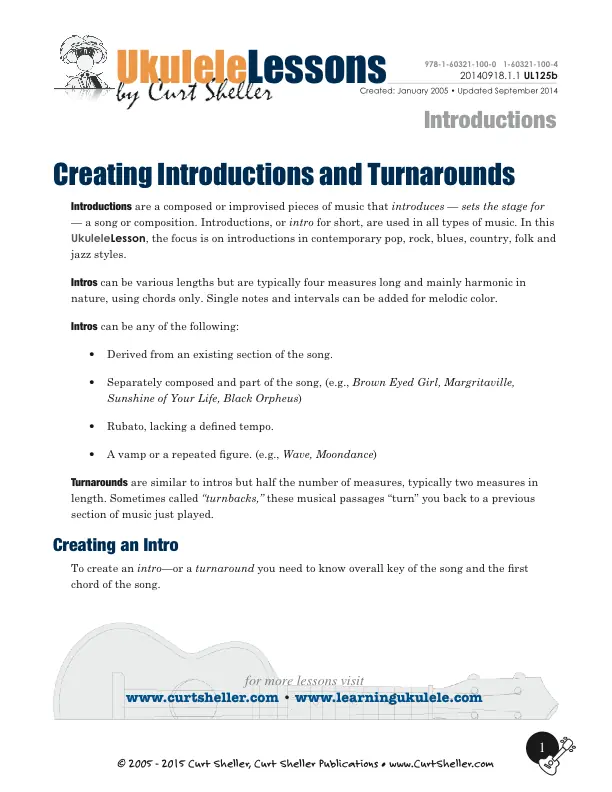
Creating Introductions and Turnarounds for `Ukulele

Introductions are a composed or improvised pieces of music that introduce - sets the stage for - a song or composition. Introductions, or intro for short, are used in all types of music. In this lesson, the focus is on introductions in contemporary pop, rock, blues, country, folk and jazz styles.


UL125b-Intro-I-V

Creating Intros, Basic I V on C Major

A basic I V introduction in the key of C major: C to G or G7. The Tonic to Dominant.

UL125b-I-Idim7-II-V

I Idim7 II V Introduction in Key of C

"I Idim7 II V in key of C" — A classic introduction and chord progression utilized in show tunes and old-time music.

UL125a

Melody and Chord Tips

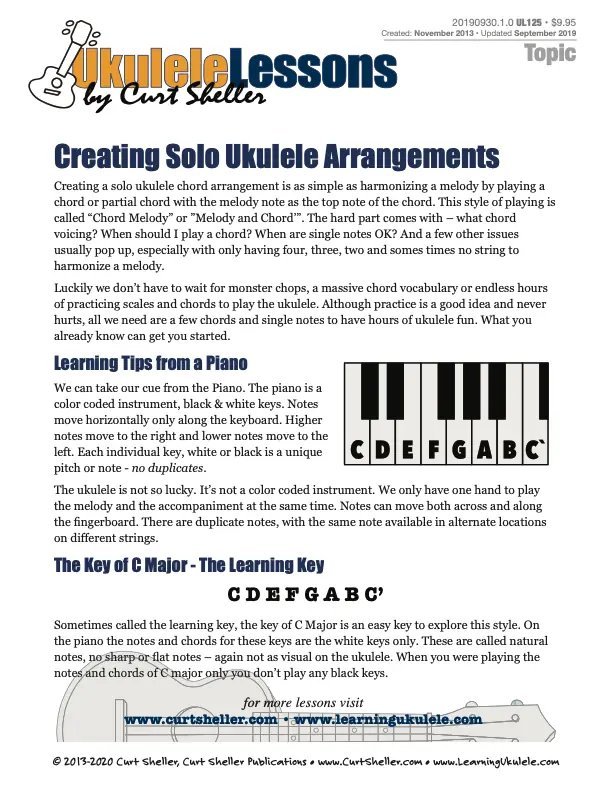
Creating "Melody and Chord Arrangements", in theory are as simple as harmonizing the melody with a chord. Which is playing a chord that has the melody note as the top note of the chord voicing. In practice it is a little more involved, but not much more.

UL126-MPR-L2-4-of-6

Rhythm and Strums Level II Rhythmic Pairs - Lesson Three

Level II Rhythmic Syllables 4 of 6 from the Modular Phonetic Rhythm, The Foundation and Workbook 1 book.

UL126-MPR-L2-3-of-6

Rhythm and Strums Level II Rhythmic Pairs - Lesson Two

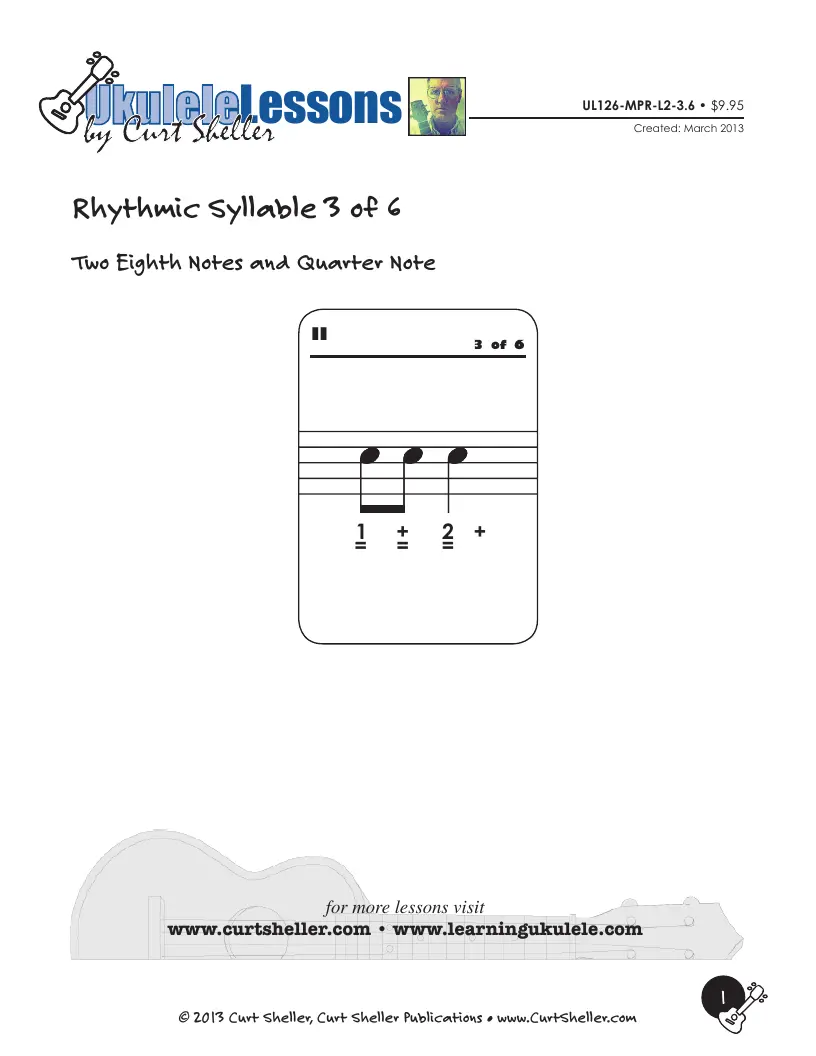
Level II Rhythmic Syllables 3 of 6 from the Modular Phonetic Rhythm, The Foundation and Workbook 1 book.

UW-UKESTRUM1

Essential Strums for Ukulele - A Guide to Ukulele Strums

Don't know what to play or tired of playing the same old down-up-down-up strums? One of the first skills a ukulele player learns is the art and craft of strumming, playing rhythm. This refers to an accompaniment technique suitable for the singer-songwriter or someone who plays a support role for another instrument.
UW-RHYTHM

Rhythm, Avoid at Your Own Peril

The often neglected and taken for granted subject of "Rhythm". Music is Melody, Harmony, and "Rhythm." We are drawn, initially to music by melody at a very early age, with the instrument of our voice. With ukulele you typically learn chords - the harmony and never really dive into learning rhythm. Unless you're a drummer we take rhythm for granted.