Published:
2003-01-01
Updated:
2023-06-08
Learning Ukulele with Curt
Reading for Ukulele - The Next Steps
Reading can be thought of on many different levels. 1) the ability to slowly and painfully work out the written music. 2) the ability to hear the music by looking at the notation. 3) the ability to notate your ideas in standard music notation. 4) the ability to read music as you read a book or an article. 5) the ability to communicate with other musicians in the written language of music. 6) the ability to learn songs that you have never heard.
Main Category: Reading Main Instrument: Ukulele

6 August 2026
The skill of Reading Music can be understood and approached in various ways. Here are several levels to consider: 1) The ability to painstakingly decipher written music, even if it is a slow and challenging process. 2) The ability to mentally hear the music by looking at the musical notation. 3) The capacity to notate your musical ideas using standard music notation. 4) The skill to read music fluently, similar to reading a book or an article, where the notation is comprehended effortlessly. 5) The capability to communicate with other musicians using the written language of music, enabling effective collaboration and sharing of musical ideas. 6) The aptitude to learn and perform songs that you have never heard before solely by reading the written music.
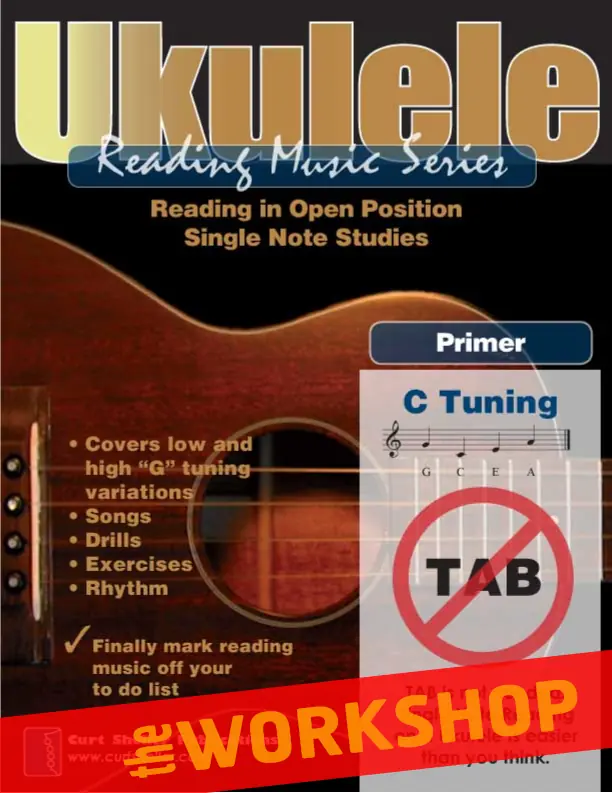
NOTE: This series of lessons serves as a continuation from the Reading Music on Ukulele – Primer
course, which focused on reading music in the open position. The lessons in this series are designed for advanced learners, aiming to enhance your reading skills to a professional level. Through these lessons, you will develop a high level of proficiency and confidence in reading music notation.
9 lessons in the Reading for Ukulele - The Next Steps LessonSERIES :
Reading for `Ukulele - Lesson Two, Note Recognition
Once you understand the basic concept of reading, it’s time to get down to the development of the skills. We know our goal is to read music as well as we read words. Now, how do we get there?
Note Recognition - If you can’t recognize the notes on the staff, you certainly can’t read them. For anyone who is past this step, great! But in many cases, the recognition of notes on the staff is not as good as it should be. If you can’t read music, this skill doesn’t exist at all.
Reading for `Ukulele - Lesson Three, Open Position
Now that you can recognize the notes on the staff in the Treble clef, it’s time to start connecting that knowledge to the ukulele.
One of the most significant problems in reading for the ukulele, is that many of the same notes can be found in multiple locations on the neck. For example, the same A note is an open string one, string two - fret (5) and string three, fret (9) and if using a high G tuning - string four fret (2). The only way to cut down this complexity is to organize the ukulele into positions where this duplication is either eliminated or at least, minimized.
We’re going to begin by isolating the first position. The first position is all the notes falling between string four and string one, from frets one through four. Open position includes these same notes but also takes advantage of open strings.
Reading for `Ukulele - Lesson Four, Key Signatures, Sharps
This lessons covers the natural symbol and the sharp key signatures keys.
In musical notation, a key signature is a collection of sharp or flat symbols placed together on the staff. Key signatures are generally written immediately after the clef at the beginning of a line of musical notation, although they can appear in other parts of a score, notably after a double barline. A key signature is use to indicate the “auto sharping or flatting of specified notes. Key signatures are also used to identify the key of a composition.
Although a key signature may be written using any combination of sharp and flat symbols, about a dozen diatonic key signatures are by far the most common, and their use is assumed in much of this article. A piece scored using a single diatonic key signature and no accidentals contains notes of at most seven of the twelve pitch classes, which seven being determined by the particular key signature.
Reading for `Ukulele - Lessons Five, Key Signatures, Flats
This lessons covers the natural symbol and the flat key signatures keys.
In musical notation, a key signature is a collection of sharp or flat symbols placed together on the staff. Key signatures are generally written immediately after the clef at the beginning of a line of musical notation, although they can appear in other parts of a score, notably after a double barline. A key signature is use to indicate the auto sharping or flatting of specified notes. Key signatures are also used to identify the key of a composition.
Although a key signature may be written using any combination of sharp and flat symbols, about a dozen diatonic key signatures are by far the most common, and their use is assumed in much of this article. A piece scored using a single diatonic key signature and no accidentals contains notes of at most seven of the twelve pitch classes, which seven being determined by the particular key signature.
Reading for `Ukulele - Lesson Six, Ties
This lessons's work will advance rhythm by introducing Ties. Many ukulele players can find the notes on their instrument but can't read rhythm with enough accuracy and speed to be considered "sight readers". Remember that sight reading is just a level of reading. It's not some special and mysterious skill. When you read a book or magazine, you don't have to "work out" the words before you "read" them. You just read them.
Series Info
Reading
Ukulele
677 visits