
Published:
2014-02-18
Updated:
2025-07-28
Learning Ukulele with Curt
Reading for `Ukulele - Lesson Three, Open Position
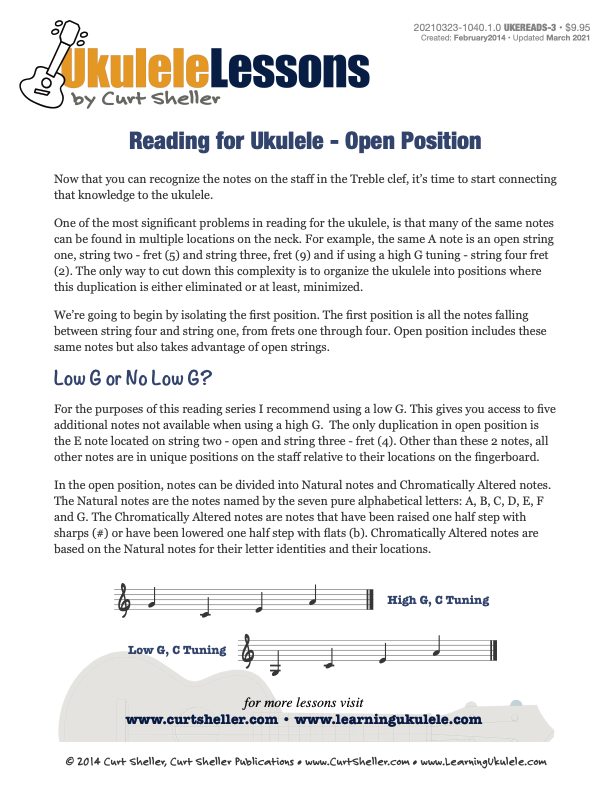
Now that you can recognize the notes on the staff in the Treble clef, it’s time to start connecting that knowledge to the ukulele. One of the most significant problems in reading for the ukulele, is that many of the same notes can be found in multiple locations on the neck. For example, the same A note is an open string one, string two - fret (5) and string three, fret (9) and if using a high G tuning - string four fret (2). The only way to cut down this complexity is to organize the ukulele into positions where this duplication is either eliminated or at least, minimized.
Author(s): Curt Sheller Publisher: Curt Sheller Publications Code: UKEREAD1S-3
Main Category: Reading Main Instrument: Ukulele
Categories: Chords

2026-08-23
RelatedLessonAssets
Number of Pages: 14
If you're a registered site member and have the correct permissions you can view ALL the pages of this PDF at a larger size using the LearningUkulele.com Online PDF Viewer (button below).
Download PDFThis Download IS part of your Gold Site Access and a FREE download. Thanks for supporting the site. — Curt
Each PDF file is a professionally prepared, formatted, high resolution file that prints out great. You'll need a PDF Reader or application capable of viewing PDF files to view the PDF.
NOTE: Download the current PDF file for the latest, complete, and most up-to-date version. As well as additional information not presented on-line.
Now that you can recognize the notes on the staff in the Treble clef, it’s time to start connecting that knowledge to the ukulele.
One of the most significant problems in reading for the ukulele, is that many of the same notes can be found in multiple locations on the neck. For example, the same A note is an open string one, string two - fret (5) and string three, fret (9) and if using a high G tuning - string four fret (2). The only way to cut down this complexity is to organize the ukulele into positions where this duplication is either eliminated or at least, minimized.
We’re going to begin by isolating the first position. The first position is all the notes falling between string four and string one, from frets one through four. Open position includes these same notes but also takes advantage of open strings.


End of Lesson - Thanks, Hope You Enjoyed It!
Related Lessons, Videos, Lesson Series, Songs, Books & Reference Charts, Resources & Assets, Workshops are below.
Related Related Series
Related Related Series for Reading for `Ukulele - Lesson Three, Open Position

Reading Music on Ukulele - Primer
In the realm of music, there are certain aspects that students and players often tend to avoid. These include skills such as learning to read music and familiarizing themselves with the notes on their instrument. While these tasks may seem challenging, particularly on the fretted string instruments, they are comparatively easier on the ukulele. With the appropriate guidance and a well-defined plan, mastering these skills can be a smooth and achievable process.


Six Secrets of Ukulele Fingering Series
Learn the six fingering principles to navigating the ukulele fingerboard. Fingering is one of the most universal topics. Whether your style is Rock, Blues, Country, Jazz or Classical, these principles will improve your technique, your solos, even your sight reading. Think of fingering as a series of pathways. When you learn to connect these pathways, there are benefits not only to technique but also to creativity. All fingering on the ukulele can be reduced to 6 principles of motion. Each principle has physical and musical characteristics that you can use to improve your playing.