Published:
2025-06-09
Updated:
2025-06-09
Learning Ukulele with Curt
Six Secrets of Ukulele Fingering Series
Learn the six fingering principles to navigating the ukulele fingerboard. Fingering is one of the most universal topics. Whether your style is Rock, Blues, Country, Jazz or Classical, these principles will improve your technique, your solos, even your sight reading. Think of fingering as a series of pathways. When you learn to connect these pathways, there are benefits not only to technique but also to creativity. All fingering on the ukulele can be reduced to 6 principles of motion. Each principle has physical and musical characteristics that you can use to improve your playing.
Main Category: Fingering Main Instrument: Fingering

6 August 2026
RelatedSeriesAssets
Learn the six fingering principles to navigating the ukulele fingerboard. Fingering is one of the most universal topics. Whether your style is Rock, Blues, Country, Jazz or Classical, these principles will improve your technique, your solos, even your sight reading. Think of fingering as a series of pathways. When you learn to connect these pathways, there are benefits not only to technique but also to creativity. All fingering on the ukulele can be reduced to 6 principles of motion. Each principle has physical and musical characteristics that you can use to improve your playing.
5 lessons in the Six Secrets of Ukulele Fingering Series LessonSERIES :
Six Secrets of Ukulele Fingering - Hand Position
Efficiency of motion and energy is the key to technique. The thumb should be flat against the back of the neck approximately under the first or second finger. The exact position varies with thumb, neck and hand size. The thumb pushes up against the neck while the fingers press down.
Series Info
Fingering
Fingering
220 visits
Reading Music on Ukulele Series - Reading in Open Position, Alternate Note Locations
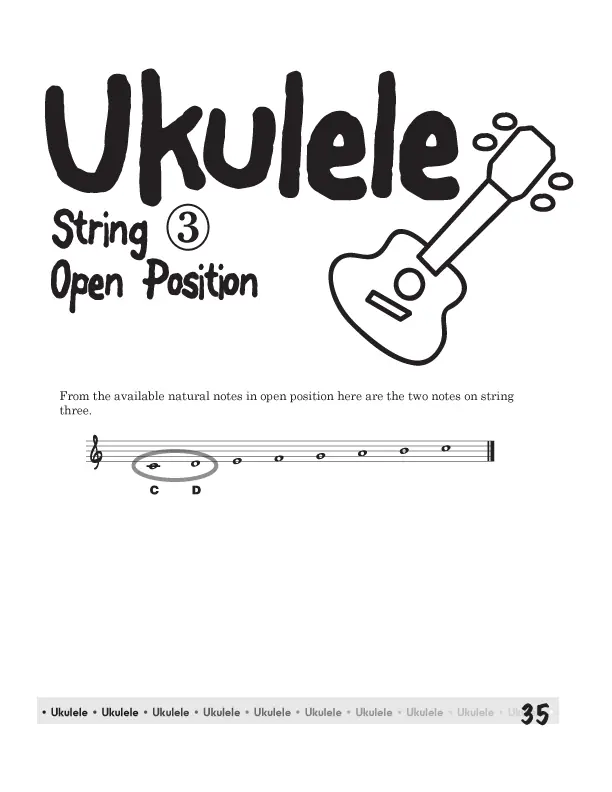
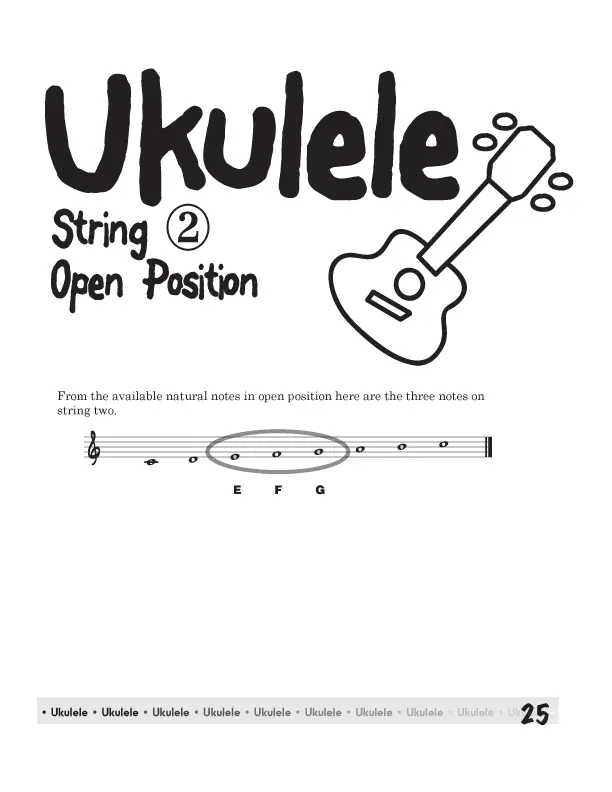
One of the reasons it is hard to read music on the guitar and the ukulele is, alternate note locations. In the open position there is one alternate note location. The open E, string two can also be played on string three, fret (3). If there is no overwhelming musical reason to play one location vs. the other. Then play the one that is easier to play. Use your ear as the final judge as to which one you prefer.
Reading Music on Ukulele Series - Reading in Open Position, Songs
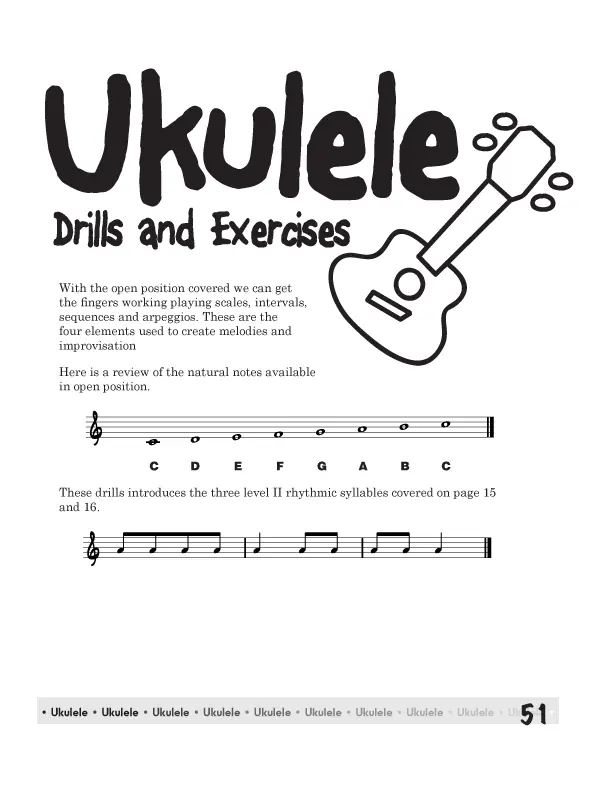
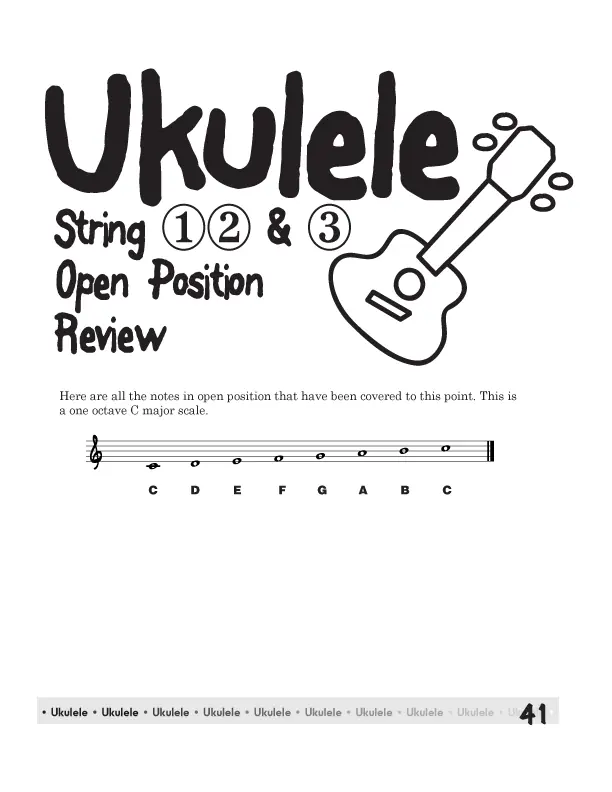
The following songs can be played in open position using the natural notes covered in the previous lessons of this primer. These songs do not use any signatures, no time signature or key signature is shown. All songs are played with a quarter note taking one beat.
Reading Music on Ukulele Series - Reading in Open Position, What About String Four?
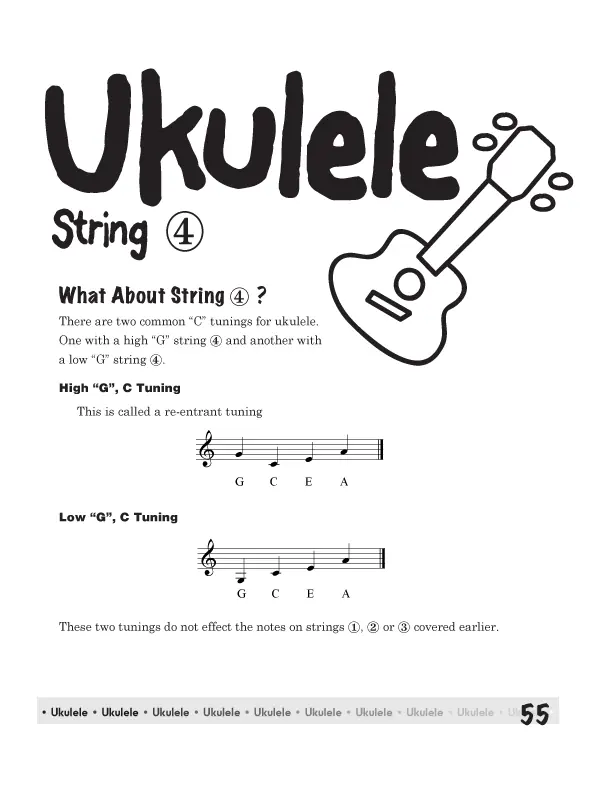
"C Tuning, Low G", extends the melodic range to G below middle C. This expanded range allows for a wider selection when selecting songs to play. The G, A and B are the same names as a high string four but sounding one octave lower.


Reading Music on `Ukulele Series - Reading in Open Position
This series of lessons will allow you finally, to check that Reading item off your music To Do list. Learning to read standard music notation opens a world of music to you. Music notation is the Lingua franca of amateur and professional musicians alike.
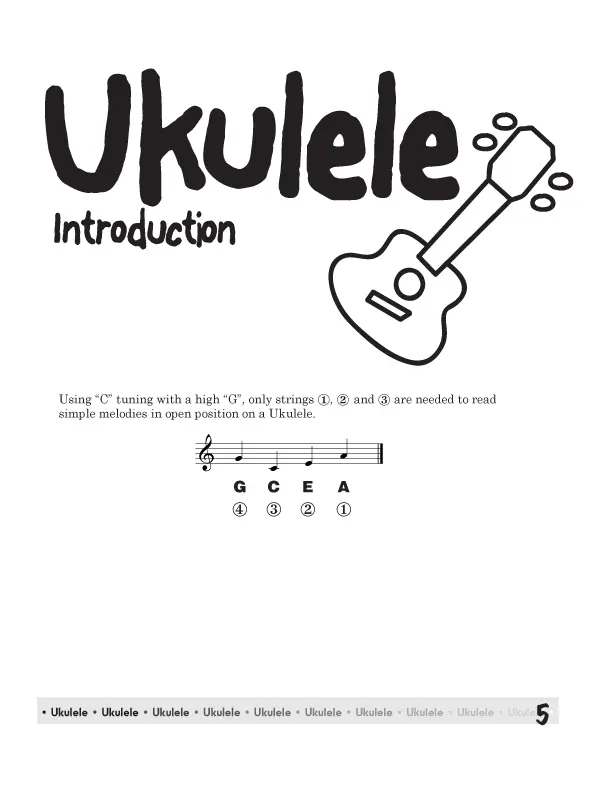
Reading Music on `Ukulele Series - Reading in Open Position, Introduction
There are a few things in music that students and players avoid. These are things like learning to read and knowing the notes of their own instrument. It is hard on guitar - but not so hard on ukulele. With the right guidance and plan of attack. IT IS EASY. It is really quite easy on a uke. Starting with natural notes in in the open position you can finally check off the Reading Music to do item. Learning to read standard music notation is really, really easy.
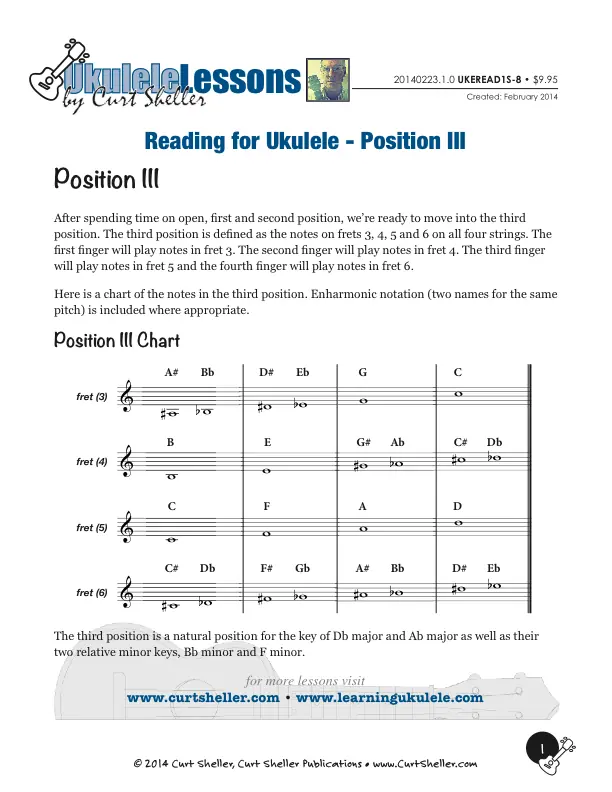
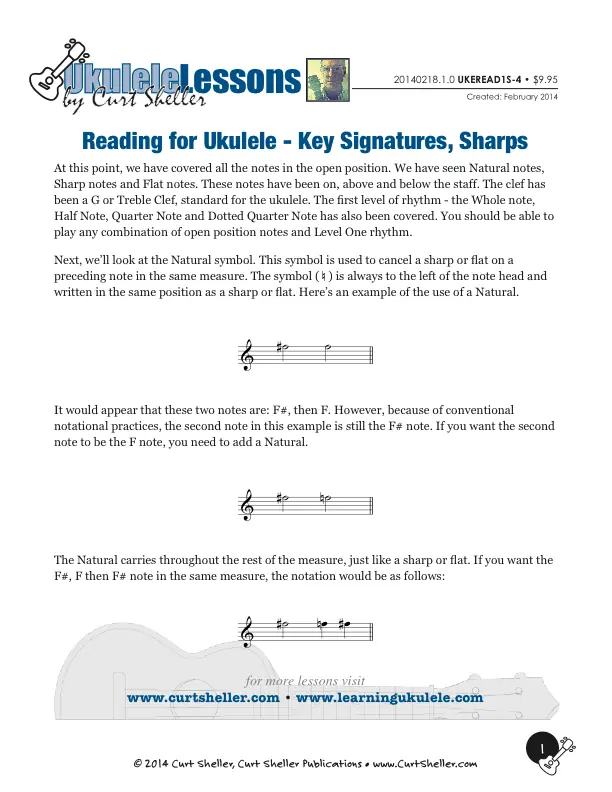
Reading for `Ukulele - Lesson Four, Key Signatures, Sharps
This lessons covers the natural symbol and the sharp key signatures keys. In musical notation, a key signature is a collection of sharp or flat symbols placed together on the staff. Key signatures are generally written immediately after the clef at the beginning of a line of musical notation, although they can appear in other parts of a score, notably after a double barline. A key signature is use to indicate the “auto sharping or flatting of specified notes. Key signatures are also used to identify the key of a composition.

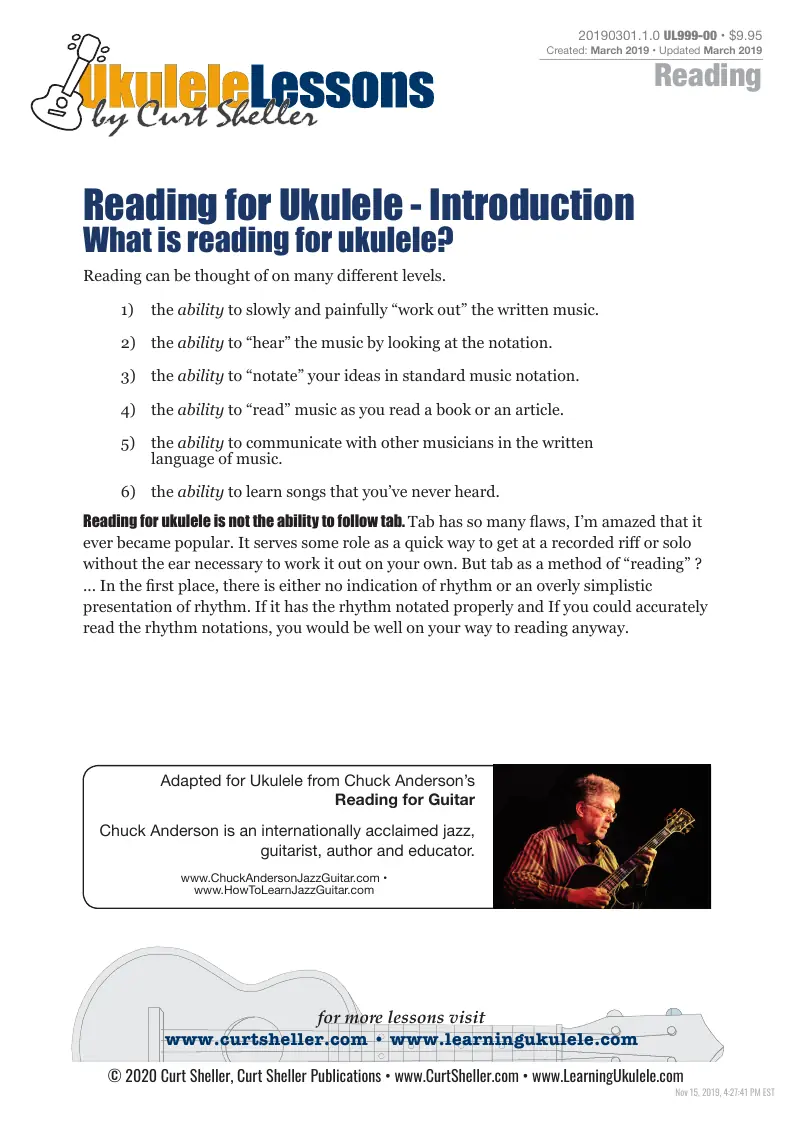
Reading for `Ukulele - Lesson One, Introduction
This is a series of lessons for reading music for ukulele at a pro level. Reading can be thought of on many different levels. 1) the ability to slowly and painfully “work out” the written music. 2) the ability to “hear” the music by looking at the notation. 3) the ability to “notate” your ideas in standard music notation. 4) the ability to “read” music as you read a book or an article. 5) the ability to communicate with other musicians in the written language of music. 6) the ability to learn songs that you’ve never heard.
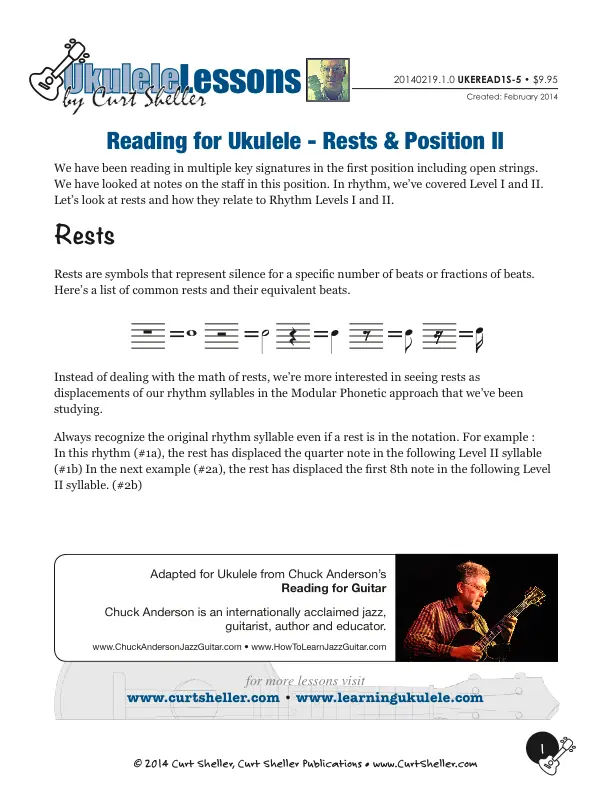
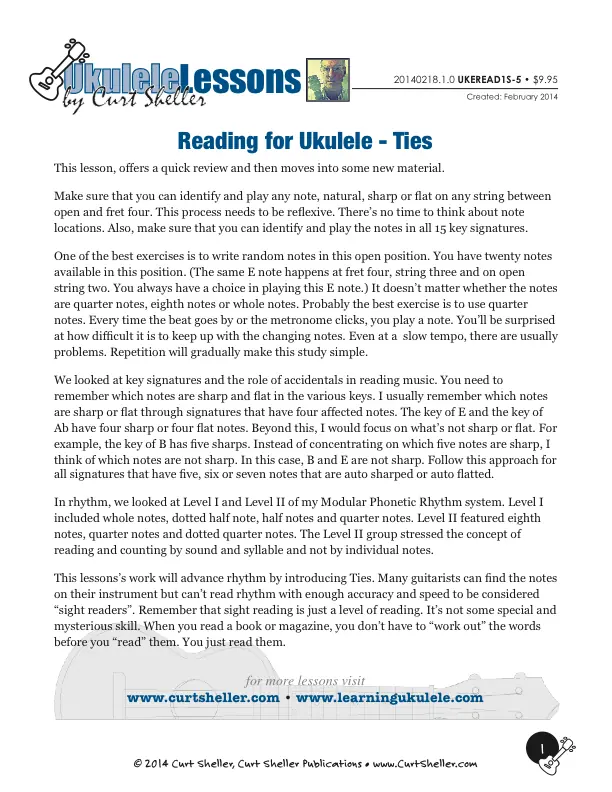
Reading for `Ukulele - Lesson Six, Ties
This lessons's work will advance rhythm by introducing Ties. Many ukulele players can find the notes on their instrument but can't read rhythm with enough accuracy and speed to be considered "sight readers". Remember that sight reading is just a level of reading. It's not some special and mysterious skill. When you read a book or magazine, you don't have to "work out" the words before you "read" them. You just read them.

Reading for `Ukulele - Lesson Three, Open Position
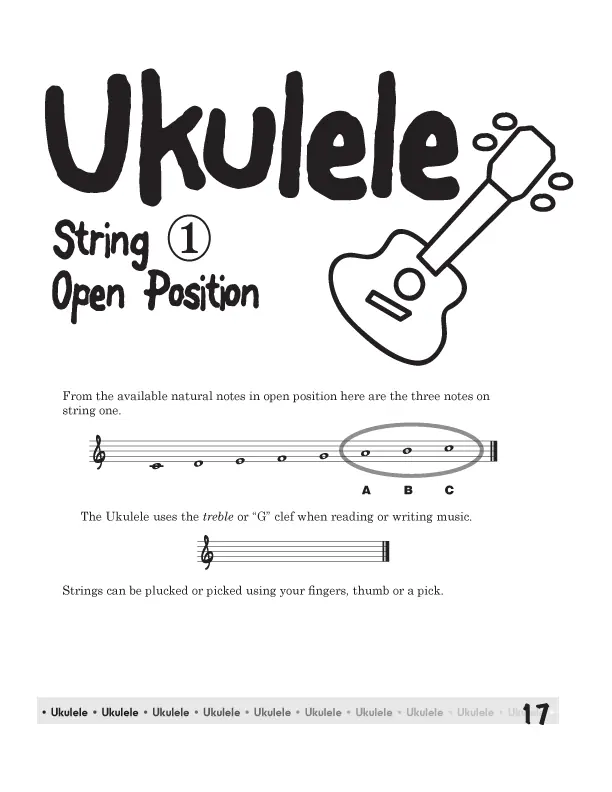
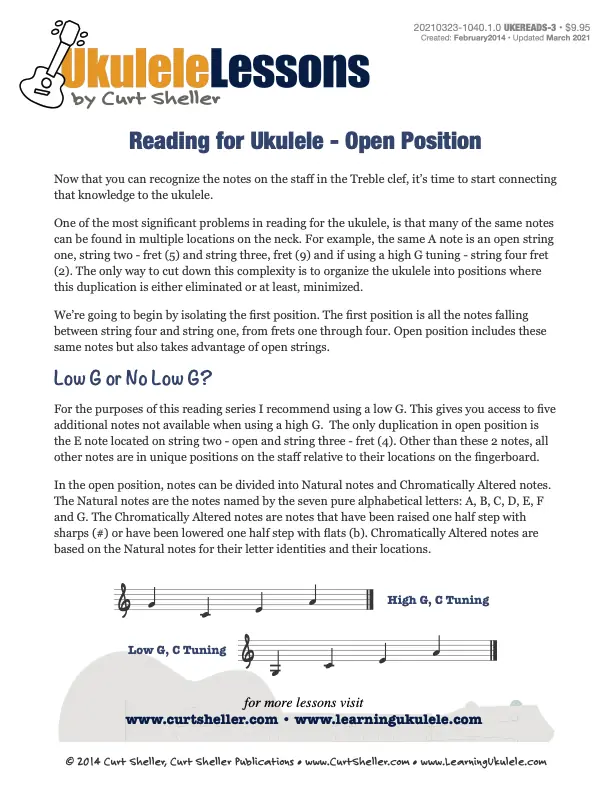
Now that you can recognize the notes on the staff in the Treble clef, it’s time to start connecting that knowledge to the ukulele. One of the most significant problems in reading for the ukulele, is that many of the same notes can be found in multiple locations on the neck. For example, the same A note is an open string one, string two - fret (5) and string three, fret (9) and if using a high G tuning - string four fret (2). The only way to cut down this complexity is to organize the ukulele into positions where this duplication is either eliminated or at least, minimized.
Reading for `Ukulele - Lesson Two, Note Recognition
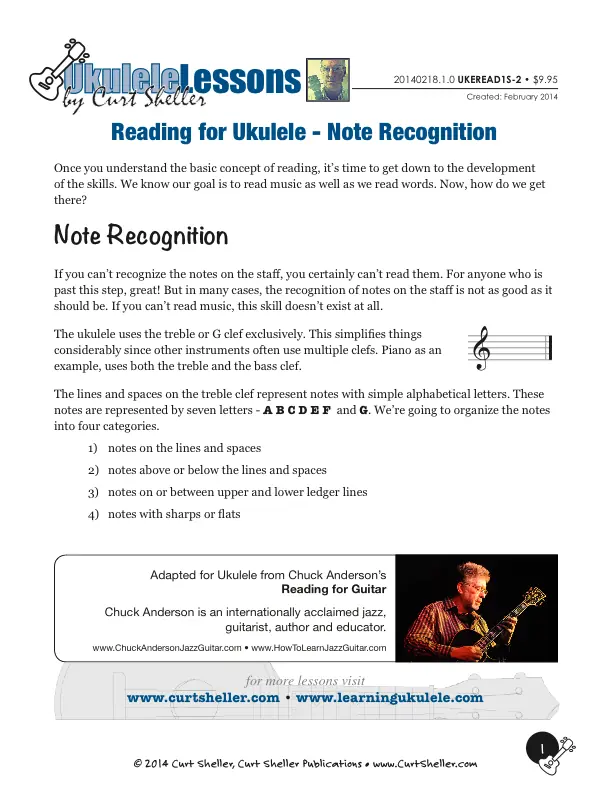
Once you understand the basic concept of reading, it’s time to get down to the development of the skills. We know our goal is to read music as well as we read words. Now, how do we get there? Note Recognition - If you can’t recognize the notes on the staff, you certainly can’t read them. For anyone who is past this step, great! But in many cases, the recognition of notes on the staff is not as good as it should be. If you can’t read music, this skill doesn’t exist at all.
Reading for `Ukulele - Lessons Five, Key Signatures, Flats
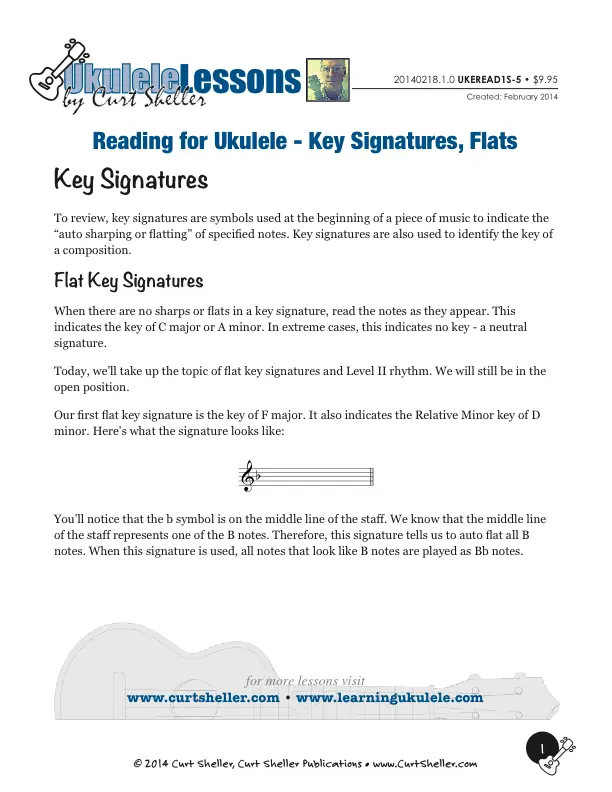
This lessons covers the natural symbol and the flat key signatures keys. In musical notation, a key signature is a collection of sharp or flat symbols placed together on the staff. Key signatures are generally written immediately after the clef at the beginning of a line of musical notation, although they can appear in other parts of a score, notably after a double barline. A key signature is use to indicate the “auto sharping or flatting of specified notes. Key signatures are also used to identify the key of a composition.