
Published:
2005-01-02
Updated:
2020-04-06
Learning Ukulele with Curt
`Ukulele Strums - Getting Started
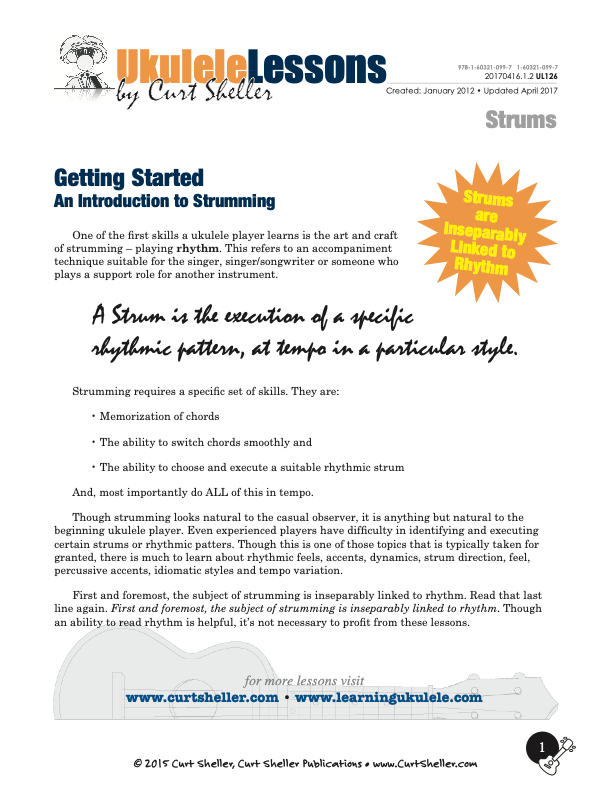
One of the first skills a ukulele player learns is the art and craft of strumming – playing rhythm. This refers to an accompaniment technique suitable for the singer, singer/songwriter or someone who plays a support role for another instrument.
Author(s): Curt Sheller Publisher: Curt Sheller Publications Code: UL126
Main Category: Strums Main Instrument: Ukulele
Categories: Basics, Chords, Rhythm, Strums, Technique

2026-08-23
RelatedLessonAssets
Show Series Lessons
Series Home
Number of Pages: 6
If you're a registered site member and have the correct permissions you can view ALL the pages of this PDF at a larger size using the LearningUkulele.com Online PDF Viewer (button below).
Download PDFThis Download IS part of your Gold Site Access and a FREE download. Thanks for supporting the site. — Curt
Each PDF file is a professionally prepared, formatted, high resolution file that prints out great. You'll need a PDF Reader or application capable of viewing PDF files to view the PDF.
NOTE: Download the current PDF file for the latest, complete, and most up-to-date version. As well as additional information not presented on-line.
One of the first skills a ukulele player learns is the art and craft of strumming – playing rhythm. This refers to an accompaniment technique suitable for the singer, singer/songwriter or someone who plays a support role for another instrument.
A Strum is the Execution of a specific Rhythmic pattern, at Tempo in a particular Style.
Strumming requires a specific set of skills. They are:
- Memorization of chords
- The ability to switch chords smoothly and
- The ability to choose and execute a suitable rhythmic pattern
Execution
For instruments such as Ukulele, Guitar, Piano, Mandolin, and Banjo capable of play harmonically, i.e., Chords. Getting the strings going can be accomplished by striking all the strings at once with a pick or plectrum or fingerstyle plucking all the strings at once.
Rhythmic
Rhythm — I have used and still use use the Modular Phonetic Rhythm, The Foundation and Workbook 1 by Chuck Anderson. With great success, pretty much guaranteed success.
More `Ukulele Strums - Getting Started
content below, continue exploring...
More `Ukulele Strums - Getting Started
Tempo
Tempo — And, most importantly do ALL of this in tempo.
Style
Style — Style is the Rhythmic patterns that are particular to that style as well as the technique to execute those patterns.
Harmonically, Chords
Though strumming looks natural to the casual observer, it is anything but natural to the beginning ukulele player. Even experienced players have difficulty in identifying and executing certain strums or rhythmic patters. Though this is one of those topics that is typically taken for granted, there is much to learn about rhythmic feels, accents, dynamics, strum direction, feel, percussive accents, idiomatic styles and tempo variation.
First and foremost, the subject of strumming is inseparably linked to rhythm. Read that last line again. First and foremost, the subject of strumming is inseparably linked to rhythm. Though an ability to read rhythm is helpful, it’s not necessary to profit from these lessons.
A Note Regarding Learning Strums and Rhythm
Many people fall into the trap of mixing up play by ear with learning by ear. Learning by ear is a hit and miss, hunt and peck proposition with more misses than hits.
The goal is to play and perform with the inner ear in control - that is “Playing by Ear”. Learning is better suited with a system and plan of attack.
I've seen it way too many times with my own private students. They insist on trying to learn a specific strumming pattern by their intrinsic stroke directional pattern — the down and up pattern. For only the basic, simplest of strums this might work at times. But, it falls apart for really learning rhythm, which is directly linked to strumming. It is helpful when training the strumming hand to place to emphasis on the downbeats or pulse of music with a down stoke.
Cutting to the Chase — You CAN learn any rhythmic pattern by it's standard music notation and the counting pattern used to recreate the sound of the pattern. What this does is allows you a method to accurately reproduce any pattern on demand — no need to resort to hearing it first. You hear it first with you inner ear and you hands are trained enough to reproduce it on demand. Eyes -> Ear -> Hands.
Personal Quarter Note Triplet
Anecdote
For years, early in my development I had several teachers that tried to teach me the quarter note triple rhythmic pattern by rote. I'd get it in the lesson and 20 minutes after the lesson - at home I wouldn't be able to duplicate what I had learned in the lesson. No fault of the teacher, they just didn't have a system for effectively teaching rhythm and give their students the ability to accurately reproduce any rhythmic pattern on their own without needing a teacher or coach or to even have to hear it first.
Then finally studying with Chuck Anderson, the creator of the Modular Phonetic Rhythm System I now use. In 30 seconds I could play the quarter note triplet and more importantly reproduce it myself — on-demand when needed. Plus even teach it to others. It's all based on learning any rhythmic pattern by knowing how it relates to the beat and the subdivision of the beat. It's actually that simple. The hard part is getting the hands and fingers to get with the show.
I guarantee, that by using this system – you, Will have success.


End of Lesson - Thanks, Hope You Enjoyed It!
Related Lessons, Videos, Lesson Series, Songs, Books & Reference Charts, Resources & Assets, Workshops are below.
A Guide to Ukulele Strums
Learn a variety of strums and rhythmic patterns in wide range of musical styles. One of the first skills a ukulele player learns is the art and craft of strumming, playing rhythm. This refers to an accompaniment technique suitable for the singer, singer - songwriter or someone who plays a support role for another instrument.
Modular Phonetic Rhythm, The Foundation and Workbook 1
Modular Phonetic Rhythm represents a significant advance in the teaching and application of rhythm. Eliminating many inefficient aspects of rhythm education, Modular Phonetic Rhythm streamlines the traditional educational approach, resulting in a reflexive reaction to rhythm.