
Published:
2008-07-12
Updated:
2025-09-29
Learning Ukulele with Curt
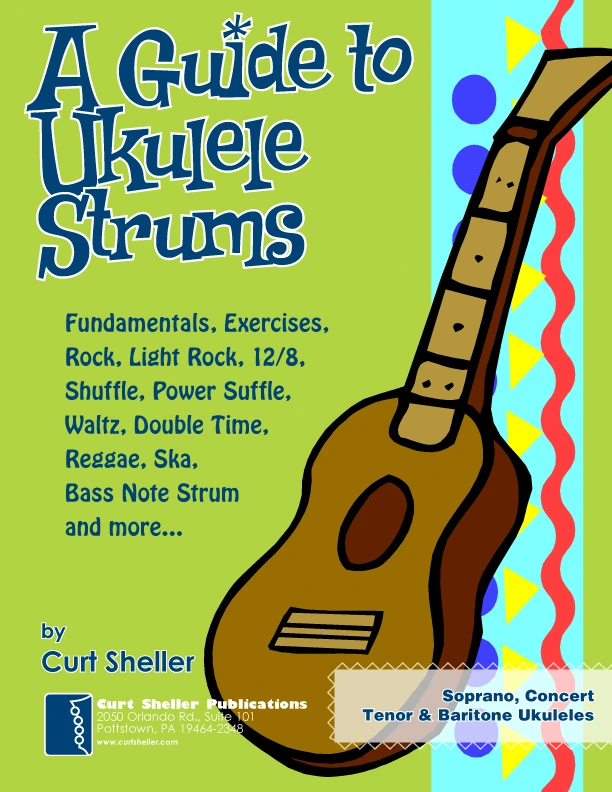
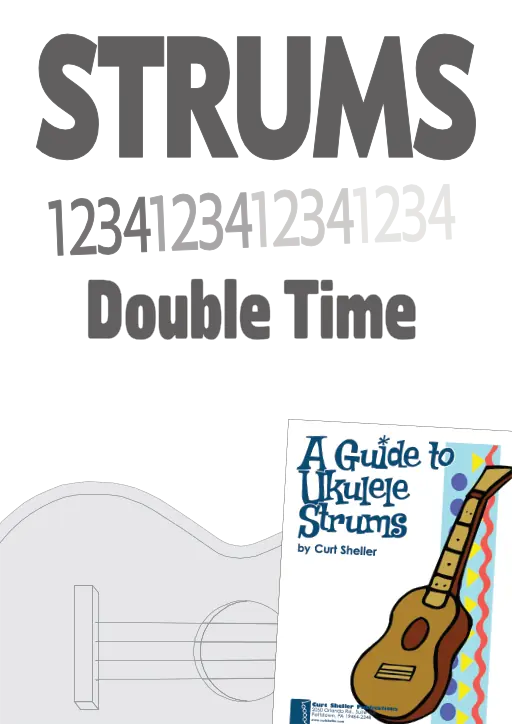
A Guide to Ukulele Strums
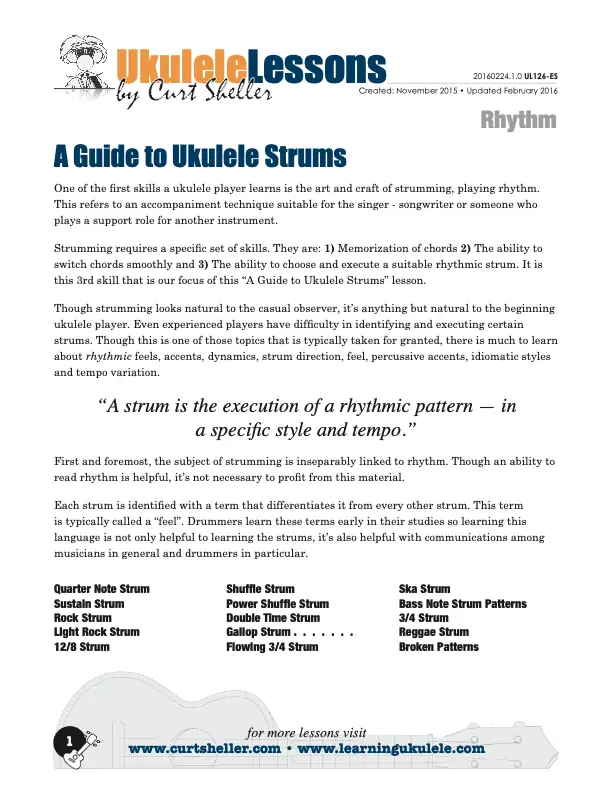
Learn a variety of strums and rhythmic patterns in wide range of musical styles. One of the first skills a ukulele player learns is the art and craft of strumming, playing rhythm. This refers to an accompaniment technique suitable for the singer, singer - songwriter or someone who plays a support role for another instrument.
Author(s): Curt Sheller Publisher: Code: UKESTRUM1
Main Category: Strums Main Instrument: Strums
Categories: Basics, Rhythm, Strums, Beginner, Intermediate

24 June 2026
If you're a registered site member and have the correct permissions you can view ALL the pages of this PDF or Samples pages at a larger size using the LearningUkulele.com Online PDF Viewer.
After purchasing a PDF a download link or PDF link will be sent to you.
This Download is NOT part of your LearningUkulele.com & Learning Ukulele with Curt membership level.
Sign-up for Premium Site Access or Upgrade Your Plan to download this PDF or your can purchase a copy for download
Sign In for Access…Contact Us if there are any issues.
However, if you'd like to support the site even more ❤️ you can buy the PDF.
After purchasing a PDF a download link or PDF link will be sent to you.
Product Info
- Product Code: UKESTRUM1
- Author(s): Curt Sheller
- Publisher(s):
- Published: 12 July 2008
- Updated: 29 September 2025
- ISBN-13: 78-1-60321-019-5
- Size*: Book ANSI A (8.5 x 11 in), PDF A4 (210 x 297 mm)
- Pages: 26
- Hard Copy Price: $15.95
- PDF Price: $7.00
Regarding Book, Lesson and Charts Paper Sizes
• click to Hide more info
• click to Show more info
Starting 2020 LearningUkulele.com & Learning Ukulele with Curt moved to A4 paper sizes for all new books and new editions of books, lessons, and charts.
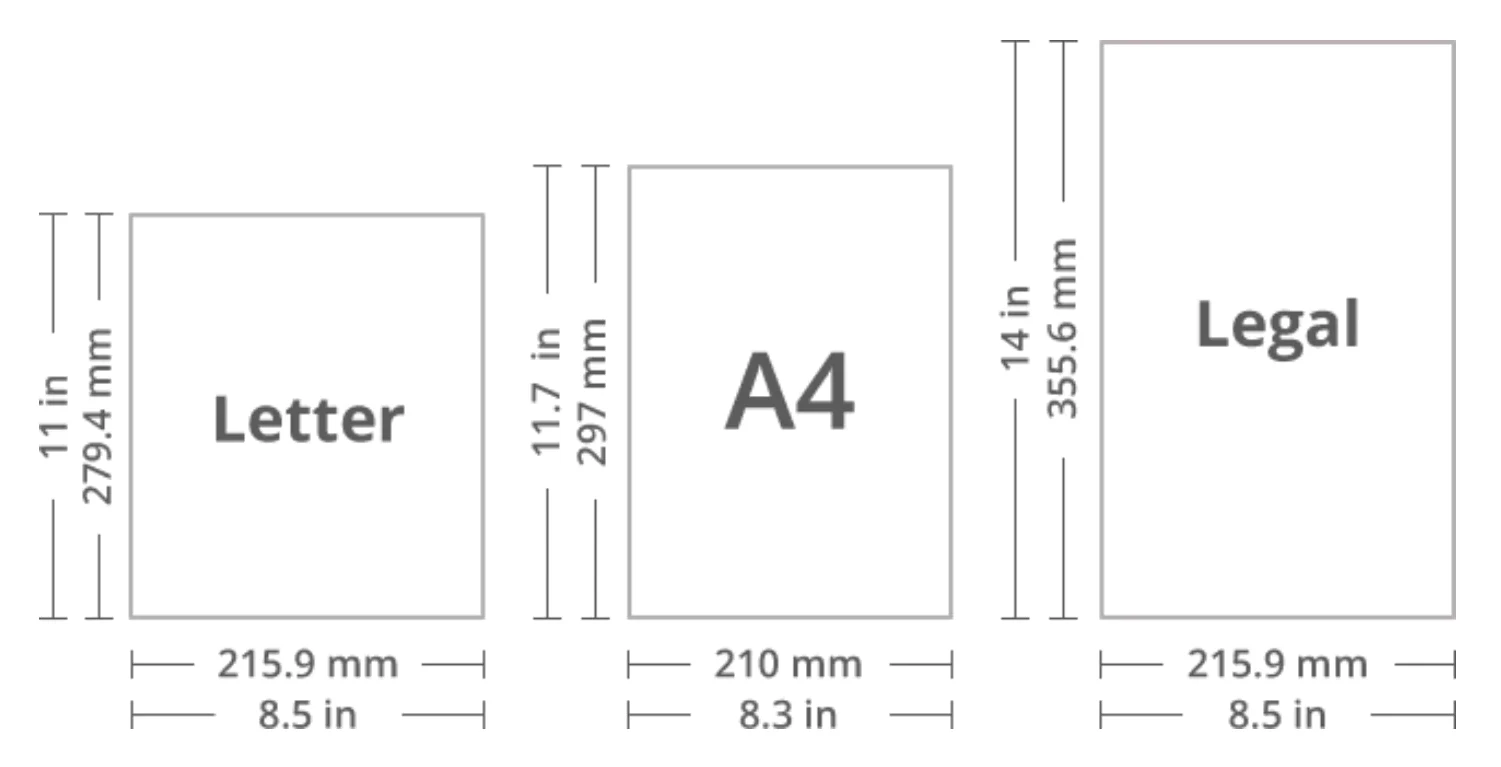
The A Series was adopted in Europe in the 19th century, and is currently used all around the world, apart from in the USA and Canada.
• Decoding Printer Paper Sizes: A4 vs Letter vs Legal. which is Standard?
NOTE: Printing A4 to US Letter Size: As the sizes are relatively close, simple select Scale to Fit
and the A4 size will print out fine.
Learn a variety of strums and rhythmic patterns in wide range of musical styles. One of the first skills a ukulele player learns is the art and craft of strumming, playing rhythm. This refers to an accompaniment technique suitable for the singer, singer - songwriter or someone who plays a support role for another instrument.
One of the first skills a ukulele player learns is the art and craft of strumming, playing rhythm. This refers to an accompaniment technique suitable for the singer, singer - songwriter or someone who plays a support role for another instrument.
Strumming requires a specific set of skills:
- Memorization of chords
- The ability to switch chords smoothly
- The ability to choose and execute a suitable rhythmic strum
It's this 3rd skill that is our focus in A Guide to Ukulele Strums and Rhythmic Patterns.
Though strumming looks natural to the casual observer, it is anything but natural to the beginning ukulele player. Even experienced players have difficulty in identifying and executing certain strums. Though this is one of those topics that is typically taken for granted, there is much to learn about rhythmic feels, accents, dynamics, strum direction, feel, percussive accents, idiomatic styles and tempo variation.
First and foremost, the subject of strumming is inseparably linked to rhythm. Though an ability to read rhythm is helpful, it's not necessary to profit from this material.
Each strum is identified with a term that differentiates it from every other strum. This term is typically called a feel. Drummers learn these terms early in their studies so learning this language is not only helpful to learning the strums, it's also helpful with communications among musicians in general and drummers in particular.
The strums in this book work in any tuning or instrument. Chord examples shown for ukuleles in C tuning.
One strum is different from another based on the stroke direction, the stroke density, the subdivision of the beat and the accent pattern.
Strums covered include: Quarter Note, Sustain, Rock, Light Rock, 12/8, Shuffle, Power Shuffle, Double Time, Gallop, Flowing 3/4, Ska, Bass Note Patterns, 3/4, Reggae and Broken Patterns.
More A Guide to Ukulele Strums
content below, continue exploring...
More A Guide to Ukulele Strums
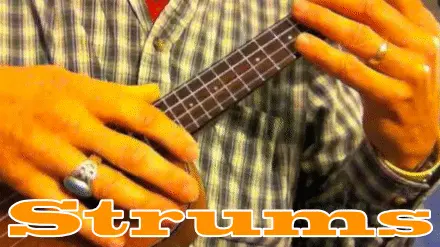
Take a journey learning various strums then cycling back and creating variations and understanding just what makes up a strum.
Strumming patterns will include: Quarter Note, Sustain, Rock, Light Rock, 12/8, Shuffle, Power Shuffle, Double Time, Gallop, Flowing 3/4, Ska, Bass Note Patterns, 3/4, Reggae and Broken Patterns.
“A strum is the execution of a specific rhythmic pattern, in a particular style and tempo.”
We'll explore the statement above and unlock just what is involved when creating a strumming pattern.
Note: Take as much time as needed to master each series of strums before proceeding to a new lesson.
Teaser Videos from 2009
Here is a series of videos I totally forgot I did a long time ago that goes over a few of the strums from my A Guide to Ukulele Strums book.
Intro from Curt Sheller on Vimeo.
Rock Heavy from Curt Sheller on Vimeo.
Rock Light from Curt Sheller on Vimeo.
12/8 from Curt Sheller on Vimeo.
Shuffle from Curt Sheller on Vimeo.
Double Time from Curt Sheller on Vimeo.
Gallup from Curt Sheller on Vimeo.
Ska from Curt Sheller on Vimeo.

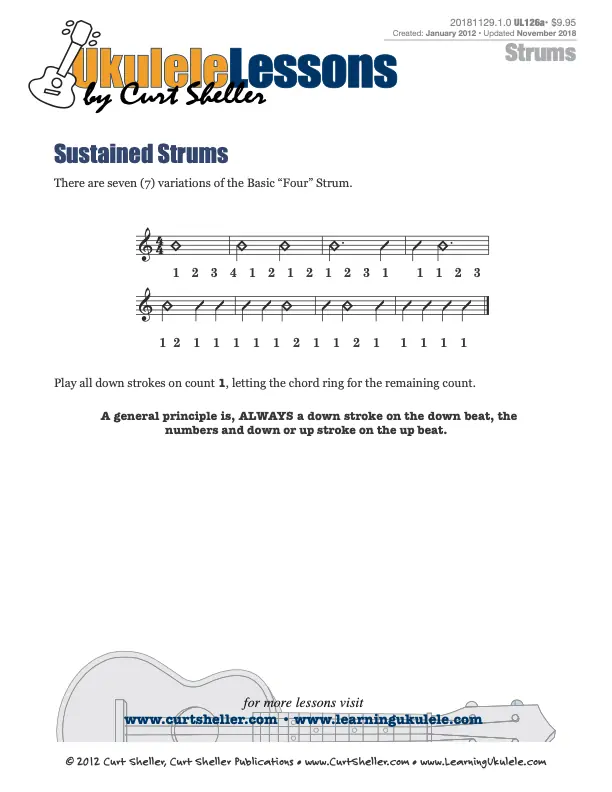
The Sustained Strums
There are the combination of Whole, Dotted Half, Half, and Quarter notes that was typicality Music 101 in elementary school music.
More Strum Lessons to Explore
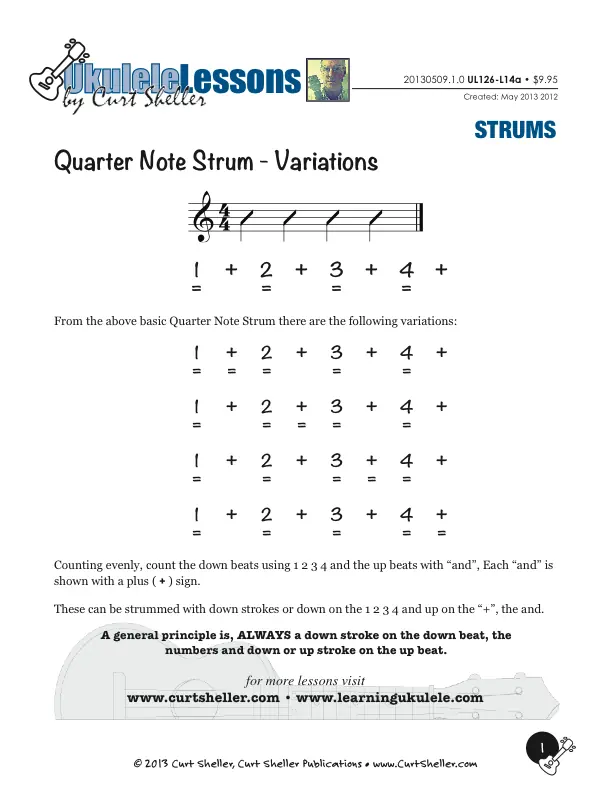
Quarter Note Strum Variations
Taking the Quarter Note Strum we start to sub divide the beats, creating instant variations. Also, I introduce strums indicated using standard music notation–which has been around for hundreds of years.
More Strum Lessons to Explore
- Introduction
- Some Fundamentals
- Preliminary Exercises
- Symbols
- Quarter Note Strum
- Sustain Strum
- Rock Strum
- Light Rock Strum
- 12/8 Strum
- Shuffle Strum
- Power Shuffle Strum
- Double Time Strum
- Gallop Strum
- Flowing 3/4 Strum
- Ska Strum
- Bass Note Strum Patterns
- 3/4 Strum
- Reggae Strum
- Broken Patterns
- Variations
- Modular Phonetic Rhythm
- Conclusion
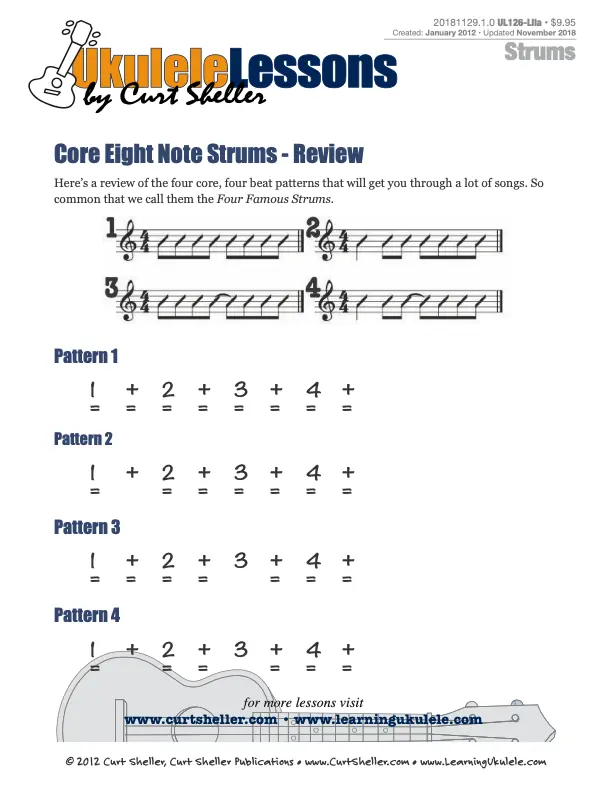
- Appendix 1: Four Famous Strums
- 2025-09-25 1856 – UPDATED
Page numbers in the Table of Contents (TOC) was off.

















































































I Ain't Got Nobody (And Nobody Cares For Me)
"I Ain't Got Nobody" (sometimes referred to as "I'm So Sad and Lonely" or "I Ain't Got Nobody Much") is a popular song and copyrighted in 1915. It was first recorded by Marion Harris, and became a perennial standard, recorded many times over the following generations, in styles ranging from pop to jazz to country music.

I Feel Fine
"I Feel Fine" is a song by the English rock band the Beatles that was released in November 1964 as the A-side of their eighth single. It was written by John Lennon and credited to the Lennon–McCartney partnership. The recording includes one of the earliest uses of guitar feedback in popular music.

I'll Fly Away
"I'll Fly Away"(Roud 18437) is a hymn written between 1929 and 1932 by Albert E. Brumley and published in 1932 by the Hartford Music Company in a collection titled Wonderful Message. Albert took three years to write the song after getting the idea while picking cotton in 1928. Over the years multiple derivative versions have been created and will be licensed for decades to come. Brumley's writing was influenced by the 1924 secular ballad "The Prisoner's Song".

I'll Follow The Sun
"I'll Follow the Sun" is a song by the English rock band the Beatles. It is a ballad written and sung by Paul McCartney and credited to Lennon–McCartney. It was released in 1964 on the Beatles for Sale album in the United Kingdom and on Beatles '65 in the United States. The band played the song on the BBC radio programm Top Gear, and the track was released on On Air – Live at the BBC Volume 2 in 2013.


If I Had A Hammer (The Hammer Song)
"If I Had a Hammer (The Hammer Song)" is a protest song written by Pete Seeger and Lee Hays. It was written in 1949 in support of the Progressive movement, and was first recorded by the Weavers, a folk music quartet composed of Seeger, Hays, Ronnie Gilbert, and Fred Hellerman.
Imagine
A song by John Lennon from his 1971 album of the same name. The best-selling single of his solo career, the lyrics encourage listeners to imagine a world of peace, beginning with living without religion and its concepts, without economic materialism, and without borders separating nations. Shortly before his death, Lennon said that much of the song's lyrics and content came from his wife, Yoko Ono, and in 2017, she received a co-writing credit.




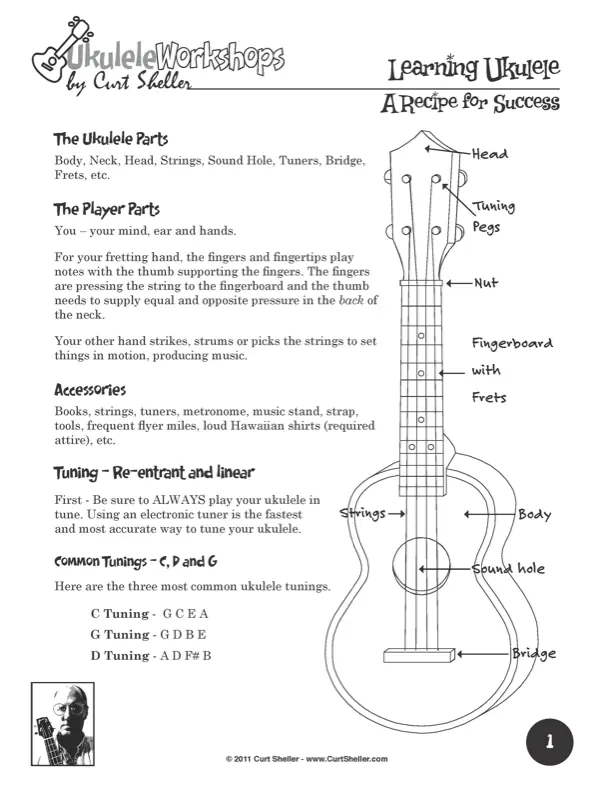
Learning `Ukulele - Recipe for Success
"Where Do I Start?" This is a common question. This workshop-lesson covers ukulele tunings, learning the ukulele fingerboard, basic chords and strums. This workshop gets you rolling on having some fun playing the ukulele. This is the workshop-lesson handout that I give ukulele players attending my Learning Ukulele - A Recipe for Success beginner workshop.
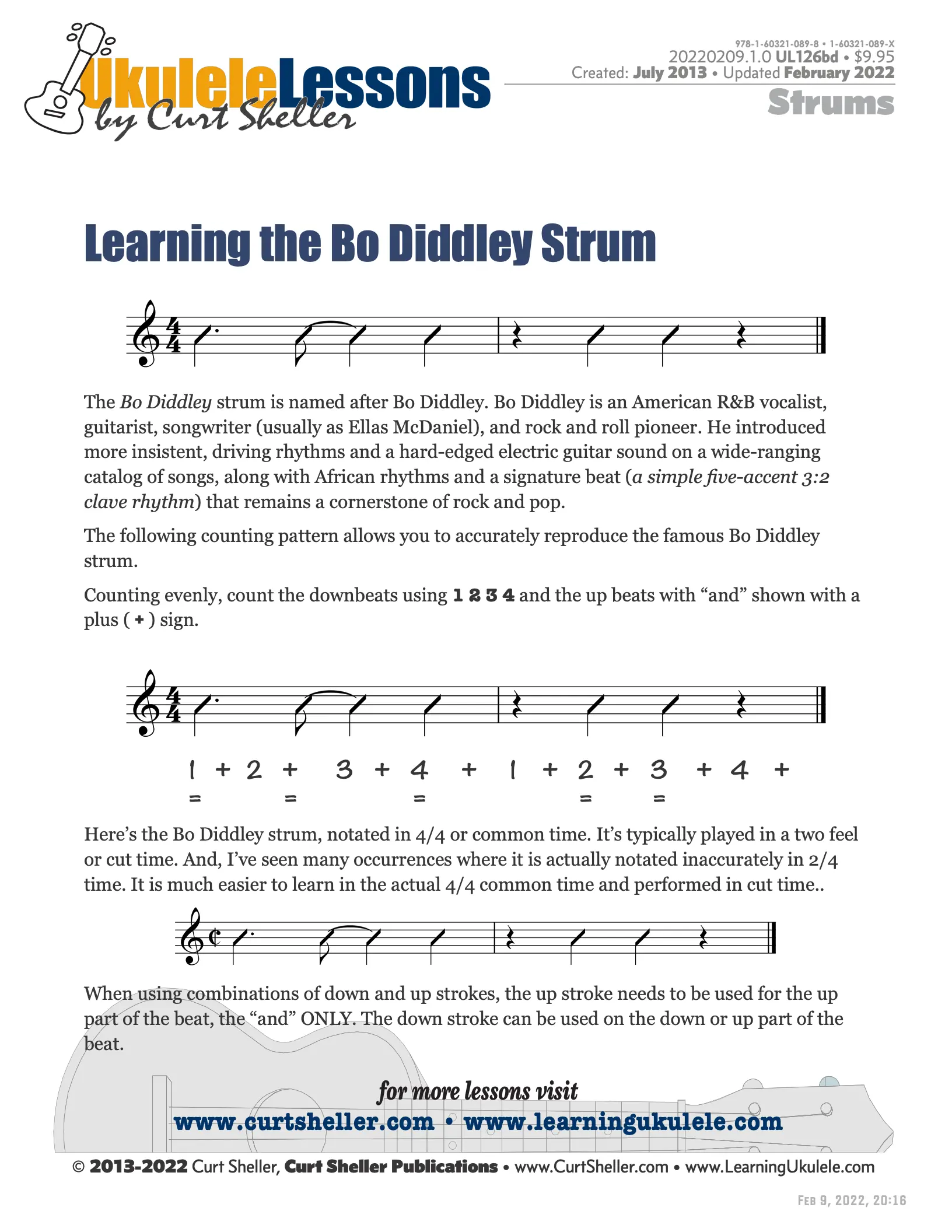
Learning the Bo Diddley Strum
The Bo Diddley strum is named after Bo Diddley. Bo Diddley is an American R&B vocalist, guitarist, songwriter ( usually as Ellas McDaniel ), and rock and roll pioneer. He introduced more insistent, driving rhythms and a hard-edged electric guitar sound on a wide-ranging catalog of songs, along with African rhythms and a signature beat (a simple five-accent clave rhythm) that remains a cornerstone of rock and pop.















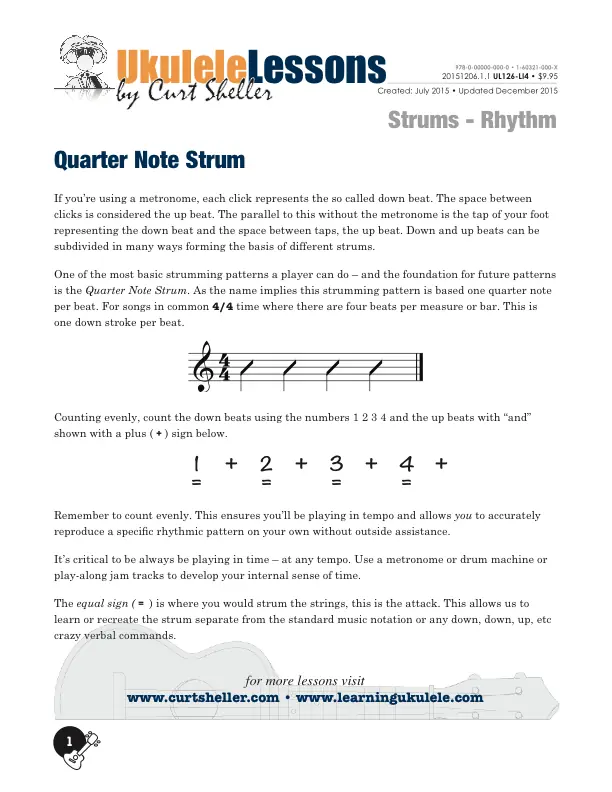
Quarter Note Strum
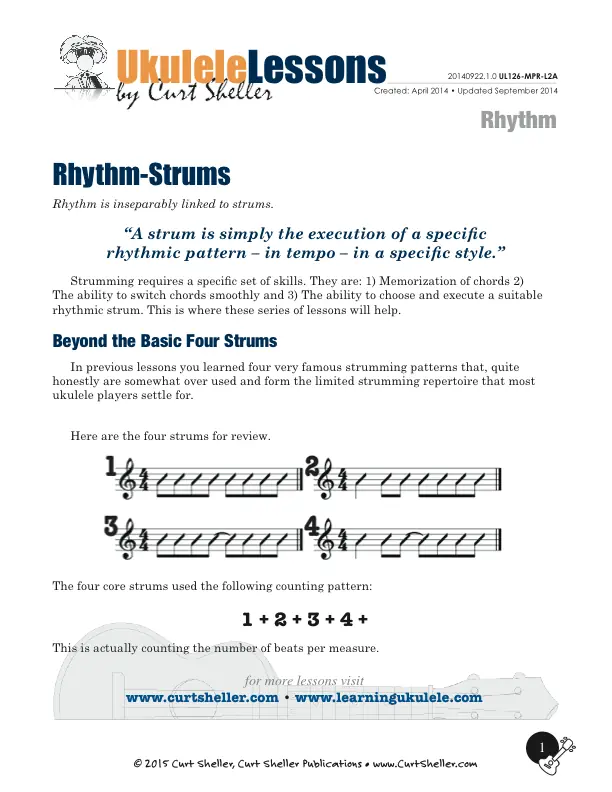
Chords and music are organized into bars or measures with the most common number of beats per bar or measure being four. One of the most basic strumming patterns and the foundation for ALL future strumming is the "Quarter Note Strum". As the name implies this strumming pattern is one quarter note per beat.




















The Muted Strum
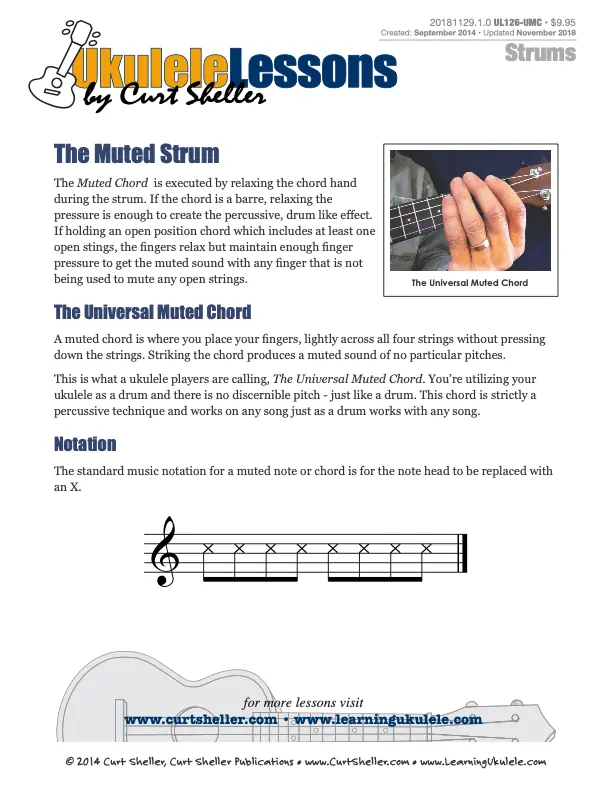
The muted strum is executed by relaxing the chord hand during the strum. If the chord is a barre, relaxing the pressure is enough to create the percussive, drum like effect. If holding an open chord, the fingers relax but maintain enough finger pressure to get the muted sound. This is what a few players are calling, The Universal Muted Chord. You're utilizing your ukulele as a percussive instrument and there is no discernible pitch - just like a drum. This chord works on any song just as a drum works with any song and does't care what the key is. This is a great chord to use when learning a new strum.



Triplet Based Strums - 12/8
A triplet, as the “tri” in the name implies, means three. It’s the subdivision of the beat into three even parts. Notice that I had used the word three for the number 3 in my writing. So, if I’m counting any beat which can be sub divided by three, it’s 1 2 3. No need to use words such as trip-o-let or one triplet, two triplet, etc to count.







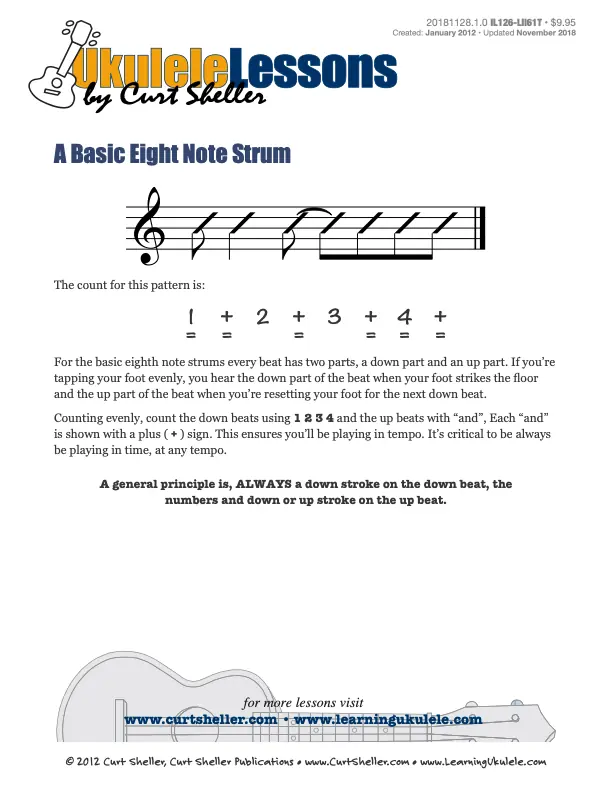
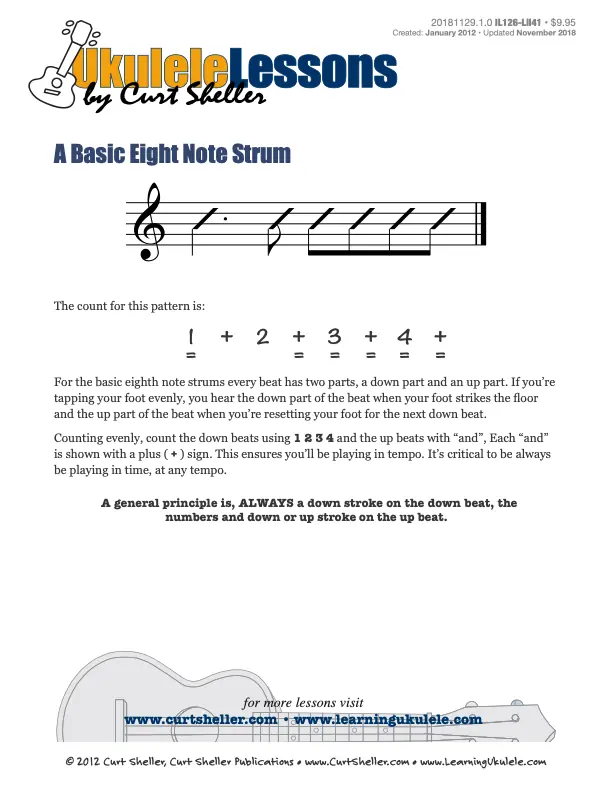
`Ukulele Strums - Core Pattern 4.1
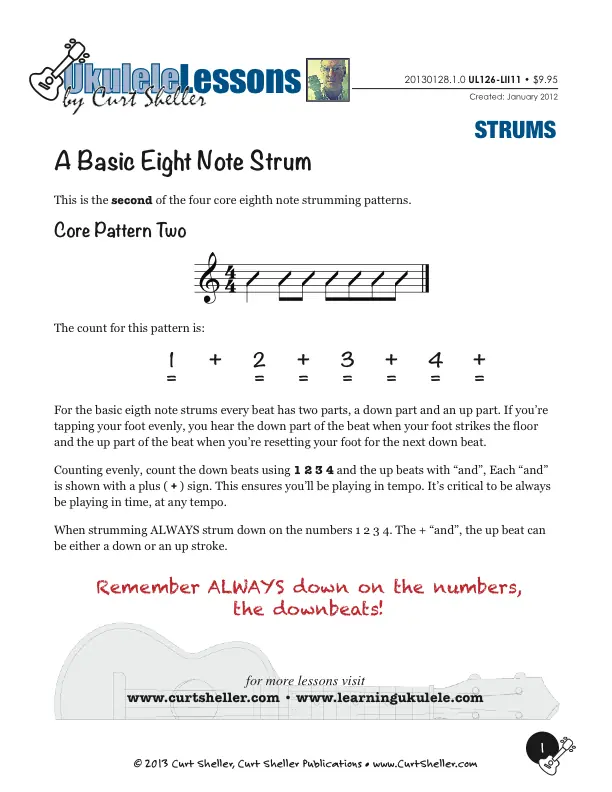
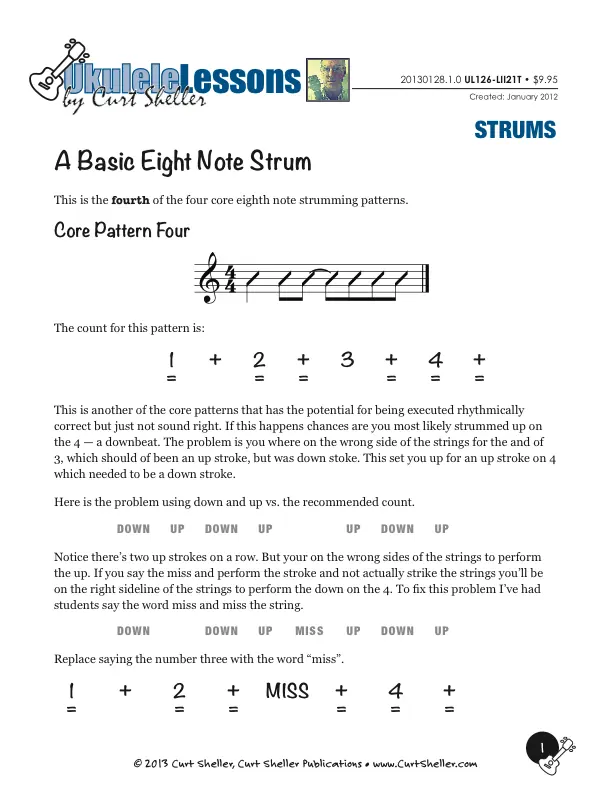
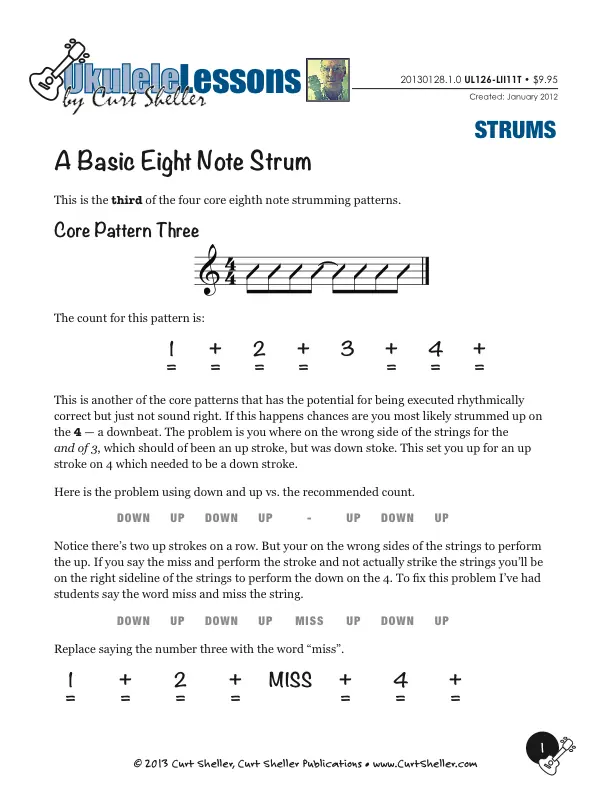
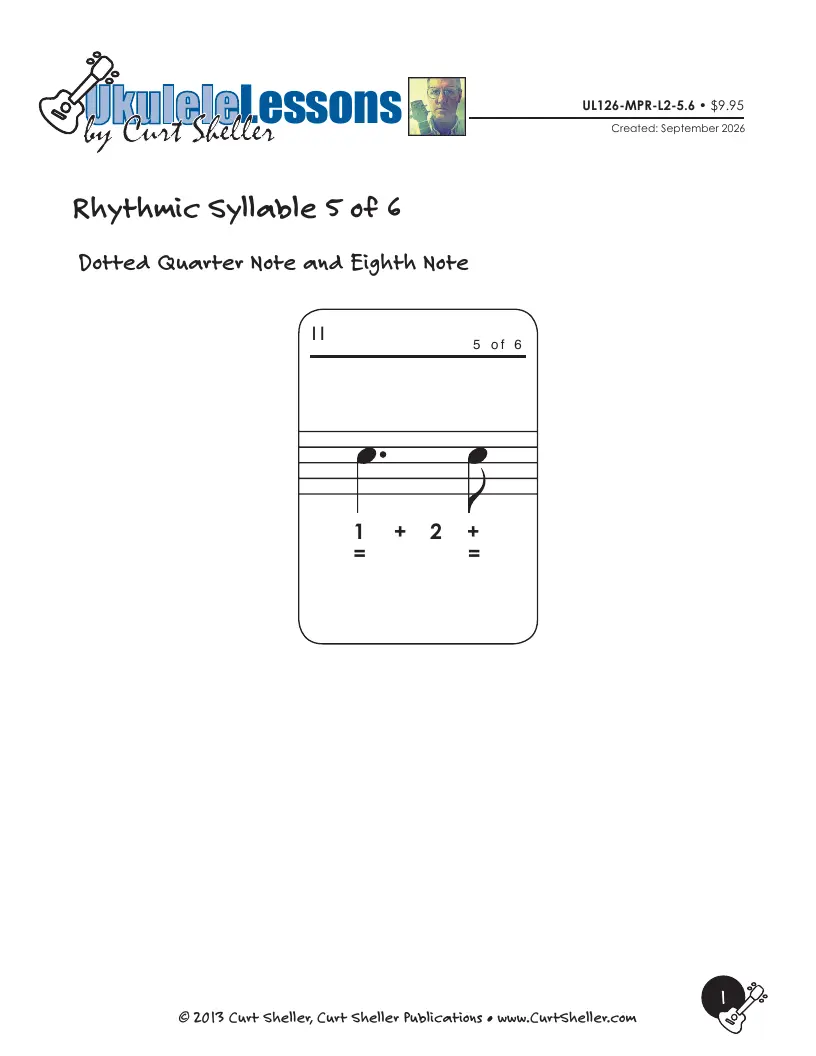
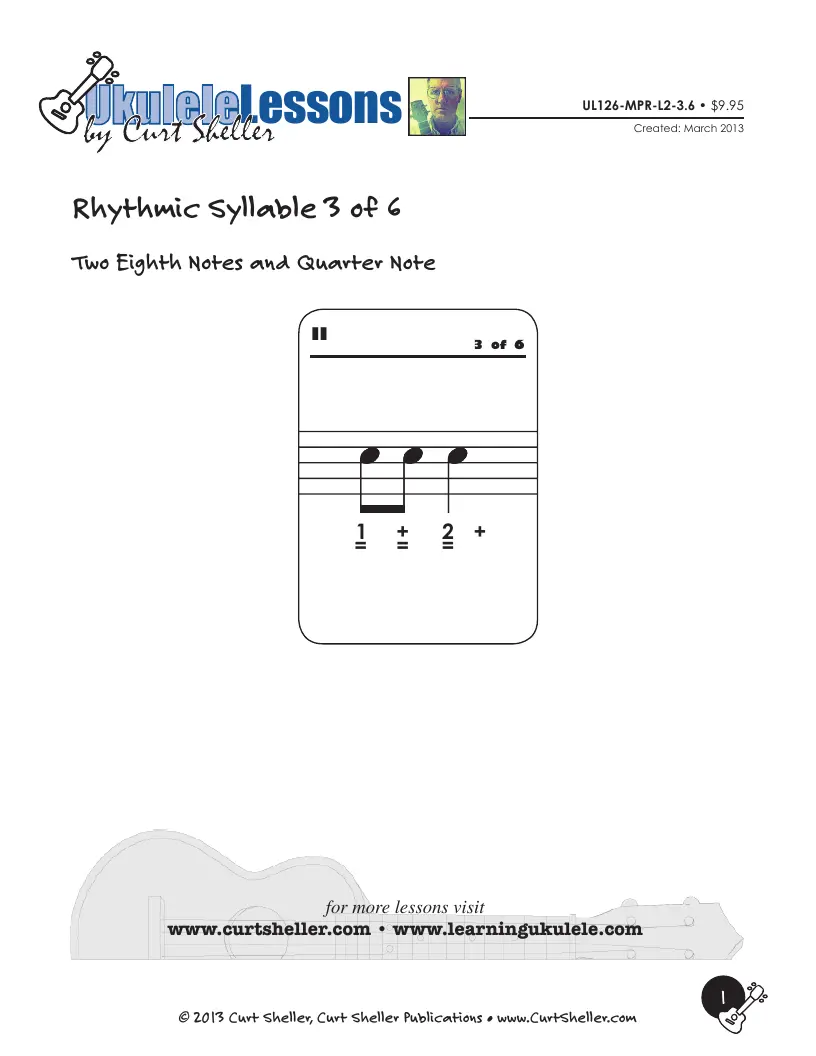
Another one of the 72 possible strumming patterns based of the Modular Phonetic Rhythm systems level II rhythmic syllables. A dotted quarter note and one eight note to four eight notes. Basically one rhythmic rhythmic syllable from the Modular Phonetic Rhythm tied to another syllable from the system.
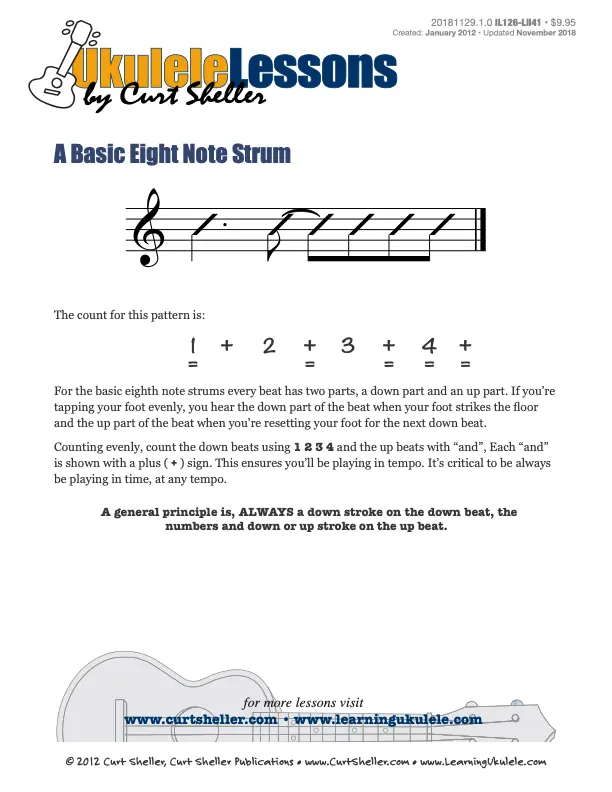
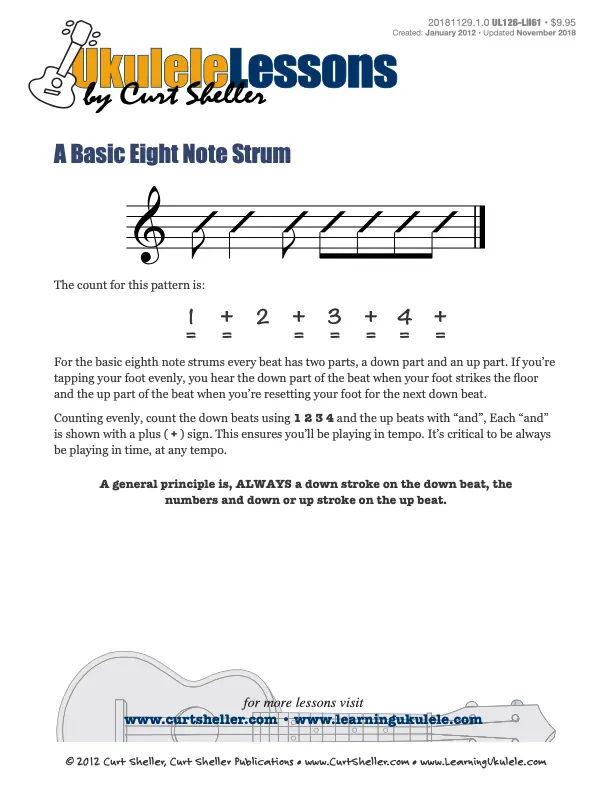
`Ukulele Strums and The Modular Phonetic Rhythm System
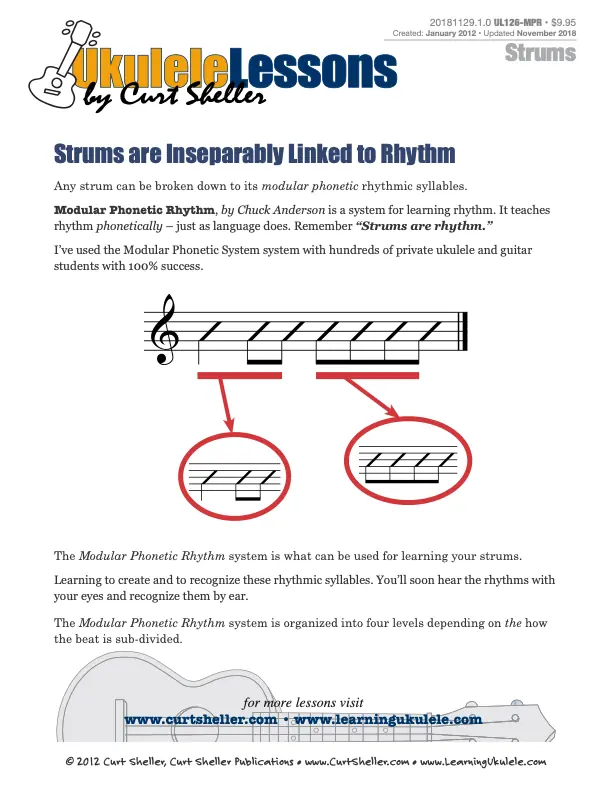
Strums are Inseparably Linked to Rhythm. Any strum can be broken down to its Modular Phonetic rhythmic syllables. Modular Phonetic Rhythm, by Chuck Anderson is a system for learning rhythm. It teaches rhythm phonetically - just as language does. Remember 'Strums ARE rhythm'