
Published:
2012-04-06
Updated:
2024-06-08
Learning Ukulele with Curt
Harmonic Analysis - The Six Harmonic Principles - Overview
This lessons cover the "Six Harmonic Principles" that are used to do a Harmonic Anlyasis - the understanding of the functional sequence of chords.
Author(s): Curt Sheller Publisher: Curt Sheller Publications Code: MLRMAe-3
Main Category: Theory Main Instrument: Any
Categories: Chords

2026-08-23
Show Series Lessons
Series Home
Number of Pages: 2
If you're a registered site member and have the correct permissions you can view ALL the pages of this PDF at a larger size using the LearningUkulele.com Online PDF Viewer (button below).
Download PDFThis Download is NOT part of your LearningUkulele.com & Learning Ukulele with Curt membership level.
Sign-up for Premium Site Access or Upgrade Your Plan to download this PDF or your can purchase a copy for download
Sign In for Access…Contact Us if there are any issues.
This lessons cover the "Six Harmonic Principles" that are used to do a Harmonic Anlyasis - the understanding of the functional sequence of chords.
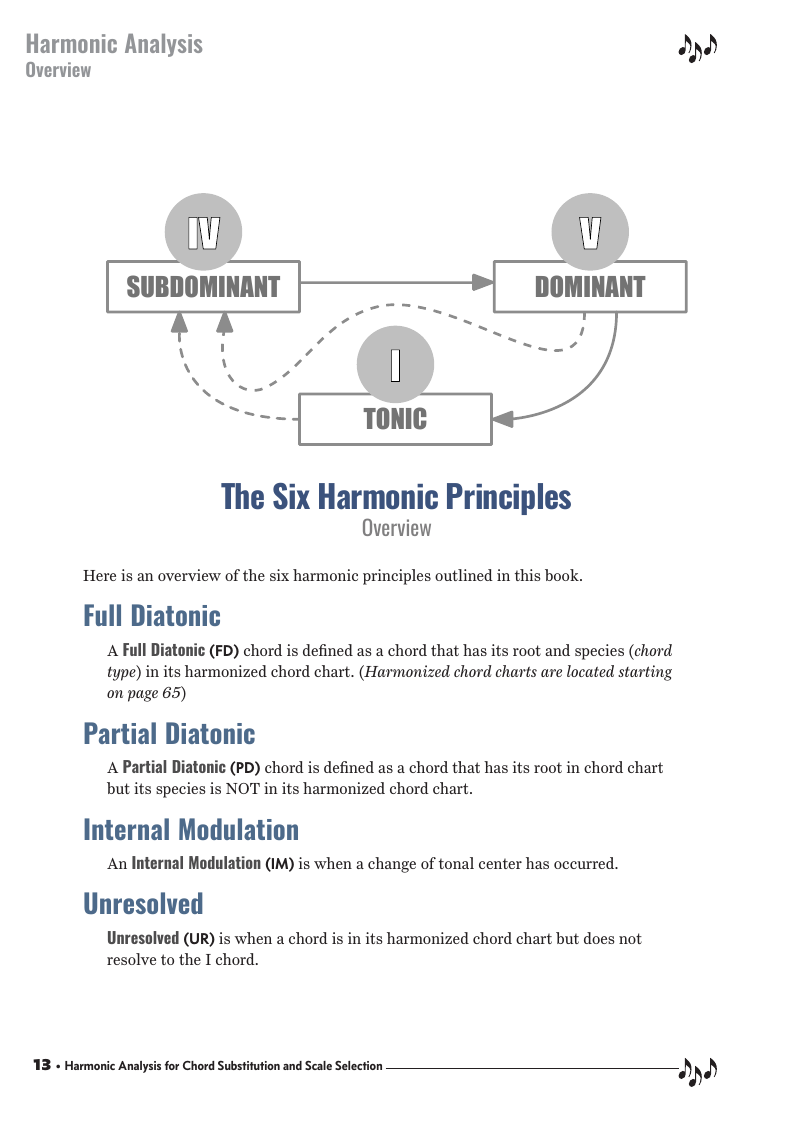
The Six Harmonic Principles
Here is an overview of the Six Harmonic Principles.
Full Diatonic
A Full Diatonic (FD) chord is defined as a chord that has its root and species (chord type) IN its Harmonized Chord Chart(s) .
Partial Diatonic
A Partial Diatonic (PD) chord is defined as a chord that has its root in chord chart but its species is NOT in its Harmonized Chord Chart(s) .
Internal Modulation
An Internal Modulation(IM) is when a change of tonal* center has occurred.
Unresolved
Unresolved (UR) is when a chord is in its Harmonized Chord Chart(s) but does not resolve to the I chord.
Chromatic
Chromatic (CH) chords ascending or descending by chromatic half steps between roots. The root and species are NOT in the Harmonized Chord Chart(s) .
Cycle
A Cycle (CYL) is when there is an equal distance between chord roots and same species for each chord, ascending or descending. A minimum of three chords is required for a cycle.
*Tonal and key will be used interchangeable throughout this series.


End of Lesson - Thanks, Hope You Enjoyed It!
Related Lessons, Videos, Lesson Series, Songs, Books & Reference Charts, Resources & Assets, Workshops are below.