
Published:
2012-04-06
Updated:
2026-09-20
Learning Ukulele with Curt
Harmonic Analysis - Basic Concepts
Harmonic Analysis (HA) is the process of determining the root movement of chords within a chord progression, the chord types that are used as well as identifying tonal centers. This root movement can be determined and categorized using one of six harmonic principles and the harmonized chord charts referenced in the lessons.
Author(s): Curt Sheller Publisher: Curt Sheller Publications Code: MLRMAe-2
Main Category: Theory Main Instrument: Any
Categories: Chords, Harmonic-Analysis, Progressions

2026-08-23
RelatedLessonAssets
Show Series Lessons
Series Home
Number of Pages: 4
If you're a registered site member and have the correct permissions you can view ALL the pages of this PDF at a larger size using the LearningUkulele.com Online PDF Viewer (button below).
Download PDFThis Download is NOT part of your LearningUkulele.com & Learning Ukulele with Curt membership level.
Sign-up for Premium Site Access or Upgrade Your Plan to download this PDF or your can purchase a copy for download
Sign In for Access…Contact Us if there are any issues.
Harmonic Analysis (HA) is the process used to determine the harmonic function of chords within a chord progression, song or composition. A chord progression is defined as a sequence of chords, with each chord having a root and a particular chord type. The relationship of a chord's root to a scale determines its function within that scale's tonality. Once a chord's function is identified, scale selections along with chord and scale substitutions are made. We call this process Root Movement Analysis (RMA).
Root Movement Analysis
Root Movement Analysis is the process of determining the root movement of chords within a chord progression, song or composition, the chord types as well as identifying tonal centers. This root movement can be determined and categorized using one of six harmonic principles and the harmonized chord charts contained in this book. These principles six harmonic principles will be covered in the next lessons.
The Harmonized Chord Scale
A chord, in music, is any harmonic set of pitches consisting of two or more (usually three or more) notes. The most common collection is created by the stacking of intervals of thirds. These thirds are a combination of major or minor thirds.
These three note chords are called triads. Four notes make up 4-part chords, five notes make up a 5-part chord, all the way up to chords that include all the notes of the scale. These chords create a Harmonized Chord Scale that is used for a Root Movement Analysis. For the purposes of harmonic analysis this book uses triads and 4-part chords only. Here are the triads and 4-part chords that form a harmonized C Major Scale .
This series, is the book Harmonic Analysis for Chord Substitution and Scale Selection by Curt Sheller broken out into individual lessons with additional examples and content. Always, the latest version of the book.
More Harmonic Analysis - Basic Concepts
content below, continue exploring...
More Harmonic Analysis - Basic Concepts
Example: C Major Harmonized Scale
Triads:
4-Part
Chords:
RMA:
* Technically called a half-diminished seventh chord in a major scale as the seventh scale degree is diminished..
By applying Roman numerals to the chords of a harmonized scale, a comparison of chord progressions can be made and the theory behind a chord's function, called Chord Scale Theory, can be learned.
This book uses Uppercase Roman Numerals Only to identify a chord's function within its harmonized chord scale as the default chord type for a given chord should already be known from its chart.
These names are commonly used to indicate a chord's position and function within its corresponding major scale.
Tonic
Supertonic
Mediant
Subdominant
Dominant
Submediant
Leading Tone
Tonic-Dominant Harmony
This series, the book Harmonic Analysis for Chord Substitution and Scale Selection by Curt sheller focuses on Tonic-Dominant harmony predominant in Western music and a staple of a contemporary musician's repertoire. Tonic-Dominant harmony stresses the use of key centers which are defined by the use of a Tonic ( I ) chord. These tonic chords are usually preceded and supported by a Dominant ( V ) chord. A dominant chord is sometimes preceded by the Subdominant ( IV ) chord which tends to resolve towards the dominant chord which either resolves to the tonic chord or goes back to the subdominant, delaying final resolution to the tonic chord.
A tonic chord is a passive chord having a feeling of rest and resolution. A dominant chord is an active chord having a feeling of restlessness and tends to be drawn to its tonic I chord.
An active chord is a triad that contains the fourth of its scale. A passive chord is a triad that contains the third of the scale.
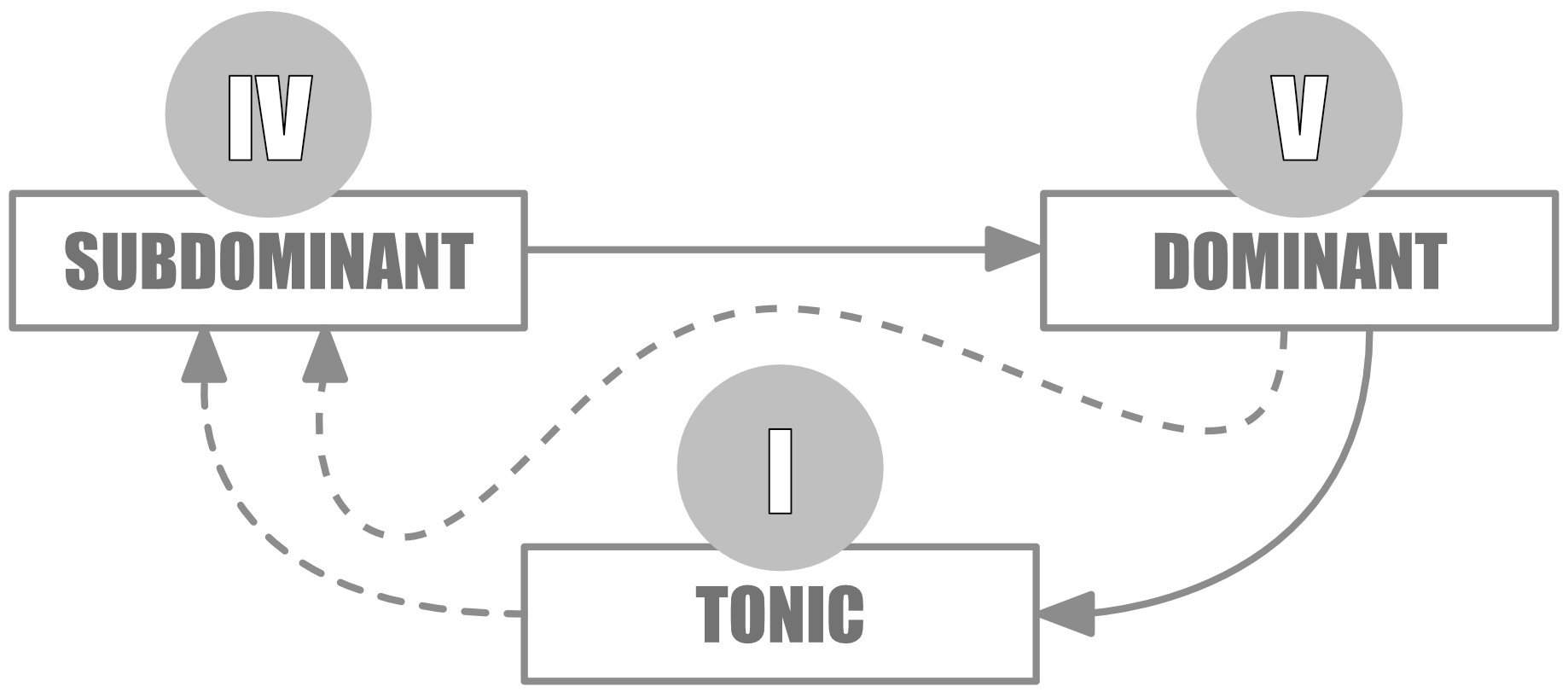
This is the Super-majority of how out chord progressions and chords are interacting.
Most progressions are tonal
with at least one key center being established. Songs can and do modulate through multiple key centers. Many of the songs that are considered part of the standard jazz repertoire modulate through several key centers. Most folk and rock songs establish a main key center and do not modulate to other key centers.


End of Lesson - Thanks, Hope You Enjoyed It!
Related Lessons, Videos, Lesson Series, Songs, Books & Reference Charts, Resources & Assets, Workshops are below.
Harmonic Analysis for Scale Selection and Chord Substitution
Harmonic Analysis is the understanding of the functional sequence of chords. It is the process used to analyze the harmonic structure of a progression, song or composition. This analysis is then used to make scale selections for improvisation and chord substitution.