Published:
2013-10-07
Updated:
2021-12-20
Learning Ukulele with Curt
Color Tones and Chords
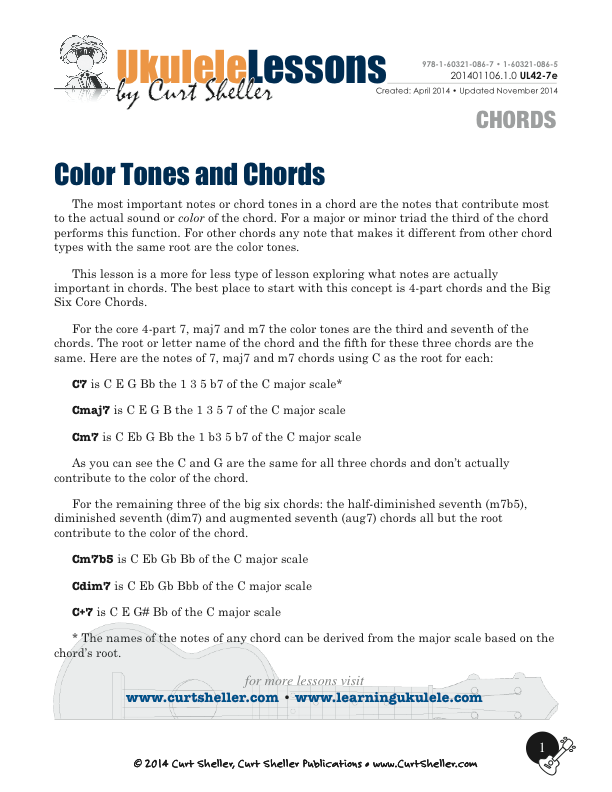
The most important notes or chord tones in a chord are the notes that contribute most to the actual sound or “color” of the chord. For a major or minor triad, the third of the chord performs this function. For other chords, any note that makes it different from other chord types with the same root are the color tones.
This lesson is a more for less type of lesson exploring what notes are actually important in chords. The best place to start with this concept is 4-part chords and the Big Six Core Chords.
Author(s): Curt Sheller Publisher: Curt Sheller Publications Code: UL42-7e
Main Category: Chords Main Instrument: Any
Categories: Chords, Triads, Intermediate, Core, Major, Minor

2026-08-23
RelatedLessonAssets
Number of Pages: 6
If you're a registered site member and have the correct permissions you can view ALL the pages of this PDF at a larger size using the LearningUkulele.com Online PDF Viewer (button below).
Download PDFThis Download is NOT part of your LearningUkulele.com & Learning Ukulele with Curt membership level.
Sign-up for Premium Site Access or Upgrade Your Plan to download this PDF or your can purchase a copy for download
Sign In for Access…Contact Us if there are any issues.
The most important notes or chord tones in a chord are the notes that contribute most to the actual sound or “color” of the chord. For a major or minor triad, the third of the chord performs this function. For other chords, any note that makes it different from other chord types with the same root are the color tones.
This lesson is a more for less type of lesson exploring what notes are actually important in chords. The best place to start with this concept is 4-part chords and the Big Six Core Chords.
This information is critical when creating your own melody and chord ukulele arrangements and are limited to four, three or two strings to harmonize a melody.
This lesson is a more for less type
of lesson exploring what notes are actually important in chords. The best place to start with this concept is 4-part chords and the Big Six Core Chords.
For the core 4-part 7, maj7 and m7 the - the Big Three of the Big Six Core Chords, the color tones are the third and seventh of the chord. The root or letter name of the chord and the fifth for these three chords are the same. Here are the notes of a 7, maj7 and m7 chord using C as the root for each:
- C7 is C E G Bb the 1 3 5 b7 of the C Major Scale
- Cmaj7 is C E G B the 1 3 5 7 of the C Major Scale
- Cm7 is C Eb G Bb the 1 b3 5 b7 of the C Major Scale
As you can see, the C and G are the same for all three chords and do not contribute to the color of the chord.
For the remaining three of the big six chords: the half-diminished seventh (m7b5), diminished seventh (dim7), and augmented seventh (aug7) chords all but the root contribute to the color of the chord.
- Cm7b5 is C Eb Gb Bb of the C Major Scale
- Cdim7 is C Eb Gb Bbb of the C Major Scale
- C+7 is C E G# Bb of the C Major Scale
More Color Tones and Chords
content below, continue exploring...
More Color Tones and Chords
NOTE: The names of the notes of any chord can be derived from the major scale based on the chord's root.
Exploring Color Tones
From the four voicings of the 7, maj7 and m7 chords in the Big Six series of lessons find and only play the thirds and sevenths of the chords - the color tones.
As you might be able to figure out – knowing the names of the notes in ALL your chords and the notes of the fingerboard will go a long way when exploring this approach to chords. You pretty much can not apply any of this without knowing the notes of the fingerboard and, at a minimum, the 15 major scales.
Altered Seventh Chords
A extreme when knowing the names of the chords tones and notes for the ukulele.
Grab any chord, any shape on the ukulele. You can also justify every note of the chord as a seventh chord as long as there is no major seventh interval/chord tone in the chord.
A seventh chord is a 1 3 5 b7 as the basic chord and can have a b9, #9, 11, #11/b5, #5/b13, 13. Just can't justify a major seventh.
Pretty much works for Jazz
chords and not very basic folk-type chords.


End of Lesson - Thanks, Hope You Enjoyed It!
Related Lessons, Videos, Lesson Series, Songs, Books & Reference Charts, Resources & Assets, Workshops are below.
A Guide to Advanced Ukulele Chords - Volume I
Beyond learning basic Ukulele chords, most players struggle with advanced chords. Commonly called "jazz" chords, these more sophisticated voicings find a wide use in all forms of music. A Guide to Advanced Chords for Ukulele - presents a highly organized and efficient approach to the mysterious subject of advanced chords. Chord dictionaries are not the answer.
A Guide to Ukulele Chords, 2nd Edition
A Guide to Ukulele Chords, Second Edition is designed as a guide to ukulele chords. Covering the basic ukulele chords that ALL ukulele players SHOULD know. A Guide to Ukulele Chords covers movable chord forms, rock chords, how to transpose chords, learning the ukulele fingerboard and includes an introduction to 4-part, a.k.a jazz chords and more...
Advanced Guide to Chords and Progressions Series
The Advanced Guide to Chords series presents a highly organized and efficient approach to the mysterious subject of advanced chords and chord progressions. Each volume provides detailed information on voicing 4-part chords, covering all major, minor, diminished and augmented chord types, their upper partials, alterations, add, sus and slash chords.