Published:
2013-11-10
Updated:
2019-03-01
Learning Ukulele with Curt
Melody and Chord Tips
Creating "Melody and Chord Arrangements", in theory are as simple as harmonizing the melody with a chord. Which is playing a chord that has the melody note as the top note of the chord voicing. In practice it is a little more involved, but not much more.
Author(s): Curt Sheller Publisher: Curt Sheller Publications Code: UL125a
Main Category: Arranging Main Instrument: Ukulele
Categories: Chords

2026-08-23
RelatedLessonAssets
Show Series Lessons
Series Home
Number of Pages: 8
If you're a registered site member and have the correct permissions you can view ALL the pages of this PDF at a larger size using the LearningUkulele.com Online PDF Viewer (button below).
Download PDFThis Download is NOT part of your LearningUkulele.com & Learning Ukulele with Curt membership level.
Sign-up for Premium Site Access or Upgrade Your Plan to download this PDF or your can purchase a copy for download
Sign In for Access…Contact Us if there are any issues.
Creating Melody and Chord Arrangements, in theory are as simple as harmonizing the melody with a chord. Which is playing a chord that has the melody note as the top note of the chord voicing. In practice it is a little more involved, but not much more.
The Art of Playing Melody and Chords at the Same Time
Chord Melody or Melody and Chord is the art of playing the melody and chords at the same time. This is what solo piano players do all the time. They have two hands to do it. On ukulele we have to do it all with one hand and only four strings. In the common high "G", C tuning, the available range of notes for creating melody and chord arrangements on ukulele is around two octaves, give or take a few notes. A little more on the lower end for a low "G", C tuning.
A few things you should know before starting:
1) The notes of the Ukulele Fingerboard and what they look like in Standard Music Notation . TAB, although an initial help when learning the ukulele has a very, very limited functionality with crafting a melody and chord arrangement.
2) The ability to identify the notes and chord intervals of a chord. Chord Spelling - A C major chord is C E G, the root, third and fifth of a C major scale. A G7 chord is G B D F, the root, third, fifth and flat seven of a G major scale.
And, it does really help if you can read Standard Music Notation .
More Melody and Chord Tips
content below, continue exploring...
More Melody and Chord Tips
Melody and Chord Guidelines
- A few tip, tricks and guidelines for creating melody and chord arrangements.
- You do not have to play a chord for every melody note. Chords can also played before or after the melody.
- Play a chord for dotted quarter notes and longer.
- Play a chord when there is a chord change.
- Add melody notes if needed and wanted.
- If melody is an arpeggio, play as single notes and sustain the notes to get create the chord.
- If only one melody note is changing in a chord play the changed note while sustaining the previous unchanged notes of the chord.
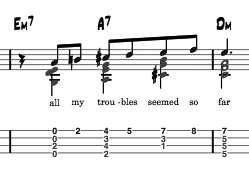
Example from measure 2 of the Beatles classic Yesterday.
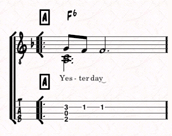
Example from first measure of Yesterday.
- Change all diminished triads to a dim 7th 4-part chords.
- Augmented triads to can be played as a 7#5.
- Do not avoid the effectiveness of triads.
- Use chord substitutions to fit the style.
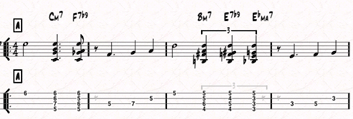
The original chord for this measure is the I chord of the key ( Bbmaj7 ). A III chord, a diatonic sub is substituted and its V chord added. Also creates a nice chromatic movement to the IV chord.
Example from Autumn Leaves. A full Melody and Chord Solo Arrangement for Autumn Leaves .
- Look for places for Contrapuntal Motion: Parallel , Oblique , Similar and Contrary motion in your chord voicings.
- Double Stops , Octaves , Intervals Arpeggios Sequences , and Chord Scales.
.png)
Example from Walk Don't Run. A song written by jazz great Johnny Smith and made famous by the Ventures.. The full melody and chord solo Melody and Chord Solo Arrangement for Walk Don't Run
- Use the principles of Voice Leading
- Chromatic passing chords and fills.
- Close chord voicings . The re-entrant tuning of the ukulele gives you this automatically.
- Incorporate an open strings chord voicing in to the arrangement.
- Use a Free form chord voicing. A Free Form Chord is a chord that does not fall into the open position, movable form or 4-part chord categories.
- Alterations, upper partials (chord extensions) and substitutions. Root to 9, b9, #9, third to 11, #11, fifth to 13, b5, #5 to fit the style. Alterations should not change the chords harmonic function.
- Embellishments - slurs, hammer-ons, pull-offs, tremolo, etc...
- Idiomatic Cliches - These are things such a bend or glissando (slides) in blues.
- Alternate Chord Voicings - A melody of a ninth can be harmonized by raising the root of a chord 2 frets or lowering the third of a minor chord one fret and the third of a major seventh or seventh chord two frets.
- A melody of an eleventh can be harmonized by raising the third of a minor chord two frets and the third of a major seventh or seventh chord one fret. Or, lowering the fifth of a seventh, minor seventh or major seventh chord two frets.
- Learn the critical notes of a chord such as the thirds and sevenths of major, minor and sevenths chords. Without these notes in the chord you loose the essence of the chord.
- The two most critical notes are the melody and the seventh of a chord.
- Leaving out the root and fifth of a chord implies 5, 6 and 7 part harmony. This is very useful on an instrument such as the a ukulele.
- Create an arrangement using Introductions and Turnarounds and Endings
- Theme, variations and re-harmonization.


End of Lesson - Thanks, Hope You Enjoyed It!
Related Lessons, Videos, Lesson Series, Songs, Books & Reference Charts, Resources & Assets, Workshops are below.

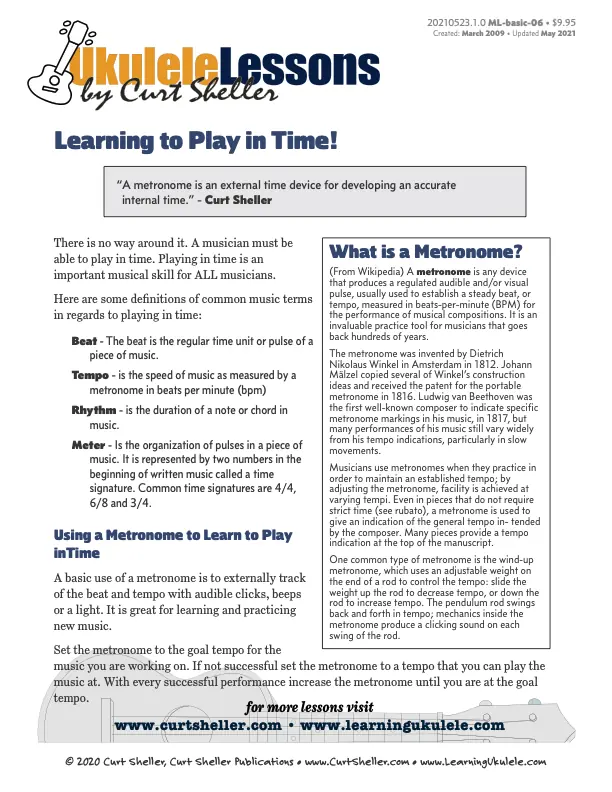
Playing in Time
Playing in time is an essential skill that every musician must possess. There are no shortcuts or alternatives when it comes to this aspect of music. Keeping your place while playing is a crucial lesson that focuses on honing your ability to maintain a consistent tempo and rhythm throughout your performance.
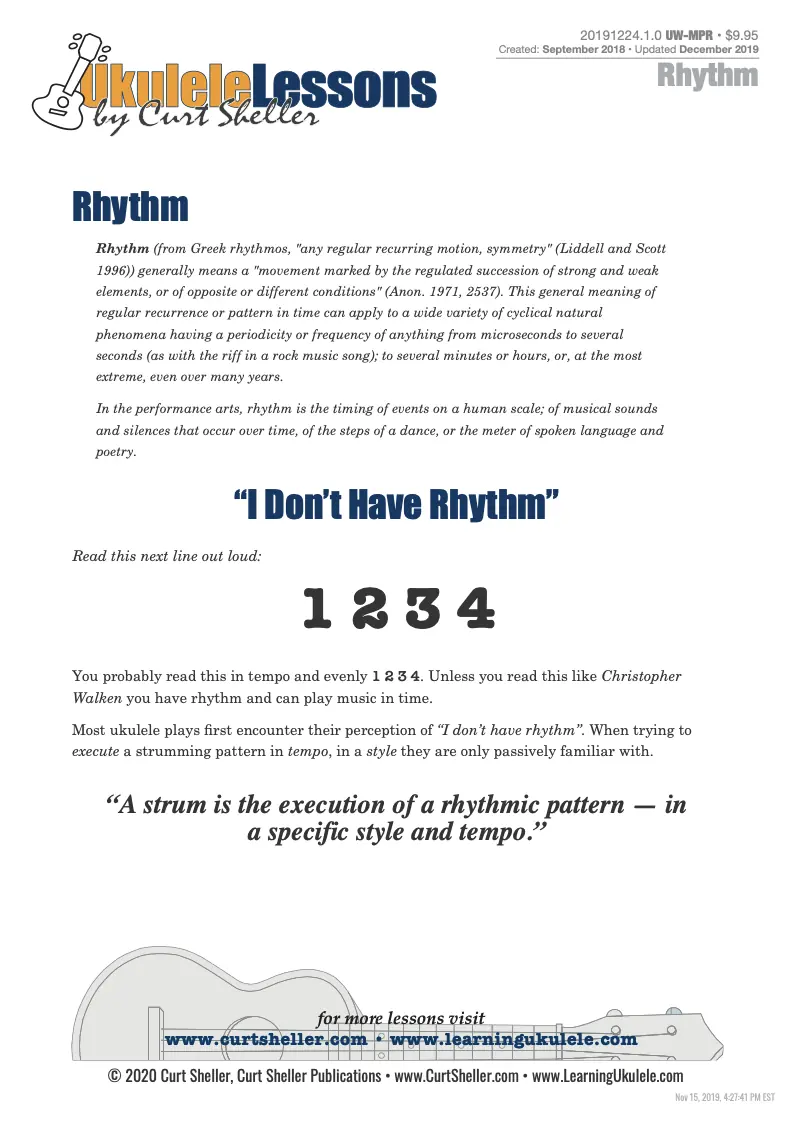
Rhythm - Avoid at Your Own Peril
The often neglected and taken for granted subject of Rhythm. Music is Melody, Harmony and Rhythm. We are drawn, initially to music by melody at a very early age, with the instrument of our voice. With ukulele you typically learn chords - the harmony and never really dive into learning rhythm. Unless you're a drummer we take rhythm for granted.


Modular Phonetic Rhythm, The Foundation and Workbook 1
Modular Phonetic Rhythm represents a significant advance in the teaching and application of rhythm. Eliminating many inefficient aspects of rhythm education, Modular Phonetic Rhythm streamlines the traditional educational approach, resulting in a reflexive reaction to rhythm.
Modular Phonetic Rhythm by Chuck Anderson
Modular Phonetic Rhythm represents a significant advance in the teaching and application of rhythm. Eliminating many inefficient aspects of rhythm education, Modular Phonetic Rhythm streamlines the traditional educational approach, resulting in a reflexive reaction to rhythm.