Published:
2005-01-02
Updated:
2022-11-08
Learning Ukulele with Curt
Classic Endings for `Ukulele
Two Feel, bVImaj7 bIImaj7, Basie Ending, Single, Double and Triple Tags, Chromatic, Take 'A' Train Ending, Shave and a Hair Cut, Lawrence Welk Ending. These are common classic songs ending that are used over and over in the standard song repertoire.
Author(s): Curt Sheller Publisher: Curt Sheller Publications Code: UL125c
Main Category: Arranging Main Instrument: Ukulele
Categories: Chords

2026-08-23
RelatedLessonAssets
Show Series Lessons
Series Home
Number of Pages: 10
If you're a registered site member and have the correct permissions you can view ALL the pages of this PDF at a larger size using the LearningUkulele.com Online PDF Viewer (button below).
Download PDFThis Download IS part of your Gold Site Access and a FREE download. Thanks for supporting the site. — Curt
Each PDF file is a professionally prepared, formatted, high resolution file that prints out great. You'll need a PDF Reader or application capable of viewing PDF files to view the PDF.
NOTE: Download the current PDF file for the latest, complete, and most up-to-date version. As well as additional information not presented on-line.
Common songs endings that are used over and over in the standard song repertoire.
Endings Covered in This Lesson
Hawai'ian Turnaround in C Major
A classic chord progression utilized in Hawaiian tunes. ( This turnaround is not in the PDF download )
LESSON: The Hawaiian Turnaround in Key C
Two Feel
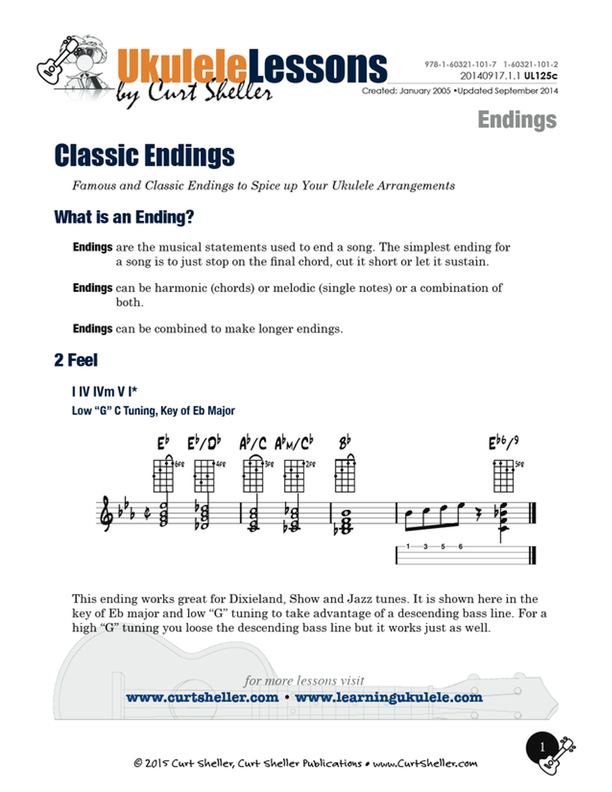
This ending works great for Dixieland, Show and Jazz tunes. It is shown here in the key of Eb major and low “G” tuning to take advantage of a descending bass line. For a high “G” tuning you loose the descending bass line but it works just as well.
The reason for the different voicing for the C/Bb is to get a moving line in the melody as well as the bassline.
VIDEO: Classic Endings, "Two Feel" video below
bVImaj7 bIImaj7
This ending can be two beats for each chord and both chords in one measure or extended out four beats each. This ending works really well on ballads.
More Classic Endings for `Ukulele
content below, continue exploring...
More Classic Endings for `Ukulele
Basie Ending
Named after the late Count Basie a jazz pianist, organist, bandleader, and composer. Widely regarded as one of the most important jazz bandleaders of his time, Count Basie led his popular Count Basie Orchestra for almost 50 years. I remember as a 10 year old lad standing right at the edge of the stage – right at the feet of the great Count Basie and looking up and listening to this great big band on Steel Pier in Atlantic City, NJ USA . That was some great stuff.
The Bass Button is a short staccato, low note typically played by a bass player. It you don’t have a bass player play it yourself.
Single, Double and Triple Tags
A Single, Double and Triple tags are one of the simplest and most common endings.
Professional musicians should know what to play just by saying single, double or triple tag. This is a very common ending.
For a tag ending you repeat the last two or more measures of the song before resolving the last chord of the song. For single tags you repeat once, for double tags repeat two times and triple tags are repeated three times.
If notating a tag ending a coda can be used before the final chord and the repeated measures placed at the coda.
Chromatic
The rhythms indicated are only a reference to the number of beats for the chords. You are free to play more syncopated rhythms.
With the chromatic version in Eb notice I ran out of ukulele with the descending bass line and the Emaj7 chords so I played a different voicing of the Emaj7 higher up the neck and would play it staccato setting up the final chord.
Take the 'A' Train Ending
This is the famous ending from the Duke Ellington song of the same name, “Take the ‘A’ Train”
Shave and a Hair Cut
This is a classic ending from the early 20th century. A haircut these days sure ain’t two bits or twenty five cents.
Lawrence Welk Ending
This is another famous ending getting its name from a band leader known for its use. Probably known by other names but this is how I learned it and know it by. Lawrence Welk was my grandmother’s favorite Saturday night show.
The ending is the chromatic scale starting on the root of the final chord, in this case C, and ending one octave higher and finishing with the V and I chords of the key.
Train Wreck
And the ever popular Chaos or Train Wreck ending :-). Well, not really a structured ending, everybody plays what they want. This one needs no guidance from me as most musicians already have their own version.
A Train Wreck
is when the train has left the tracks. Ending a songs in this fashion has the same results.


End of Lesson - Thanks, Hope You Enjoyed It!
Related Lessons, Videos, Lesson Series, Songs, Books & Reference Charts, Resources & Assets, Workshops are below.

Playing in Time
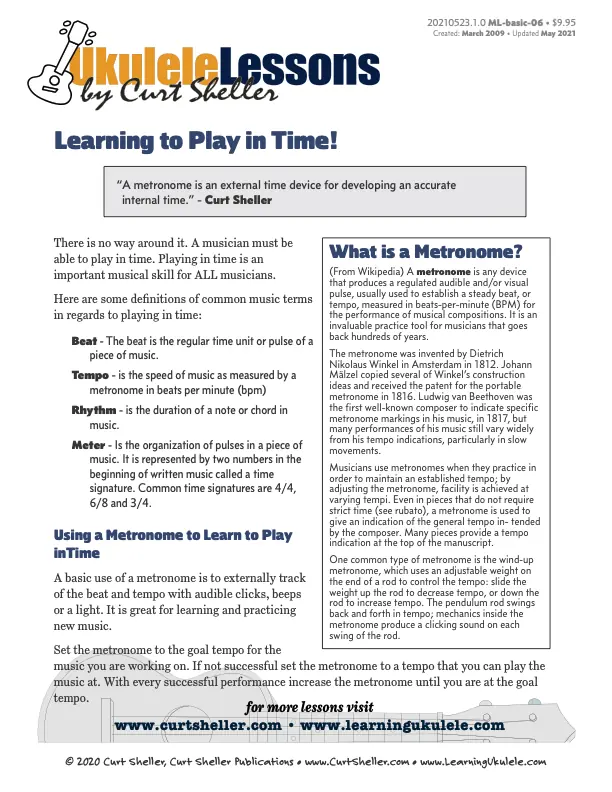
Playing in time is an essential skill that every musician must possess. There are no shortcuts or alternatives when it comes to this aspect of music. Keeping your place while playing is a crucial lesson that focuses on honing your ability to maintain a consistent tempo and rhythm throughout your performance.
Rhythm - Avoid at Your Own Peril
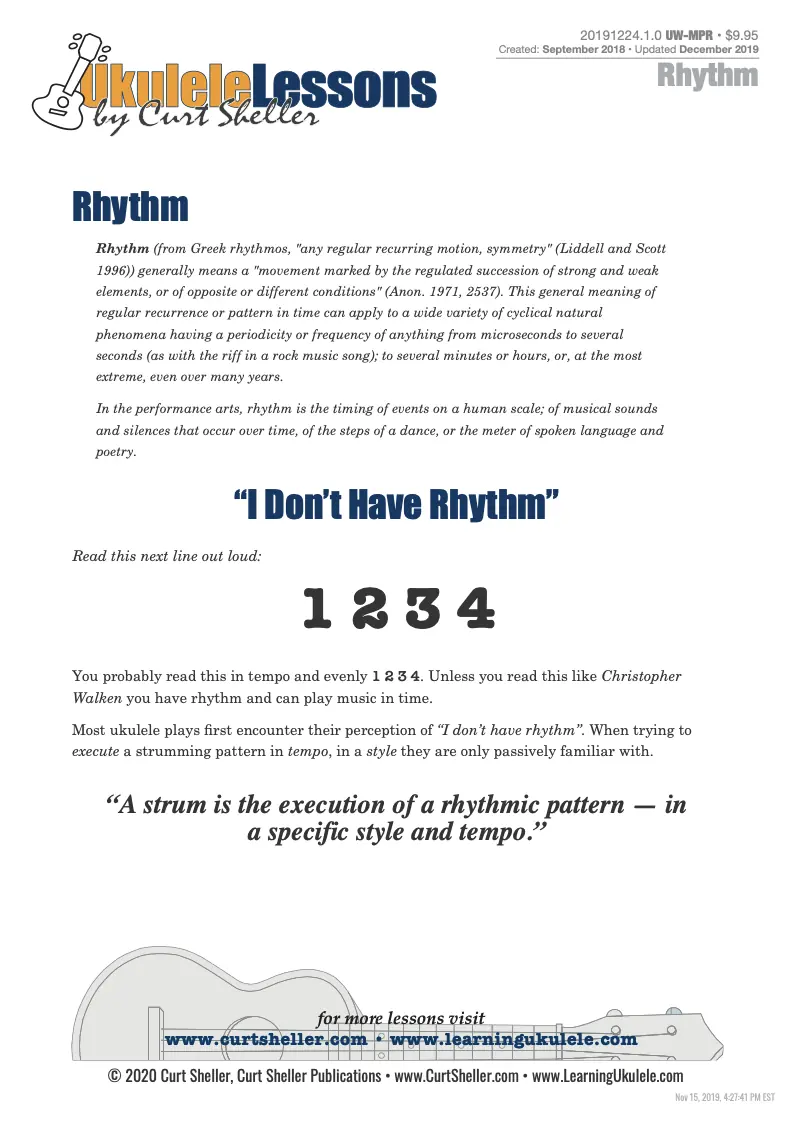
The often neglected and taken for granted subject of Rhythm. Music is Melody, Harmony and Rhythm. We are drawn, initially to music by melody at a very early age, with the instrument of our voice. With ukulele you typically learn chords - the harmony and never really dive into learning rhythm. Unless you're a drummer we take rhythm for granted.


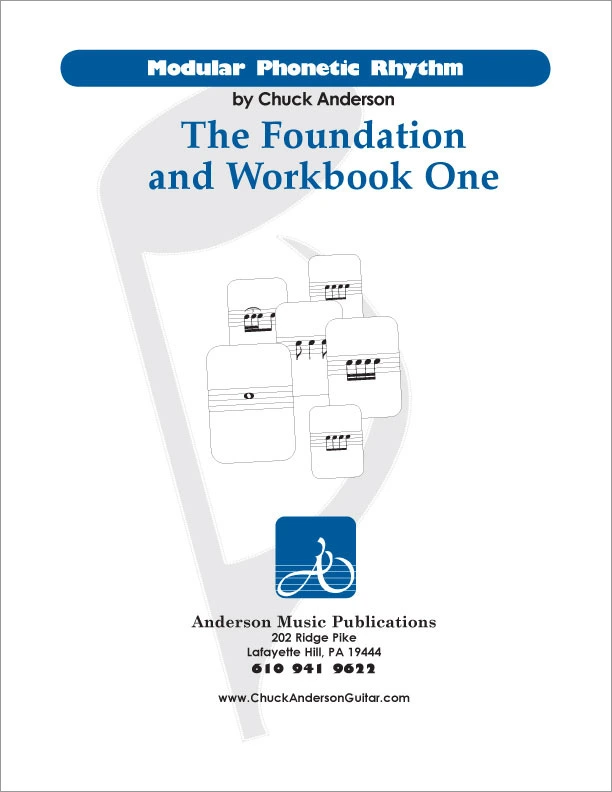
Modular Phonetic Rhythm, The Foundation and Workbook 1
Modular Phonetic Rhythm represents a significant advance in the teaching and application of rhythm. Eliminating many inefficient aspects of rhythm education, Modular Phonetic Rhythm streamlines the traditional educational approach, resulting in a reflexive reaction to rhythm.
Modular Phonetic Rhythm by Chuck Anderson
Modular Phonetic Rhythm represents a significant advance in the teaching and application of rhythm. Eliminating many inefficient aspects of rhythm education, Modular Phonetic Rhythm streamlines the traditional educational approach, resulting in a reflexive reaction to rhythm.