
Published:
2005-01-02
Updated:
2024-05-13
Learning Ukulele with Curt
Understanding Diatonic Intervals
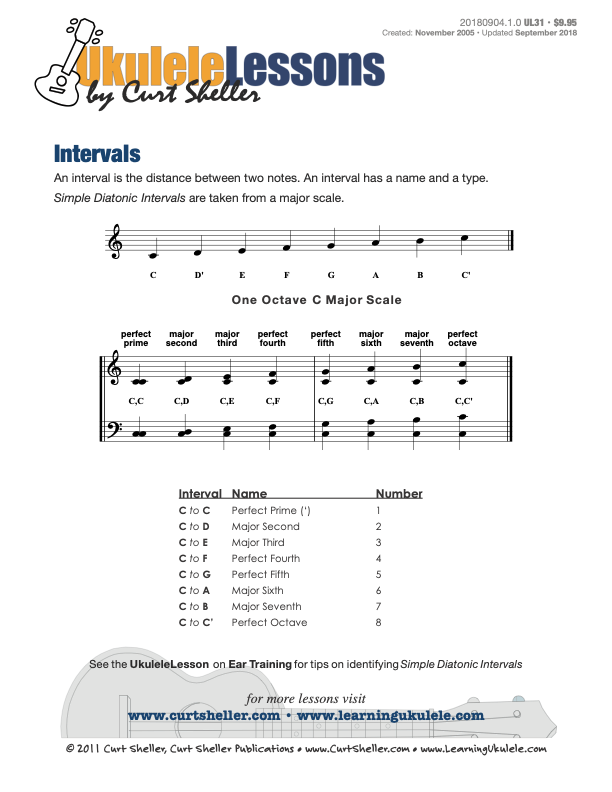
An interval is the distance between two notes. An interval has a name and a type. Intervals can be played one note (melodic) or two notes (harmonic) at a time, ascending or descending. Simple and Compound Intervals are taken from a major scale. Chromatic Intervals are NOT taken from a major scale. They are derived from the diatonic intervals.
Author(s): Curt Sheller Publisher: Curt Sheller Publications Code: UL31
Main Category: Intervals Main Instrument: Ukulele
Categories: Chords

2026-08-23
Show Series Lessons
Series Home
Number of Pages: 2
If you're a registered site member and have the correct permissions you can view ALL the pages of this PDF at a larger size using the LearningUkulele.com Online PDF Viewer (button below).
Download PDFThis Download is NOT part of your LearningUkulele.com & Learning Ukulele with Curt membership level.
Sign-up for Premium Site Access or Upgrade Your Plan to download this PDF or your can purchase a copy for download
Sign In for Access…Contact Us if there are any issues.
An interval is the distance between two notes. An interval has a name and a type. Intervals can be played one note (melodic) or two notes (harmonic) at a time, ascending or descending.
Simple and Compound Intervals are taken from a major scale.
Chromatic Intervals are NOT taken from a major scale. They are derived from the diatonic intervals.
More Understanding Diatonic Intervals
content below, continue exploring...
More Understanding Diatonic Intervals
Calculating The Distance Between Two Notes
The distance part of an interval can be determined by counting the lines and space from the bottom note to the top note.
NOTE: You can use the audio examples below to do some ear training. Play the interval, sing the interval (do, re, me ,fa, sol, la, ti, do). Sing the interval and check how accurate you are.
Major Second: C to D
- Frere Jacques, Do A Dear, Silent Night, First two notes of a major scale.


Major Third: C to E
- Michael Row Your Boat Ashore, When the Saints Go Marching In, Kum By Ya, Ob-la-di Ob-la-da (The Beatles), Have Yourself a Merry Little Christmas


Perfect Fourth: C to F
- Here Comes the Bride, The Look of Love, Amazing Grace, Auld Lang Syne, Love Me Tender


Perfect* Fifth: C to G
- Twinkle Twinkle Little Star, My Favorite Things, Theme from Star Wars, Hey There Georgie Girl, Can't Help Falling In Love, Blue Skies


NOTE: All intervals of a Diatonic Major Scale are Major unless both notes of the interval are in each other's major scale. Then the interval is called Perfect.
Major Sixth: C to A
- My Bonnie Lies Over The Ocean, the N B C theme, I Heard the Bells, Take the A Train


Major Seventh: C to B
- Major Seventh: ( Do - Ti (Si) ) i.e., C to B
- Theme from Fantasy Island


Perfect Octave: C to C`
- Perfect Octave: ( Do - Do ) i.e., C to C
- Over The Rainbow


Ukulele Major Scale
Here is how the Simple Diatonic intervals layout in the open position C Major scale on ukulele.
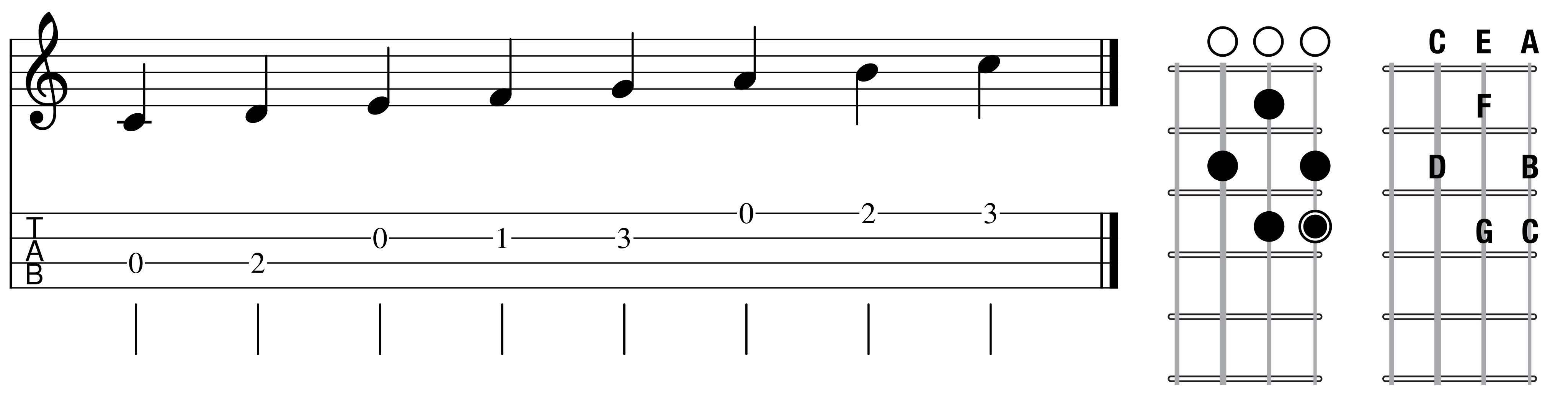
- Descending the Major Scale is the song Joy to the World. If it doen't sound like that song when descending it is not the major scale. Start on the third of the scale, descent to the root and the ascend the sacle and you have another Christmas song: The First Noel. We know these — our fingers don't. 😜


End of Lesson - Thanks, Hope You Enjoyed It!
Related Lessons, Videos, Lesson Series, Songs, Books & Reference Charts, Resources & Assets, Workshops are below.