
Published:
2023-04-03
Updated:
2023-04-03
Learning Ukulele with Curt
The Girl From Ipanema
Harmonic Analysis (RMA) Worksheet for the song: "The Girl From Ipanema".
Author(s): Curt Sheller Publisher: Curt Sheller Publications Code: ULHA-RB1-171
Main Category: Harmonic-Analysis Main Instrument: Any
Categories: Chords, Theory, Intervals, Progressions, RMA, Harmony

2026-08-23
Harmonic Analysis (RMA) Worksheet for the song: The Girl From Ipanema.
The Girl From Ipanema
Garota de Ipanema (The Girl From Ipanema) is a Brazilian bossa nova and jazz song. It was a worldwide hit in the mid-1960s and won a Grammy for Record of the Year in 1965. It was written in 1962, with music by Antônio Carlos Jobim and Portuguese lyrics by Vinícius de Moraes. English lyrics were written later by Norman Gimbel.
The first commercial recording was in 1962, by Pery Ribeiro. The Stan Getz recording featuring the vocal debut of Astrud Gilberto became an international hit. This version had been shortened from the version on the album Getz/Gilberto (recorded in March 1963, released in March 1964), which had also included the Portuguese lyrics sung by Astrud's then husband João Gilberto. In the US, the single peaked at number five on the Billboard Hot 100, and went to number one for two weeks on the Easy Listening chart. Overseas it peaked at number 29 in the United Kingdom, and charted highly throughout the world.
Numerous recordings have been used in films, sometimes as an elevator music cliché. It is believed to be the second most recorded pop song in history, after "Yesterday" by The Beatles. The song was inducted into the Latin Grammy Hall of Fame in 2001. In 2004, it was one of 50 recordings chosen that year by the Library of Congress to be added to the National Recording Registry. wikiwand
Ukulele Chords
These and many other chords are covered in the Learn A Chord A Day series of lessons.
C Tuning Chords
In the Daily Ukulele series of book the chords are actually listing in their order of appearance. And, are always the basic open position chords when possible.

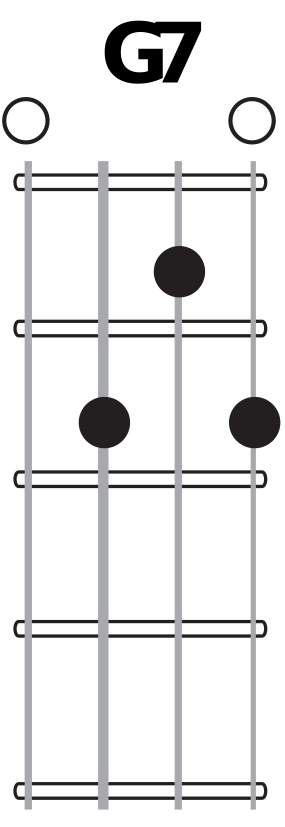
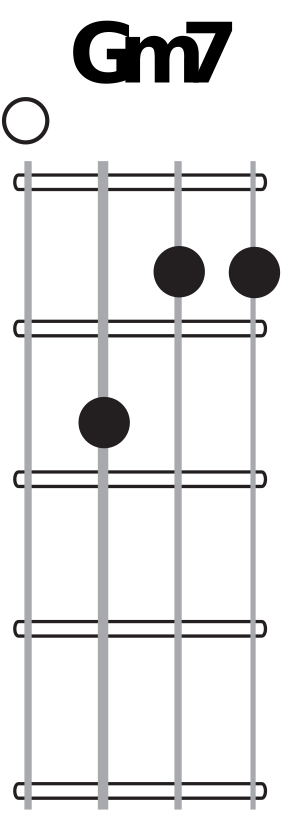


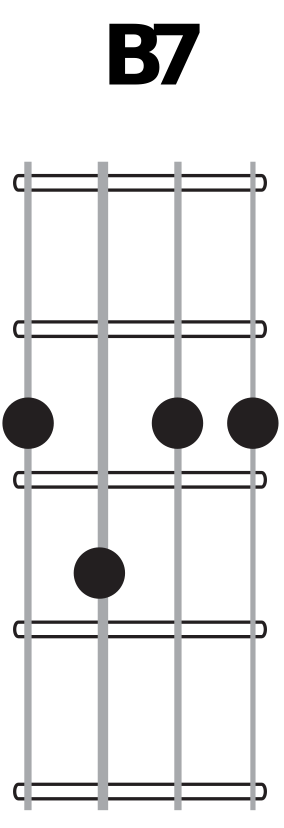

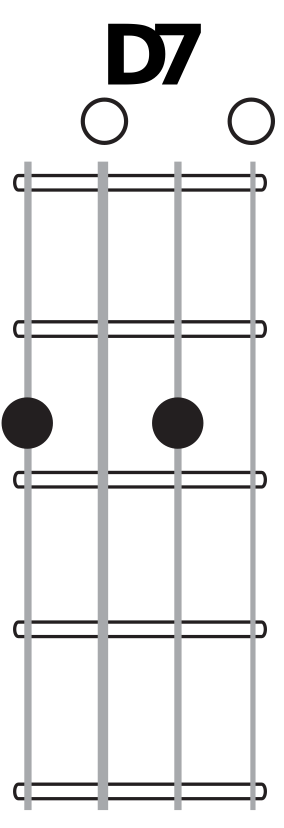
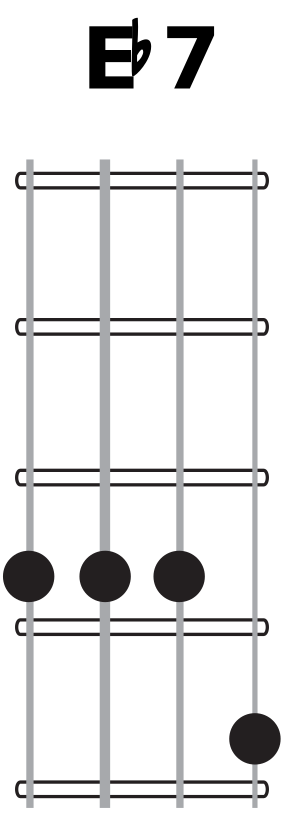
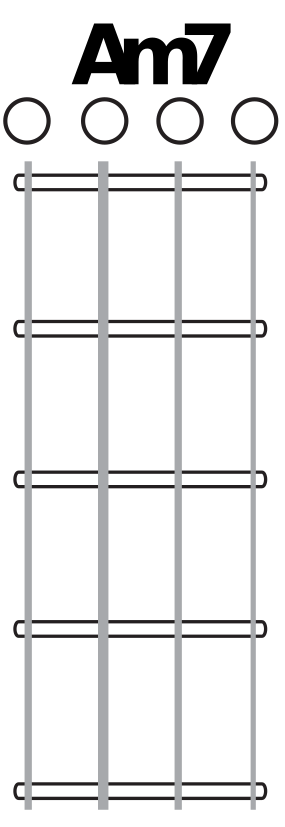


Starting Melody Note and 1st Interval
- The Girl From Ipanema is in 4/4, Common Time and the Key of F .
- Start on M2 ↓ m3.
Intervals Legend: Root=note that begins a scale of the starting key; C is C, D is D, Am is A, Em is E, etc… m=minor; M=Major; P=Perfect; D=Diminished; A=Augmented. • ↑ is up/ascending; ↓ is down/descending;
Harmonic Analysis (HA) Worksheet
Visit the Harmonic Analysis for Scale and Chord Selection series of lessons for information on creating your own Harmonic Analysis Worksheet
A re-harmonization, in Red can be a simple, sticking pretty close to the original composer's intentions or complex and a whole new set of chord changes.
RMA Worksheet Coming Soon
Ralph Patt Vanilla Book

Checkout the Ralph Patt Vanilla Book (ralphpatt.com/Song.html) for the Vanilla
changes for The Girl From Ipanema • The Vanilla Book uncovers the basic (“Vanilla”) chord changes to over 400 of the most commonly played jazz standards
to help the jazz player learn the basic changes
and allow the player to add embellishments and substitutions on a solid framework.
Embellishments to basic chords such as added 6ths, 9ths, 13ths, flat 5ths etc. are usually determined by the melody notes and the style of music being played and finally your ear.
NOTE: Ralph Oliver Patt (5 December 1929 – 6 October 2010) was an American jazz guitarist who introduced major-thirds tuning, which can simplify the learning of the fretboard and chords by beginners and facilitate improvisation by advanced guitarists. His use of this tuning was first inspired by the atonal music of Arnold Schoenberg, and later by the jazz of John Coltrane and Ornette Coleman.
NOTE 2026-09: It appears the ralphpatt.com gone. Checkout the WaubackMachine: web.archive.org/web/20250308000742/http://www.ralphpatt.com/Song.html
The Harmonic Analysis (HA)
A Harmonic Analysis (RMA/HA) and its worksheet are intended to show the function of the chords, the harmonic principles used, the keys and tonalities the song explores. And, can be used for scale selections and chord and scale substitutions.
NOTE: A Harmonic Analysis Worksheet is NOT intended to be a lead leadsheet.
Minimal roadmap information such as repeats, fine, D.S., D.C., and codas has been used in preparing the worksheets to somewhat mirror the leadsheet in the Daily Ukulele book.
Sections, Verse, Chorus, 1st, 2nd Ending, turnbacks …
The worksheets will show 1st, 2nd Ending, turnbacks, etc. as indicated in the Yellow Book
. You should start to recognize that 1st endings typically always return to a previous verse or an  section. With a 2nd ending, a transition to a different part of the song, a
  or chorus. Harmonic Principles are used for these repeats and transitions.
If turnback chords are not indicated for these 1st and 2nd endings in the original Yellow Book leadsheet, recommended chord(s) will be indicated in parentheses or as an alternate harmony in Red . Typically the last measures or turnbacks will be a chord that resolves to and harmonically leads you to the next section or turning you back to the same section. Typically a V or direct substitution of that next chord.
Reference Key
This is the key of the source leadsheet.
- The Girl From Ipanema is in 4/4, Common Time and the Key of F .
Harmonic Principles Used:
These are the harmonic principles used in The Girl From Ipanema.
- Full Diatonic
- Partial Diatonic • Full Diatonic includes Secondary Dominant chords
- Internal Modulation
Nashville Number System (NNS)
Nashville Numbering System always uses four bars/measures per line, no bar lines, and default is each number of the number of beats per bar/measure based on the time signature. If multiple chords in same bar then they are underlined. It can be as simple as converting the Roman Numerals above to Arabic numbers.
At its simplest you simply replace the roman numbers with Arabic numbers. e.g., I becomes 1 , II becomes 2 , etc. The only exception is the bVII7 chord becomes 7 as this borrowed chord from the Mixolydian tonality is so common and the VII (half-diminished seventh) in a major chord is so rare (actually never). And, you could go as far as saying all the modes are numbered: I II III IV V VI VII — just as in the major scale. So calling it a 7 is not that far out.
Check the definitive book Nashville Number System
Scale Selection
Once a Harmonic Analysis has been completed, scale selections can be made. These scale selections can be either vertical or horizontal choices. And, really, only needed if you are going to take a solo or embellish the melody with added notes.
Scale Abbreviation Legend
Traditional Scales: Maj: Major (Ionian), Nat Min: Natural Minor, Dim: Diminished, WT: Whole Tone, Har Min: Harmonic Minor
Contemporary Scales: Minor Pent: Minor Pentatonic, Pent: Major Pentatonic, Blues
Scale/Mode Names: Ion: Ionian (Major), Dor: Dorian (Minor), Phrygian: Phrygian, Lyd: Lydian, Mix: Mixolydian (Dominant), Aeol: Aeolian (Natural Minor), Loc: Locrian
Altered Scales: Mix+4: Mixolydian Plus 4 / Lydian Dominant, Mix-2-6: Mixolydian flat 2, flat 6
Checkout the Lesson Series: Harmonic Analysis for Scale and Chord Selection or download the Harmonic Analysis for Scale and Chord Selection book. And the QuickStart Series of Scale and Arpeggio books.


End of Lesson - Thanks, Hope You Enjoyed It!
Related Lessons, Videos, Lesson Series, Songs, Books & Reference Charts, Resources & Assets, Workshops are below.