
Published:
2012-04-06
Updated:
2024-06-08
Learning Ukulele with Curt
Harmonic Analysis - Partial Diatonic
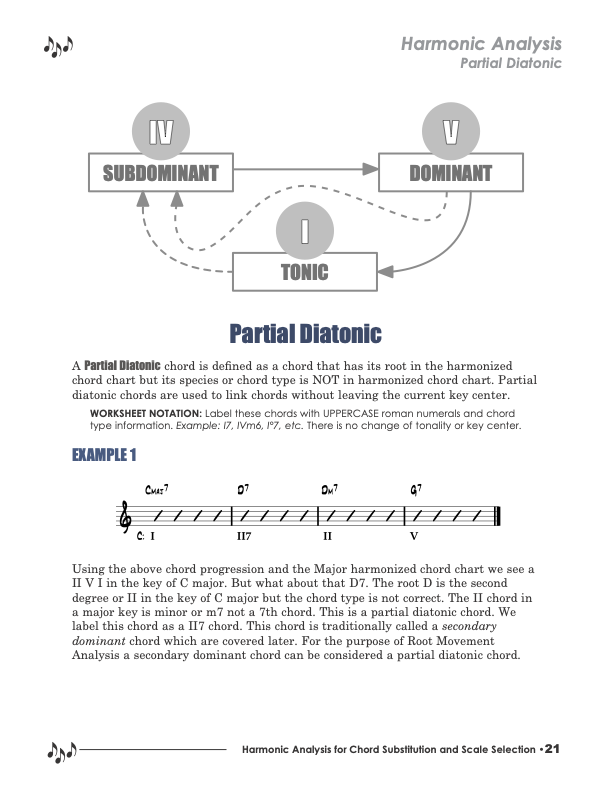
"Partial Diatonic" is defined as a chord that HAS its root in the - "Harmonize Chord Chart," but its species or chord type is NOT in the Harmonized Chord Chart. Partial Diatonic chords are used to link chords without leaving the current key center. Secondary Dominant chords are a big part of this harmonic principle.
Author(s): Curt Sheller Publisher: Curt Sheller Publications Code: MLRMAe-5
Main Category: Theory Main Instrument: Any
Categories: Chords
2026-08-23
Show Series Lessons
Series Home
Number of Pages: 19
If you're a registered site member and have the correct permissions you can view ALL the pages of this PDF at a larger size using the LearningUkulele.com Online PDF Viewer (button below).
Download PDFThis Download is NOT part of your LearningUkulele.com & Learning Ukulele with Curt membership level.
Sign-up for Premium Site Access or Upgrade Your Plan to download this PDF or your can purchase a copy for download
Sign In for Access…Contact Us if there are any issues.
Partial Diatonic is defined as a chord that HAS its root in the - "Harmonize Chord Chart," but its species or chord type is NOT in the Harmonized Chord Chart. Partial Diatonic chords are used to link chords without leaving the current key center.
Secondary Dominant, partial diatonic, chords are a big part of this the Partial Diatonic harmonic principle.
This series, is the book Harmonic Analysis for Chord Substitution and Scale Selection by Curt Sheller broken out into individual lessons with additional examples and content. Always, the latest version of the book.
WORKSHEET NOTATION: Label these chords with UPPERCASE roman numerals and the tonality or key center using an uppercase letter. Example: I7, IVm6, I°7, etc. There is no change of tonality or key center.
EXAMPLE 1
4-Part Jazz
Chords
Triads
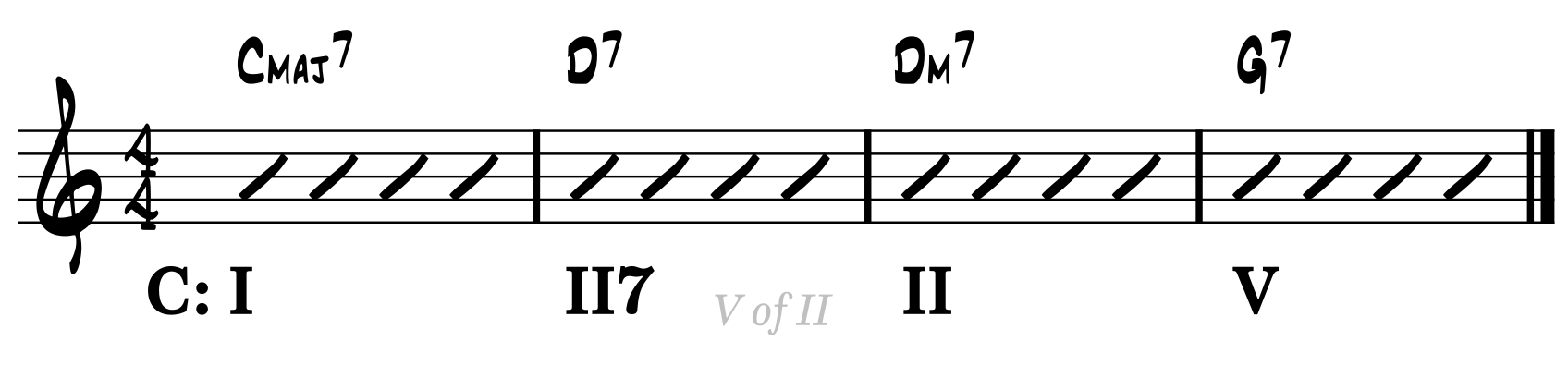
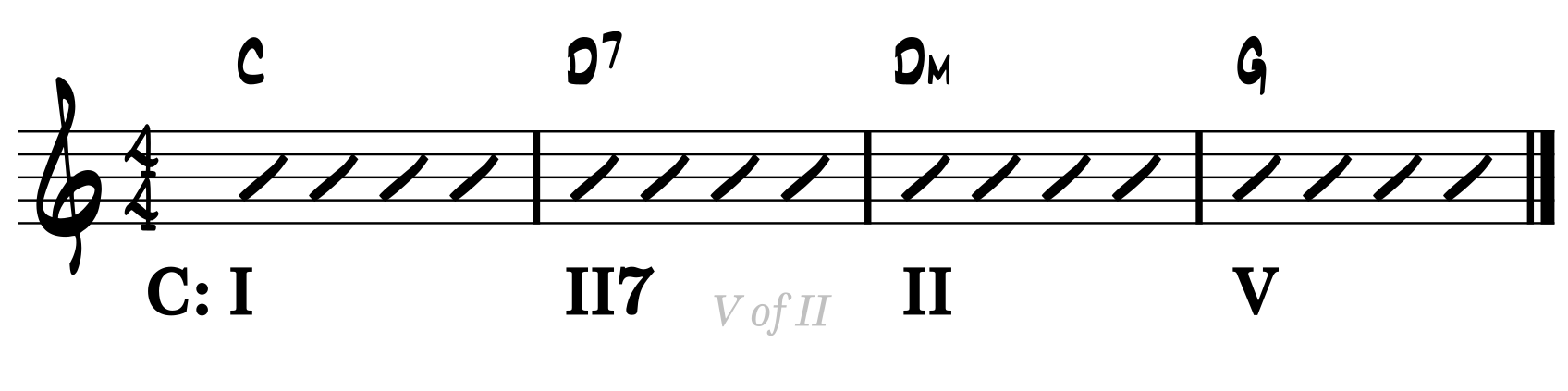
Using the above chord progression and the Major harmonized chord chart we see a II V I , full diatonic chords in the key of C major. But what about that D7. The root D is the second degree or II in the key of C major but the chord type is not correct. The II chord in a major key is minor or m7, not a 7th chord. This is a Partial Diatonic chord. We label this chord as a II7 a * V of II chord. This chord is traditionally called a secondary dominant chord which are covered later. For the purpose of Root Movement Analysis a secondary dominant chord can be considered a partial diatonic chord.
* A Secondary Dominant chord cover later in this lesson.
More Harmonic Analysis - Partial Diatonic
content below, continue exploring...
More Harmonic Analysis - Partial Diatonic
Download the PDF file to explore the Partial Diatonic Major & Minor chord progressions in various keys using the Major & Minor Harmonic Chord Charts .
Secondary Dominants
V of …
A common function of a partial diatonic chord in Tonic-Dominant harmony is to act as a Secondary Dominant, a linking chord.
A Secondary Dominant chord is defined as any seventh chord built on a scale root that resolves up a perfect fourth (P4) or down a perfect fifth (P5) to a Full Diatonic chord. These chords function as a dominant V chord to the next chord, serving to temporarily tonicize the following chord having it act as a I chord. For any secondary dominant chord its II chord can also precede it. Secondary Dominant chords fall under the Partial Diatonic harmonic principle and are labeled as such.
Here are the possible Secondary Dominant chords as defined by the above definition for both Major and Minor tonalities.
VI7 → V of II

NOTE: Major only, Minor does not fit our definition as Ab7 would resolve to D♭maj7 which is not a Full Diatonic chord in the key of Cm.
VI7 → V of III

NOTE: Major only, Minor does not fit our definition as B7 would resolve to Emaj7 which is not a Full Diatonic chord in the key of Cm.
VI7 → V of IV

NOTE: Major and Minor Tonalities
VI7 → V of V

NOTE: Major and Minor Tonalities
VI7 → V of VI

NOTE: Major and Minor Tonalities
The I7 , II7 , III7 are possible in BOTH major and minor tonalities. The VI7 and VII7 are possible in major tonalities only.
Chained Secondary Dominant Cycles
When several Secondary Dominant chords are used in a row and resolve up a fourth or down a fifth to a seventh chord, this is called a chained secondary dominant cycle or sequential dominants. Functioning as a dominant of a dominant V of… .

Chained Secondary Dominant Cycle
These Secondary Dominant chords can be preceded by there II chords.

Chained Secondary Dominant Cycle with Their II Chords
For scale selection treat these Chained Secondary Dominant chords as series of Unresolved V chords or unresolved II V chords.
Chained Secondary Dominant Cycles Examples
I Got Rhythm (Bridge)
Scrapple the Apple (I Got Rhythm "Changes" Bridge)
Jordu
Contains two Secondary Dominant cycles in the bridge.
Stompin' at the Savoy
Contains a Secondary Dominant cycle in the bridge starting on the IV7 chord.
Diminished Chords?
°7 vs. 7♭9
Some diminished chords are actually functioning as Disguised Secondary Dominant chords. So…
Q. When is a Diminished Chord NOT a Diminished Chord?
To determine if a diminished chord is functioning as a Disguised Secondary Dominant write out all four notes of the diminished chord: C Eb Gb Bbb (A) .

Drop each note 1/2 step and make each a root of a 7th chord:
C7 , Eb7 , Gb7 , A7
If the next chord is a major 7 or minor 7 chord, which if it was a I chord and the preceding chord could be its V chord. Then the diminished chord is really a 7 flat 9 chord — A Disguised Secondary Dominant. This is a common notational practice to insure that a specific chord tone is played as the lowest note of the chord voicing. Slash chord notation could and should have been used.
Examples in the Key of C
♯I°7 (♭II) = VI7♭9 • V of II
C#°7 = A7♭9/C♯
♯II°7 (♭III) = VII7♭9 • V of III
D♯°7 = B7♭9/C♯
♯IV°7 (♭V) = III7♭9 • V of VI
F♯°7 = E7♭9/C♯
♯V°7 (♭VI) = II7♭9 • V of V
G♯°7 = D7♭9/C♯
A.
When a Diminished Seventh chord resolves to a chord 1/2 step above its root it is functioning as a Disguised Secondary Dominant chord.
Song Examples
Jazz Classics
God Bless The Child
bar 1
I7
Have You Meet Miss Jones
bar 2
I#dim7 Disquised Secondary Dominant
Hello Dolly
bar 6
Idim7 (A True Diminished Chord).
Lover Man
bar 5
I7
bar 6
IV7
Meditation
bar 3
VII7
bar 8
VI7)
Satin Doll
bar 5
II7
bar 7
IV7
The Shadow of Your Smile
bar 4
IV7
Someday My Prince Will Come
bar 2
VI7
Take the 'A' Train
bar 3
II7
The Girl from Ipenama
bar 3
II7
Killer Joe
bar 2
VII7
Checkout the Songs section of LearningUkulele.com , as many of the songs examples above are available.


End of Lesson - Thanks, Hope You Enjoyed It!
Related Lessons, Videos, Lesson Series, Songs, Books & Reference Charts, Resources & Assets, Workshops are below.