
Published:
2022-09-07
Updated:
2026-06-29
Learning Ukulele with Curt
Ain't Misbehavin
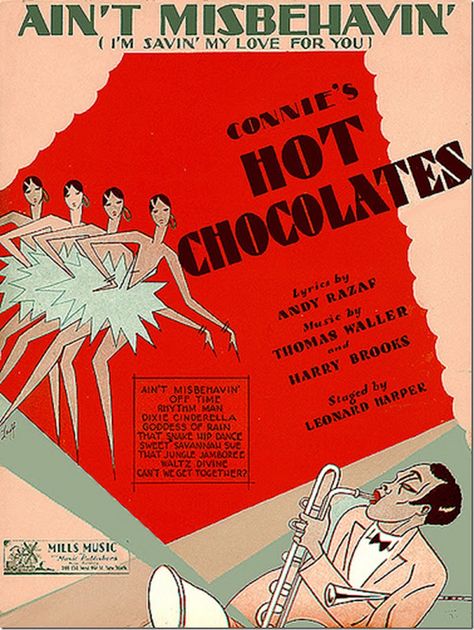
"Ain't Misbehavin'" is a 1929 stride jazz/early swing song. Andy Razaf wrote the lyrics to a score by Thomas "Fats" Waller and Harry Brooks for the Broadway musical comedy play Connie's Hot Chocolates.
Author(s): Curt Sheller Publisher: Curt Sheller Publications Code: UL1104
Main Category: Arpeggios Main Instrument: Ukulele
Categories: Jazz

2026-08-19
If you're a registered site member and have the correct permissions you can view ALL the pages of this PDF or Samples pages at a larger size using the LearningUkulele.com Online PDF Viewer.
Download PDFThis Download IS part of your Gold Site Access and a FREE download. Thanks for supporting the site. – Curt
Each PDF file is a professionally prepared, formatted, high resolution file that prints out great. You'll need a PDF Reader or application capable of viewing PDF files to view the PDF.
NOTE: Download the current PDF file for the latest, complete, and most up-to-date version. As well as additional information not presented on-line.
"Ain't Misbehavin'" is a 1929 stride jazz/early swing song. Andy Razaf wrote the lyrics to a score by Thomas "Fats" Waller and Harry Brooks for the Broadway musical comedy play Connie's Hot Chocolates.
The song was first performed at the premiere of Connie's Hot Chocolates in Harlem at Connie's Inn as an opening song by Paul Bass and Margaret Simms, and repeated later in the musical by Russell Wooding's Hallelujah Singers. Connie's Hst Chocolates was transferred to the Hudson Theatre on Broadway during June 1929, where it was renamed to Hot Chocolates and where Louis Armstrong became the orchestra director. The script also required Armstrong to play "Ain't Misbehavin'" in a trumpet solo, and although this was initially slated only to be a reprise of the opening song, Armstrong's performance was so well received that the trumpeter was asked to climb out of the orchestra pit and play the piece on stage. As noted by Thomas Brothers in his book Louis Armstrong: Master of Modernism, Armstrong was first taught Ain't Misbehavin'
by Waller himself, woodshedding
it until he could play all around it
; he cherished it because it was 'one of those songs you could cut loose and swing with.'

Ain't Misbehavin` is in the The Daily Ukulele — 365 Songs for Better Living book.
Strum a different song every day with easy arrangements of 365 of your favorite songs in one big songbook! The Daily Ukulele features ukulele arrangements with melody, lyrics and uke chord grids and are in ukulele-friendly keys that are particularly suited for groups of one to one hundred to play and sing.
- Checkout the Harmonic Analysis for Ain't Misbehavin` in the Daily Uke Book.
More Ain't Misbehavin
content below, continue exploring...
More Ain't Misbehavin
As a work from 1929 with its copyright renewed, it entered the American public domain on January 1, 2025.
Video Demonstrations below
Ain't Misbehavin' – iReadPro Playalong — Click on the link and the leadsheet will load into the iRealPro app (if you have it installed). The Main Download mp3 file is the iReal Pro leadsheet without an intro or ending, straight up AABA form.
Musescore Leadsheet – Melody, Lyrics, and Sample Bass Line — This is good to download and play to practice as the melody will play as if someone was singing it.
Performance & Arrangement Notes
 This arrangement utilizes a richer harmonic palette of
4-part
This arrangement utilizes a richer harmonic palette of
4-part Jazz
chords
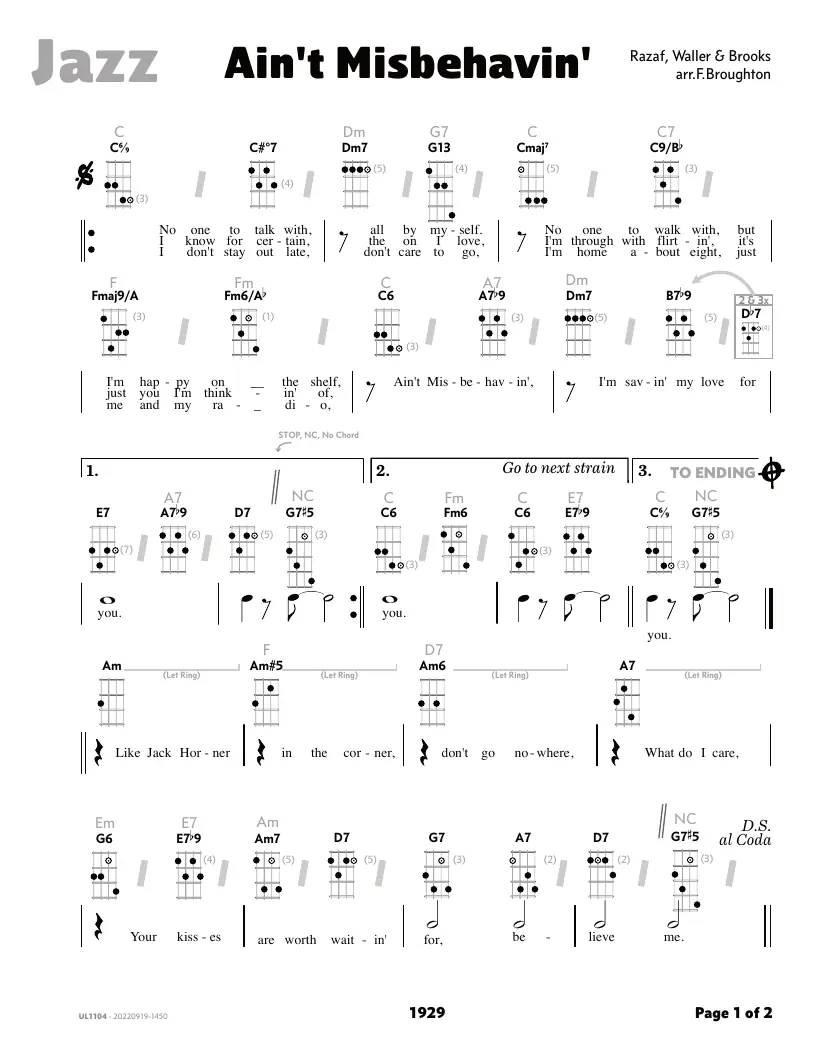
. These chords offer one a broader range of possible chord voicings and moving lines within the chords. This is in the style of the era, with a little touch of modern harmony.
Typically this type of arrangement a single chordal instrument such as a piano or guitar is playing in an accompaniment role, i.e. comping
style with the rhythm patterns improvised in the style of the song. Any additional chordal instruments would have to find their part, as they would have no idea of the rhythmic figures and chord voicings that the main
accompanist is selecting. Listen to the iRealPro recording and try to guess what the piano is doing rhythmically and chord wise — you would have to perfectly match that. Basically one would need to find the harmonic and rhythmic space that is not being taken already.
These are the choices that I had to make for this arrangement to be played ensemble, by multiple ukuleles. Rhythmically we have to keep a steady four to the bar to sound together and pleasant. See the
video demonstrations below
for an example using the simpler basic open position chords version that was created to mesh with the richer 4-part, a.k.a. Jazz
chords version.
When performing us a light, staccato down stroke on the one and three and a light accent on the two and four. A light muted up-stroke can follow on the upbeats, the and of two and/or four.
An even simpler approach is to strike the chords, lightly and let it ring for the duration of the chords rhythmic value — either half notes or whole notes. This will give you time to switch.
All three of these
comping
styles will work harmonically and rhythmically. Creating the illusion of a well-rehearsed band.
Remember the role of an accompanist is to support and showcase the vocalist — it's not about them.
Chord Decisions Made for the Arrangement
- The
C#dim7
is really a disguised Secondary Dominant
chord, an
A7♭9/C♯
, a
V
of
II
. Basically,
A7
to
Dm
or
Dm7
in the
Key of C Major
. More commonly notated as C♯dim7, a diminished seventh chord. This chord is used for the
Easy
version, as you have a better chance of beginner to intermediate players giving you the C♯ bass note you want for the C♯ to D chromatic bass line. Advanced players should have no problem with the A7♭9/C♯ notation and voicing and should give you the C♯ chromatic bass line. - The Cdim7 is truly a diminished chord.
- Slash Chords — These are the chords like A7♭9/C♯, C7/B♭, Fmaj9/A. The letter after the slash (/) is the bass note you want as the lowest in the chord voicing, typically a bass player will handle this. Any chordal instrument that has these low notes available, i.e., piano and guitar, they should play chord voicings with that note as the lowest note in the voicing. On a ukulele with a
high
string four, you can pretty much ignore that and simply play any available voicing that you know. A ukulele with a low string four is very limited in playing these slash chords and can safely ignore them as well. It's bonus points to players with alow
string four that play voicings with the notated bass-line/voicings when available on their instrument. - Altered Chords — for the altered chords functioning in a dominant harmonic role. I've used 7♭9 substitutions and not ♯9 , ♭5 , or ♯5 alterations as they would tend to clash harmonically with someone playing basic chords that will have a perfect fifth in them. There will still be a little dissonance with the ♭9 , but that is what we want in those chords, as they heighten the feeling of resolution to the next chord. To get a ♭9 simply raise the root of the chord one fret or one half-step.
- The
Am
,
Am♯5
,
Am6
chords are the correct names of these chords. You might say,
The F is the same as Am♯5 and the D7 is the same as Am6 .
Again, it's creating a chart where you increase you chances of getting the desired results form chordal instruments as well as any bass player. Often simpler chord names, albeit harmonically and theoretically wrong will get you the results you are looking for.
One might ask why bother playing all those fancy
quote un-quote Jazz
chords. Simply listen or play both versions, and you make the call. They are worth the effort.
Video Demonstration
Open Position Chords Version
Beginner Intermediate Level
Easy Open Position Chords Version
Jazz Chords Version
Intermediate, Advanced
A bit more challenging and in the style of the times.
Contemporary 4-part Jazz
Chords Version
Great YouTube Videos
- Fats Waller – Ain't Misbehavin • Can't go wrong with the composer — great video.
- Louis Armstrong – Ain't Misbehavin • The master at work.
- Ain’t Misbehavin’ in C Bass Line Play Along Backing Track – MySunnybass • This is a great backing track for learning and practicing against.