
Published:
2006-01-02
Updated:
2023-10-22
Learning Ukulele with Curt
Reading Music on Ukulele Series - The Basics
Learning to read begins with recognizing the notes on the staff and knowing where they are located on the fingerboard. Knowing the name is also a essential skill.
Author(s): Curt Sheller Publisher: Curt Sheller Publications Code: UKEREAD1P-LB
Main Category: Reading Main Instrument: Ukulele
Categories: Basics, Chords, Fingerboard, Reading, Notation
2026-08-23
RelatedLessonAssets
Show Series Lessons
Series Home
Learning to read begins with recognizing the notes on the staff and knowing where they are located on the fingerboard. Knowing the name is also a essential skill.
Note Recognition

Music uses a five line staff with four spaces and the first seven letters of the alphabet ( A, B, C, D, E, F, and G ) to names notes. Notes can fall on the lines and spaces of the staff and above and below the staff. Additional lines called ledger lines are added for notes above and below the staff.
The ukulele uses the Treble or G
clef. The curl in the clef actually encircles the G
note, line two from the bottom.
The Lines and Spaces of the Staff
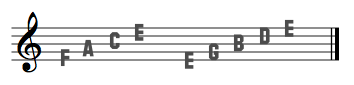
The lines are named, starting with the bottom line, E G B D and F. This has been traditionally remembered as Every Good Boy Does Fine. Other popular mnemonics include Empty Garbage Before Dad Flips, Even Grandma Belly Dances Fine..
The spaces are named, starting with the bottom space and going up, F A C and E. This spells face
.
Practice reading and writing these notes.
There are two notes that fall directly above and below the staff. There are D and G. D is the first space below the staff and the G is the first space above the staff.


Note: Put the names of the lines and spaces in a continuous loop and you have: E G B D F A C E G B D F A C E G B D F E C … In music the distance from one letter the next in this sequence is an interval of a third, either a major or minor third . You'll find that chords are typically built in thirds – so this sequence is handy to remember when it comes to reading chords and arpeggios and knowing the notes of individual chords, i.e., Chord Spelling .
Sharps, Flats and Naturals - Accidentals
 The Sharp( ♯ ), flat( ♭ ) and natural( ♮ ) symbol always appear to the left of and before the note. Just say the sharp, flat or natural after the letter name of the note. C sharp, B flat, F natural, E flat, etc…
- The Sharp raises the pitch of a note 1/2 step or semitone.
- The Flat lowers the pitch of a note 1/2 step or semitone.
- The Natural returns a previously sharped or flatted note to it's original
natural
note.
NOTE: There are such things as double flats and sharps, and even triple flats and sharps. These are quite rare. If you encounter them, a double simple raises a note two half steps and a double flat lowers a note two half steps.
Learn the recognize these sharp, flat, and natural notes. Where to play them on the ukulele will come after learning the locations of the natural notes.
For more information on whole steps, half steps, tones, and semitones visit this lesson page on the The Chromatic Scale
Ledger Lines
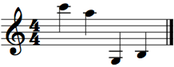
Ledger Lines are small lines that appear above or below the staff. These extend the range of notes above or below the staff. The ukulele will use one or two ledger lines below the staff depending on the tuning you're use. C tuning uses one ledger line below and a C tuning with a low G uses two ledger lines below.
Natural, Sharp and Flat Notes of the `Ukulele Fingerboard - C Tuning
Here is a FREE Chart of the Natural, Sharp and Flat Notes in C Tuning .
Note Duration
The notes on the staff indicate the pitches to play and the duration of each pitch.
First the note symbols used to indication the length or duration that a note is to sound.
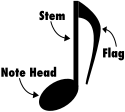
A written notes contains at a minimum a note head, positioned on the staff to indicate pitch and a stem and possibly a flag or beam.
Whole Note Semibreve

In music, a Whole note (American) or Semibreve (British) is a note represented by a hollow oval note head and no note stem.
Half Note Minim

Half note (American) or Minim (British) is a note played for half the duration of a whole note (or semibreve) and twice the duration of a quarter note (or crotchet).
Quarter Note Crotchet
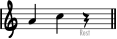
A Quarter note (American) or Crotchet (British) is a note played for one quarter of the duration of a whole note (or semibreve). Often, musicians will say that a crotchet is one beat, but this is not always correct, as the beat is indicated by the time signature of the music; a quarter note may or may not be the beat. Quarter notes are notated with a filled-in oval note head and a straight, flagless stem. The stem usually points upwards if it is below the middle line of the stave or downwards if it is on or above the middle line. However, the stem direction may differentiate more than one part. The head of the note also reverses its orientation in relation to the stem.
Eighth Note Quaver
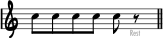
An Eighth note (American) or a Quaver (British) is a musical note played for one eighth the duration of whole note (semibreve), hence the name.
Sixteenth Note Minim
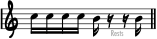
Sixteenth note (American) or minim (British) is a note played for half the duration of an eighth note (quaver), hence the names.
Thirty-Second Note
Thirty-Second note (American) or Demisemiquaver (British) is a note played for 1⁄32 of the duration of a whole note (or semibreve). It lasts half as long as a sixteenth note (or semiquaver) and twice as long as a sixty-fourth (or hemidemisemiquaver).
Other note duration's such as Hemidemisemiquaver / Sixty-Fourth note, Semihemidemisemiquaver / Quasihemidemisemiquaver / Hundred Twenty-Eighth note and Demisemihemidemisemiquaver / Two hundred Fifty-Sixth note. Which are quite rare.
Time Signatures
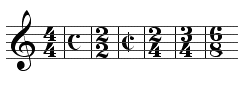
The actual duration depends on the Time Signature. A time signature is a notational used in standard music notation to specify how many beats are to be contained in each measure — the top number, and which note value is equivalent to one beat — the top number. That equivalent to one beat is critical to know. The time signature appears at the beginning of a section of music. It can appear as, stacked numerals, like a fraction or as a letter. 4/4 is the most common time signature, so common that the letter C is substituted for 4/4. A C with a vertical indicates, Cut Time
, still 4/4 common time, however felt as if it is 2/4.
Music Symbols
Musical Symbols are the marks and symbols, used since about the 13th century in the musical notation of musical scores, styles, and instruments to describe pitch, rhythm, tempo and, to some degree, its articulation.
A great list of music symbols, more then you'll ever need or see can be found on wikiwand: List of Musical Symbols
D.C, D.S., and Endings
Most musical terms are Italian, French, or Germany - with Italian being the most common.
Da Capo (often abbreviated as D.C.) is an Italian musical term that means "from the beginning" (literally, "from the head"). Tells the performer to repeat playing of the music from its beginning. It is a space saving device.

Da Segno (lit. "From the sign") Tells the performer to repeat playing of the music starting at the nearest segno. This is followed by al fine or al coda just as with da capo.

Da Capo al Fine (often abbreviated as D.C. al Fine). Da Capo as above is an Italian musical term that means "from the beginning" (literally, "from the head") with the additional instruction to play till the Fine
(the End).

Da Segno al Fine Back to the Sign and then to Fine (the end).

Repeats
Repeats come in two flavors. Both indication what measures or section to repeat.

For the next repeat it used to indicate repeating long section, more measures that the above repeats. Repeat once if there is no indication of the number of times to repeat.


End of Lesson - Thanks, Hope You Enjoyed It!
Related Lessons, Videos, Lesson Series, Songs, Books & Reference Charts, Resources & Assets, Workshops are below.
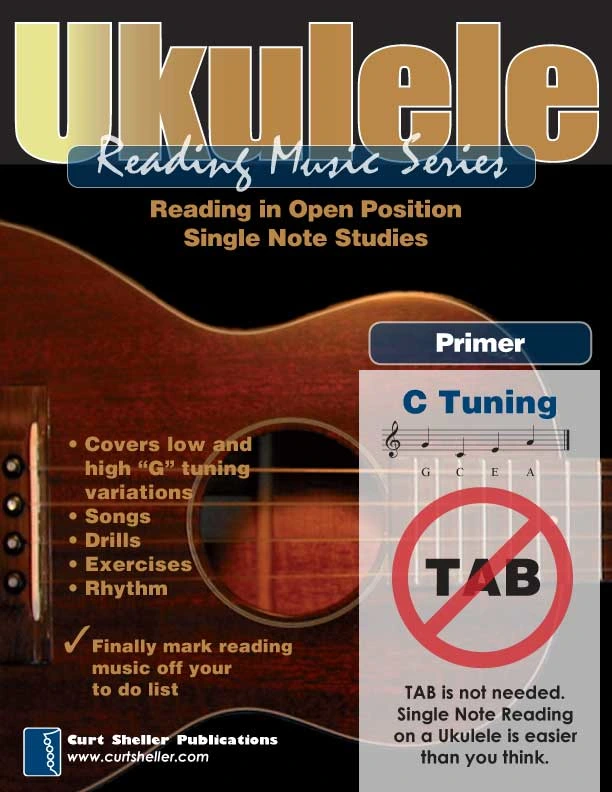
Reading Music on Ukulele - Primer
In the realm of music, there are certain aspects that students and players often tend to avoid. These include skills such as learning to read music and familiarizing themselves with the notes on their instrument. While these tasks may seem challenging, particularly on the fretted string instruments, they are comparatively easier on the ukulele. With the appropriate guidance and a well-defined plan, mastering these skills can be a smooth and achievable process.
Six Secrets of Ukulele Fingering Series
Learn the six fingering principles to navigating the ukulele fingerboard. Fingering is one of the most universal topics. Whether your style is Rock, Blues, Country, Jazz or Classical, these principles will improve your technique, your solos, even your sight reading. Think of fingering as a series of pathways. When you learn to connect these pathways, there are benefits not only to technique but also to creativity. All fingering on the ukulele can be reduced to 6 principles of motion. Each principle has physical and musical characteristics that you can use to improve your playing.