
Published:
2013-01-31
Updated:
2021-11-06
Learning Ukulele with Curt
Four Famous Core `Ukulele Strums - Pattern - Pattern Four
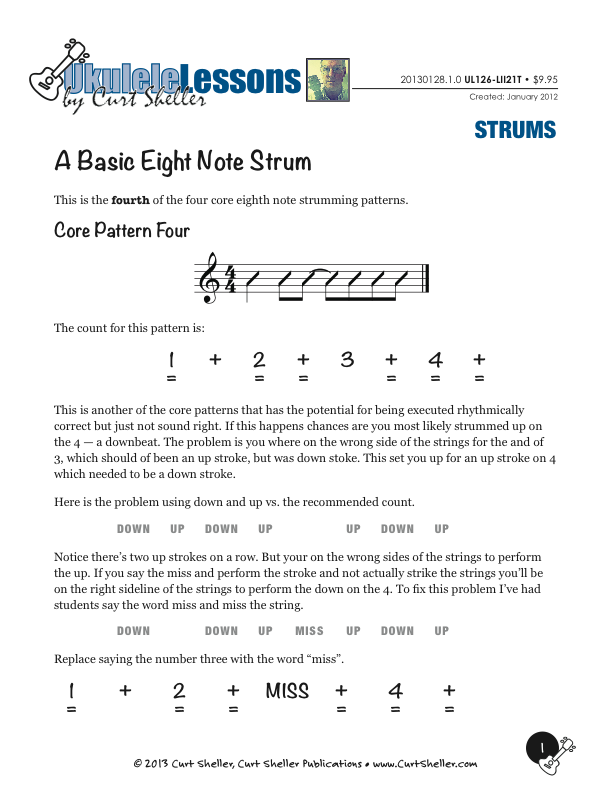
For ukulele, there are four core, basic strums that will get you started. This is the fourth of the four core patterns. This is the famous Island Strum that you will hear a lot in the Ukulele community.
Author(s): Curt Sheller Publisher: Curt Sheller Publications Code: UL126-LII21T
Main Category: Strums Main Instrument: Ukulele
Categories: Chords

2026-08-23
Show Series Lessons
Series Home
Number of Pages: 2
If you're a registered site member and have the correct permissions you can view ALL the pages of this PDF at a larger size using the LearningUkulele.com Online PDF Viewer (button below).
Download PDFThis Download is NOT part of your LearningUkulele.com & Learning Ukulele with Curt membership level.
Sign-up for Premium Site Access or Upgrade Your Plan to download this PDF or your can purchase a copy for download
Sign In for Access…Contact Us if there are any issues.
For ukulele, there are four core, basic strums that will get you started. This is the fourth of the four core patterns. This is the famous Island Strum that you will hear a lot in the Ukulele community.
The left and right hand on the ukulele don't always follow direction. So if you need it use the followin verbal direction to you strumming hand to sync with the pulse of a four beat pattern. D is down and U is up.

The standard rhythmic notation for this pattern in time is:

Modular Phonetic Rhythmic
This core strum is two Level II Modular Phonetic Rhythmic Syllables. Just like the core strum two but with a tie from the end of the first rhythmic syllables to the beginning of the second syllable.
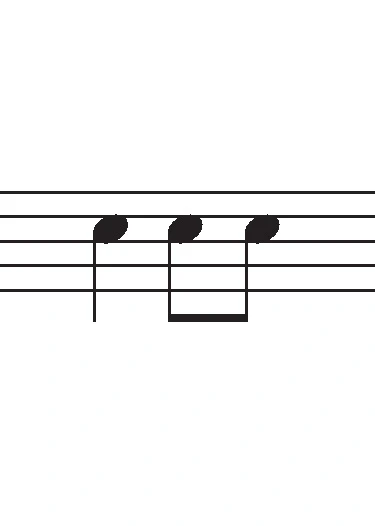
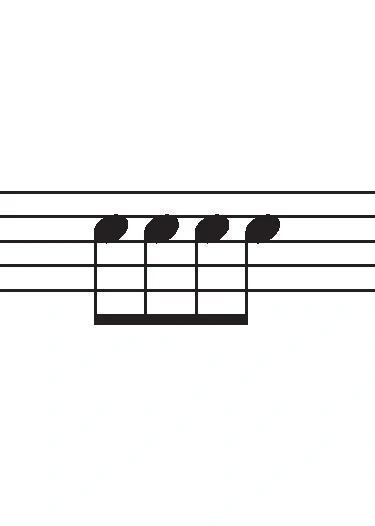
Level II-T Modular Phonetic Rhythmic Syllable with their counts.
More Four Famous Core `Ukulele Strums - Pattern - Pattern Four
content below, continue exploring...
More Four Famous Core `Ukulele Strums - Pattern - Pattern Four
Modular Phonetic Rhythmic Universal Counting
except from Chuck Anderson's Modular Phonetic Rhythm • Foundation
Modular Phonetic Rhythmic Universal Counting
 Universal counting is a (non-traditional) approach to counting rhythm. Counting has traditionally been linked to time signatures. If a piece were in common time, the count would always extend to 4 by the end of each measure. The half note for example, would be counted 1 2, or 2 3 or 3 4 depending on its location in the measure. In signatures other than common time, the variety can be even greater. In the universal counting system, a half note is always counted 1 2, regardless of its location in the measure. This concept is extended to every syllable in modular phonetics. Though some of these counts appear to duplicate from one level to another, they are unique when you factor in the subdivisions. 123 in level I is not heard or felt the same as 123 in level III.
In the long run, counting systems are relatively unimportant because, at more advanced levels, the counting is eliminated in favor of the eye - ear - hand reflex. The eye sees the rhythm, the ear hears it and the hand reflexively executes it. The closest parallel to this process is reading a language. As our knowledge of vocabulary in a language grows, we begin to recognize words, how they are pronounced and what they mean. We can achieve the exact same fluent result in reading the visual language of rhythm.


End of Lesson - Thanks, Hope You Enjoyed It!
Related Lessons, Videos, Lesson Series, Songs, Books & Reference Charts, Resources & Assets, Workshops are below.