Published:
2024-01-05
Updated:
2024-01-05
Learning Ukulele with Curt
The 59th Street Bridge Song (Feelin' Groovy)
Harmonic Analysis (RMA) Worksheet for the song: "The 59th Street Bridge Song (Feelin' Groovy)".
Author(s): Curt Sheller Publisher: Curt Sheller Publications Code: ULHA-YB-97
Main Category: Harmonic-Analysis Main Instrument: Any
Categories: Theory, Intervals, Progressions, RMA, Harmony

2026-08-23
RelatedLessonAssets
Harmonic Analysis (RMA) Worksheet for the song: The 59th Street Bridge Song (Feelin' Groovy).
The 59th Street Bridge Song (Feelin' Groovy)
Released: 16 August 1966
The 59th Street Bridge Song (Feelin' Groovy) is a song by folk rock duo Simon & Garfunkel, written by Paul Simon and originally released on their 1966 album Parsley, Sage, Rosemary and Thyme. Cash Box called it a "sparkling, spirited lid".
The song is named for the Queensboro Bridge which spans the East River between the New York City boroughs of Manhattan and Queens, 59th Street Bridge being a popular unofficial alternate name for that landmark whose Manhattan end is located between 59th and 60th Streets. Reportedly the song came to Paul Simon during a daybreak walk across the Queensboro Bridge: the line: "Just kicking down the cobblestones" refers to the paving at the approach to the bridge's Queens' end, while "Hello lamppost, what'cha knowing" refers to either of two bronze lampposts one of which stood at both the bridge's Manhattan and Queens' ends, the latter being removed circa 1975. Simon opted to entitle the song after its site of inspiration rather than its prominent "Feelin' Groovy" hook line "Feelin' Groovy", Simon balking at labeling one of his songs with such a lowbrow turn of phrase: however "The 59th Street Bridge Song" would be tracklisted on the Parsley, Sage, Rosemary and Thyme album with "Feelin' Groovy" as its parenthetical subtitle. wikiwand
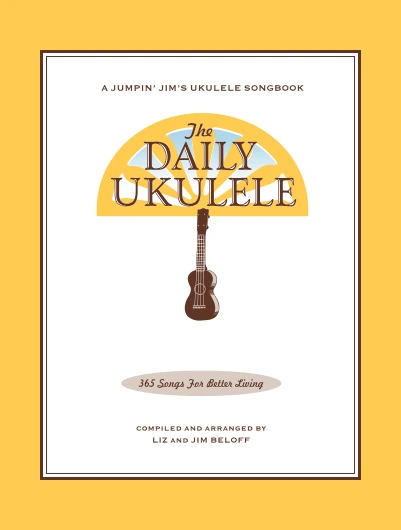
The 59th Street Bridge Song (Feelin' Groovy) is in the The Daily Ukulele — 365 Songs for Better Living book.
Strum a different song every day with easy arrangements of 365 of your favorite songs in one big songbook! The Daily Ukulele features ukulele arrangements with melody, lyrics and uke chord grids and are in ukulele-friendly keys that are particularly suited for groups of one to one hundred to play and sing.
Ukulele Chords
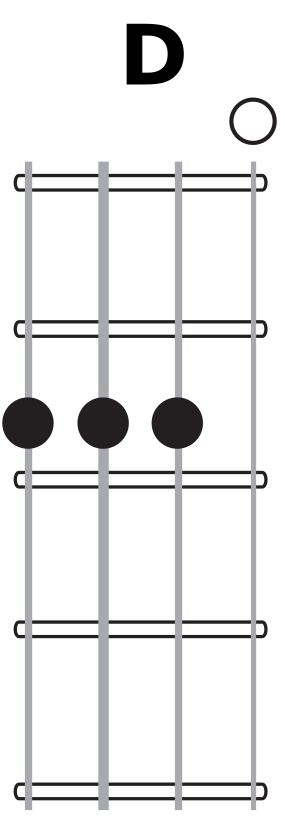
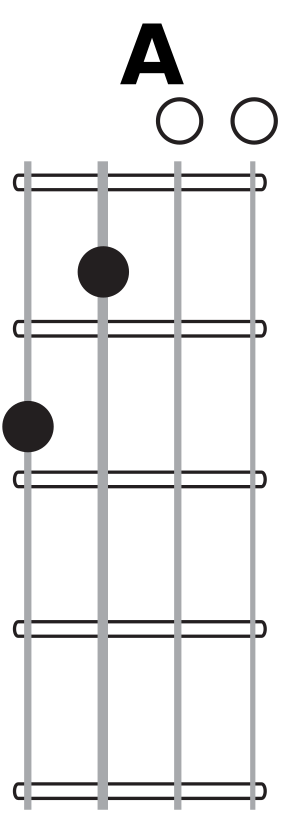
These and many other chords are covered in the Learn A Chord A Day series of lessons.
C Tuning Chords
In the Daily Ukulele series of book the chords are actually listing in their order of appearance. And, are always the basic open position chords when possible.
Starting Melody Note and 1st Interval
Intervals Legend: Root=note that begins a scale of the starting key; C is C, D is D, Am is A, Em is E, etc… m=minor; M=Major; P=Perfect; D=Diminished; A=Augmented. • ↑ is up/ascending; ↓ is down/descending;
Harmonic Analysis (HA) Worksheet
Visit the Harmonic Analysis for Scale and Chord Selection series of lessons for information on creating your own Harmonic Analysis Worksheet
Repeat and fade out
Notice and lot of Harmonic Repetition. A simple FUll Diatonic chord progression you'll be able to do an analysis on the fly over time.
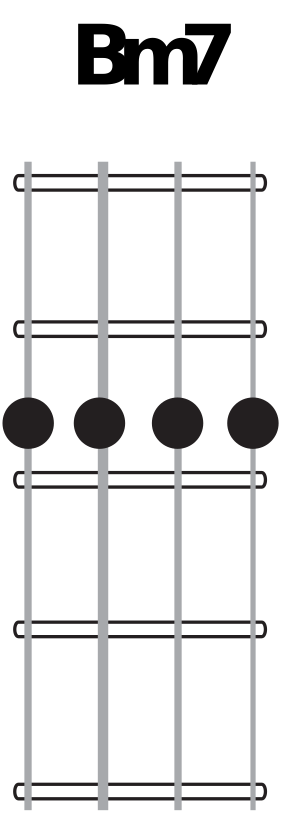
If there is a Bass Player handling the low end you can safely play D vs. Bm7 . With D , D F# A you have three of the notes of the Bm7 [B D F# A].
The Harmonic Analysis (HA)
A Harmonic Analysis (RMA/HA) and its worksheet are intended to show the function of the chords, the harmonic principles used, the keys and tonalities the song explores. And, can be used for scale selections and chord and scale substitutions.
NOTE: A Harmonic Analysis Worksheet is NOT intended to be a lead leadsheet.
Minimal roadmap information such as repeats, fine, D.S., D.C., and codas has been used in preparing the worksheets to somewhat mirror the leadsheet in the Daily Ukulele book.
Sections, Verse, Chorus, 1st, 2nd Ending, turnbacks …
The worksheets will show 1st, 2nd Ending, turnbacks, etc. as indicated in the Yellow Book
. You should start to recognize that 1st endings typically always return to a previous verse or an  section. With a 2nd ending, a transition to a different part of the song, a
  or chorus. Harmonic Principles are used for these repeats and transitions.
If turnback chords are not indicated for these 1st and 2nd endings in the original Yellow Book leadsheet, recommended chord(s) will be indicated in parentheses or as an alternate harmony in Red . Typically the last measures or turnbacks will be a chord that resolves to and harmonically leads you to the next section or turning you back to the same section. Typically a V or direct substitution of that next chord.
Reference Key
This is the key of the source leadsheet.
- The 59th Street Bridge Song (Feelin' Groovy) is in 4/4, Common Time and the Key of D . The original is in the Key of C , Tempo: 76 bpm
Harmonic Principles Used:
These are the harmonic principles used in The 59th Street Bridge Song (Feelin' Groovy).
Nashville Number System (NNS)
Nashville Numbering System always uses four bars/measures per line, no bar lines, and default is each number of the number of beats per bar/measure based on the time signature. If multiple chords in same bar then they are underlined. It can be as simple as converting the Roman Numerals above to Arabic numbers.
At its simplest you simply replace the roman numbers with Arabic numbers. e.g., I becomes 1 , II becomes 2 , etc. The only exception is the bVII7 chord becomes 7 as this borrowed chord from the Mixolydian tonality is so common and the VII (half-diminished seventh) in a major chord is so rare (actually never). And, you could go as far as saying all the modes are numbered: I II III IV V VI VII — just as in the major scale. So calling it a 7 is not that far out.
Check the definitive book Nashville Number System
Scale Selection
Once a Harmonic Analysis has been completed, scale selections can be made. These scale selections can be either vertical or horizontal choices. And, really, only needed if you are going to take a solo or embellish the melody with added notes.
Scale Abbreviation Legend
Traditional Scales: Maj: Major (Ionian), Nat Min: Natural Minor, Dim: Diminished, WT: Whole Tone, Har Min: Harmonic Minor
Contemporary Scales: Minor Pent: Minor Pentatonic, Pent: Major Pentatonic, Blues
Scale/Mode Names: Ion: Ionian (Major), Dor: Dorian (Minor), Phrygian: Phrygian, Lyd: Lydian, Mix: Mixolydian (Dominant), Aeol: Aeolian (Natural Minor), Loc: Locrian
Altered Scales: Mix+4: Mixolydian Plus 4 / Lydian Dominant, Mix-2-6: Mixolydian flat 2, flat 6
Checkout the Lesson Series: Harmonic Analysis for Scale and Chord Selection or download the Harmonic Analysis for Scale and Chord Selection book. And the QuickStart Series of Scale and Arpeggio books.
Performance Notes
Intro
Steady, swung fingerpicking of the chords, best done on a low string four tuning so you can get a bit of Paul Simon's descending baseline.


End of Lesson - Thanks, Hope You Enjoyed It!
Related Lessons, Videos, Lesson Series, Songs, Books & Reference Charts, Resources & Assets, Workshops are below.

A Guide to Ukulele Strums
Learn a variety of strums and rhythmic patterns in wide range of musical styles. One of the first skills a ukulele player learns is the art and craft of strumming, playing rhythm. This refers to an accompaniment technique suitable for the singer, singer - songwriter or someone who plays a support role for another instrument.
Harmonic Analysis for Scale Selection and Chord Substitution
Harmonic Analysis is the understanding of the functional sequence of chords. It is the process used to analyze the harmonic structure of a progression, song or composition. This analysis is then used to make scale selections for improvisation and chord substitution.
The Daily Ukulele
Strum a different song every day with easy arrangements of 365 of your favorite songs in one big songbook! The Daily Ukulele features ukulele arrangements with melody, lyrics and uke chord grids and are in ukulele-friendly keys that are particularly suited for groups of one to one hundred to play and sing.

Harmonic Analysis for Scale and Chord Selection
Harmonic Analysis (HA), also known as the study of chord relationships, is the method used to identify the harmonic role of chords within a chord progression or song. A chord progression refers to a sequence of chords, with each chord having a root note and belonging to a specific chord type. The function of a chord within a particular scale's tonality is determined by its relationship to that scale.