
Published:
2013-06-30
Updated:
0202-02-12
Learning Ukulele with Curt
Key Signatures - Introduction
A key signature is a summary of the sharps or flats in a Major or its relative Natural Minor scale. Key signatures are generally written immediately after the clef at the beginning of a line of standard musical notation. Each major and minor key has an associated key signature that sharpens or flattens the notes which are used in its scale.
Author(s): Curt Sheller Publisher: Curt Sheller Publications Code: UL44i
Main Category: Theory Main Instrument: Any
Categories: Chords, Scales, Theory, Major, Minor, Harmony, Beginner, Notation

2026-08-23
Show Series Lessons
Series Home
A key signature is a summary of the sharps or flats in a Major or its relative Natural Minor scale.
Key signatures are generally written immediately after the clef at the beginning of a line of standard musical notation. Each major and minor key has an associated key signature that sharpens or flattens the notes which are used in its scale.
Key signatures represent a set of default sharps or flats for a piece of music. In traditional tonal music, they most directly indicate a major key or its relative minor and are most closely associated with major and relative minor tonalities in common practice (traditional) music theory. Modes also use key signatures — each mode borrows the key signature of its parent major scale (for example, E Phrygian uses the C major key signature).
Key Signatures
What is a Key Signature?
Key signatures are generally written immediately after the clef at the beginning of a line of musical notation, although they can appear in other parts of a score, notably after a double bar line. The key signature provides important information about the notes that should be consistently altered throughout the piece.
The purpose of a key signature is to simplify the notation and reading of music. Instead of having to notate every accidental (sharps or flats) individually, the key signature establishes a consistent alteration of specific notes throughout the composition.
Although a key signature may be written using any combination of sharp and flat symbols, about a dozen diatonic key signatures are by far the most common, and their use is assumed in much of this lesson.
The presence of sharps (♯) or flats (♭) in the key signature indicates which notes should be raised or lowered by a half step (semitone) from their natural pitch. Sharps are indicated by symbols placed on specific lines or spaces of the staff, while flats are indicated by symbols on different lines or spaces. The order and placement of these symbols in the key signature follow a specific pattern.
The key signature not only provides information about the altered notes but also aides musicians in identifying the tonal center of a piece of music. It influences the overall character, mood, and harmonic structure of the music.
Each major and minor key has an associated key signature that sharpens or flattens the notes which are used in its scale.
By understanding and recognizing key signatures, musicians can more easily read and interpret sheet music, improvise melodies, transpose music to different keys, and understand the relationships between different chords and notes within a given key.
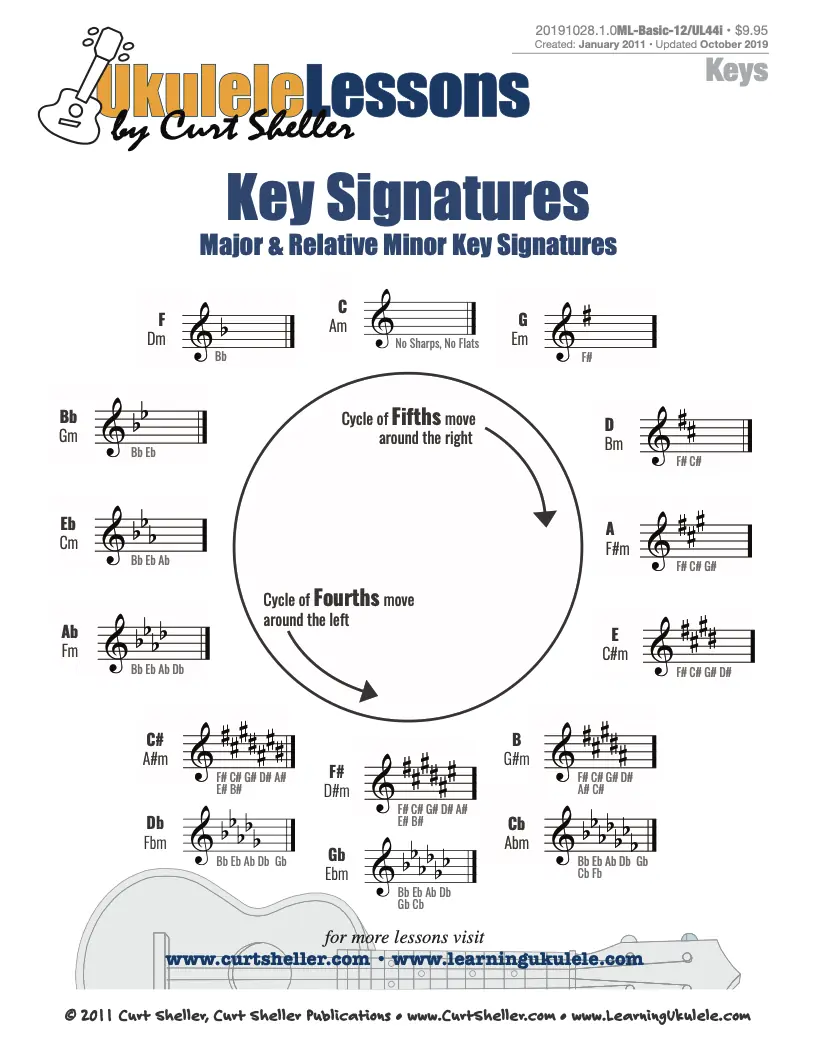
ALL 15 Major and Relative Minor Keys
A key signature is a summary of the sharps or flats in a Major or it’s relative Natural Minor scale.
Key signatures are generally written immediately after the clef at the beginning of a line of standard musical notation. Each major and minor key has an associated key signature that sharpens or flattens the notes which are used in its scale.
In addition to the Key of C Major and it's Relative Minor Key of Am , there are 14 additional major keys.
If a song or composition has a major tonal shift a new key signature will be introduced with the previous key signature canceled with the use of the natural accidental.
C Major / A Minor
It all starts with the Major scales and there‘s not better scale to start with then the C Major scale .
All Natural Notes
Sharp ( ♯ ) Keys
All Natural Notes
Flat ( ♭ ) Keys
A Key's Characteristic
These are very subjective and historically they have proven to be a good guide as to the general feeling of each key. These actually do not apple since our Equal Temperament (all intervals the same in all keys) vs. Meantone Temperament .
Major Keys
- C Major — Simple, Naive, Frank, or flat and commonplace
- G Major — Rural, Merry
- D Major — Gay, Brilliant, Bright
- A Major — Frank, Sonorous
- E Major — Radiant, Warm, Joyous
- B Major* — Energetic
- F# Major* — Rugged
- C# Major* — Charming, Suave, Placid
- F Major — Pastoral, Rustic
- Bb Major — Noble and Elegant, Graceful
- Eb Major — Sonorous, Vigorous, Chivalrous
- Ab Major — Gentle, Caressing, or Pompous
- Db* Major — Charming, Suave, Placid
- Gb* Major — Rugged
- Cb* Major — Energetic
Minor Keys
- A Minor — Simple, MNaive, Rustic
- E Minor —
- B Minor — Savage or Sombre, But Vigorous
- F# Minor —
- C# Minor —
- G# Minor —
- D# Minor — Rough or Light, Aerial
- A# Minor —
- D Minor — Serious. Concentrated
- G Minor — Melancholy, Shy
- C Minor — Gloomy, Dramatic, Violent
- F Minor — Morose. Surly, or Energetic
- Bb Minor — Funereal or Mysterious
- Eb Minor — Profoundly Sad
- Ab Minor — Doleful, Anxious
* B/Cb, Gb/F#, and C#/Db as Enharmonic Equivalent keys.
Common Keys
Common Rock, Pop, Folk and Country Keys: C, G, D, A, and E.
These common keys can be directly attributed to the popularity of the guitar in popular popular music.
Common Jazz Keys
Common Jazz Keys: C, F, Bb, Eb, Ab, Db, and the lone sharp key of G.
This is directly attributed to the popularity of the trumpet and saxophone in this genre of music. Both the trumpet and tenor saxophone are transposing instruments pitched in Bb.
wikiwand: Has a lot of additional information regarding Keys and Key Signatures .


End of Lesson - Thanks, Hope You Enjoyed It!
Related Lessons, Videos, Lesson Series, Songs, Books & Reference Charts, Resources & Assets, Workshops are below.