
Published:
2013-11-04
Updated:
2026-02-27
Learning Ukulele with Curt
Open Position Chords
The basic first chords most players learn. There are the chords in the first, second, third, and fourth frets of the ukulele and include at least one open string.
Author(s): Curt Sheller Publisher: Curt Sheller Publications Code: UL114a
Main Category: Chords Main Instrument: Ukulele
Categories: Chords

2026-08-23
The basic first chords most players learn. There are the chords in the first, second, third, and fourth frets of the ukulele and include at least one open string.
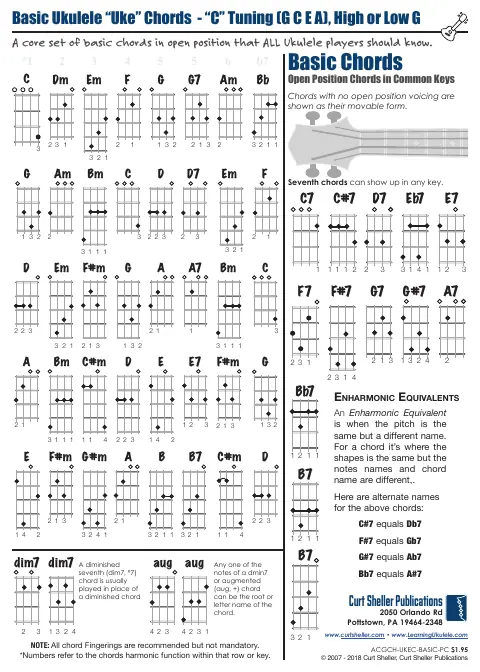
Open Position Chords are the basic, first chords most ukulele players learn. These chords, played in the fret one, two, three, and four frets area of the ukulele and includes at least one open string in the chord.
These are the chords you'll be playing the most in your ukulele travels.
Here is a FREE – Basic Open Position Ukulele Chords
chart in common keys to get you started in C Tuning, high or low G
. For most simple songs, the chords all are from a main key and stay in that key.
Learning Chords
The The Song Approach is to pick a song that you would like to learn and those are the chords you need to learn. Look them up, ask a friend or take a lesson or two. Then practice away. You need to know at least one version/voicing for each chord used in that song.
A song is like a recipe, it contains ingredients: the chords, lyrics, and melody. The style and arrangement can be like the original recording or your own arrangement. And, just like a recipe—if you don;t have on of the ingredients you have to run out a get it.
For basic Open Position Chords in a few common keys, this approach will get you started. Simply memorize the shape and sound of each chord required.
Another approach is to learn the common chords that show up in common keys and songs. This is especially helpful for occasions where you might have never played a particular song before or are reading the chords as you go. This happens a lot at jam sessions, meetup groups and club play-a-longs. Still, just memorize the shape and sound of the chord.
All you really need is to know one of each chord you might encounter.
For Folk, Rock, Pop, Country and and Bluegrass common major keys are C , G , D , A , and E . The keys of A and E are more common on guitar. The key of F is somewhat common for ukulele and not common on guitar unless you play jazz.
Common Chords for the Key of C Major and the C Major Scale
The Key of C Major is one, if not one of the most common keys. It’s sometimes called the learning key as it corresponds to the white keys of the piano. It’s a good place to start and can form a great foundation for diving in and exploring a bit of music theory.
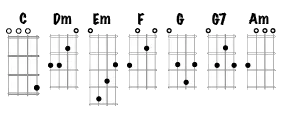
The basic chords are:
- C major
- D minor
- E minor
- F major
- G major and G7
- A minor
- B diminished
The diminished chord is rarely used and a G7 can be substituted for it. A Diminished Seventh chord with the same root (letter name of the chord) can also a substitute for the diminished chord.
With major chords being the most common chord the “major” part of the chord is typically not said or notated. If you say play a C chord, it’s understood to mean “C Major”. The minor chord type is shortened to “min”, “m” or -
. The diminished notation is shortened to “dim” or a degree sign. Leaving us with an easier to read list.
- C
- Dm
- Em
- F
- G, G7
- Am
- B° or Bdim
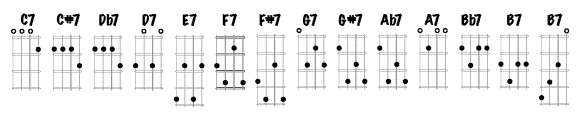
Any one of the chords can be a seventh chord, a Secondary Dominants for all but G7 : C7, D7, E7, F7, G7, A7, and B7. These are 4-part chords containing four notes with no duplicate notes. All but the G7 are chords outside of the key of C major but commonly used in the key of C.
Here are all the possible open position seventh chords. For the chords that do not have an open position form their basic movable form is shown.
See the Key Signatures Series of Lessons — Introduction for the common chords to all 15 Major Keys .
The Second Approach, which is almost required with movable form and "Jazz" chords is to have a core set of chords and a system for deriving additional chords from those known chords. And, knowing where and how chords are created and used.


End of Lesson - Thanks, Hope You Enjoyed It!
Related Lessons, Videos, Lesson Series, Songs, Books & Reference Charts, Resources & Assets, Workshops are below.