Published:
2005-01-02
Updated:
2025-12-16
Learning Ukulele with Curt
Dominant Seventh Chords?
Not all seventh chords are actually "dominant" seventh chords. This lesson covers when is a Dominant Seventh Chord NOT truly a Dominant seventh?
Author(s): Curt Sheller Publisher: Curt Sheller Publications Code: UL42-7-dom
Main Category: Chords Main Instrument: Any
Categories: Chords, Intermediate, Core, Seventh, Dominant, TmpPagyCatDebug
2026-08-23
RelatedLessonAssets
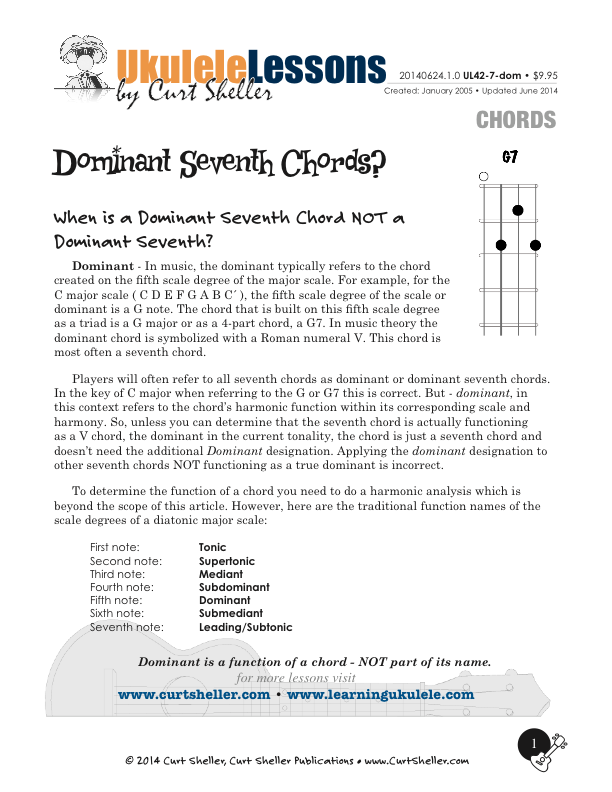
Number of Pages: 2
If you're a registered site member and have the correct permissions you can view ALL the pages of this PDF at a larger size using the LearningUkulele.com Online PDF Viewer (button below).
Download PDFThis Download IS part of your Gold Site Access and a FREE download. Thanks for supporting the site. — Curt
Each PDF file is a professionally prepared, formatted, high resolution file that prints out great. You'll need a PDF Reader or application capable of viewing PDF files to view the PDF.
NOTE: Download the current PDF file for the latest, complete, and most up-to-date version. As well as additional information not presented on-line.
Not all seventh chords are actually "dominant" seventh chords. This lesson covers when is a Dominant Seventh Chord NOT truly a Dominant seventh?
We first have to define what are the parts of a chord and in particular its chord name — so….
First, What Is a Chord?
A chord is a Capital Letter, — its chord name, one of the seven letters of the music alphabet: A B C D E F, or G —and their flat, or sharp equivalents and Chord Type information.
In our Western Tonic-Dominant Harmony, with chords built from major thirds and minor thirds, Tertiary Harmony , the overwhelming chord construction used and the only harmony with established names — the chord names. These chords are based on the traditional triads: major, minor, diminished, and augmented.
Players will often refer to ALL seventh chords as dominant or dominant seventh chords (not major sevenths and minor sevenths) . In the Key of C Major when referring to the G or G7 , this is somewhat correct — but still not a chord name but a chord function.
But — Dominant, in this context, actually refers to the chord's Harmonic Function within a scale, tonality, and harmony — NOT the Chord Type. So, unless you can determine that a seventh chord is functioning as a V or dominant chord in the current tonality. The chord is just a seventh chord and does not need the additional dominant designation. I might be functioning in a dominant role in the harmony by resolving to what would be it's one chord – but it's not the main dominant and is a secondary dominant. And agin, a function NOT a chord type.
Bottom-line is, you still don't and shouldn't call it a Dominant chord. Harmonic function is not a chord type.
More Dominant Seventh Chords?
content below, continue exploring...
More Dominant Seventh Chords?
Chord Names & Types
A chord has a name - the root or letter name of the chord and chord type information. REMEMBER: Dominant is not a chord type — it is a chord function.
Most chords are built by stacking intervals of a third and start as triads. 4-part chords are additional notes added to these triads. The traditional triads are: major, minor, diminished, and augmented. Notice No Dominant.
To determine the function of a chord, you need to do a Harmonic Analysis (HA) which is the subject of several other lessons and the book Harmonic Analysis for Scale Selection and Chord Substitution by your {{ config('csp.site.name') }} host and creator, Curt Sheller.
Here are the traditional function names of the scale degrees of a Diatonic major scale:
Example triads followed by theirh 4-part chords in the Key of C Major .
- First note and chord: Tonic — I — C, Cmaj7
- Second note and chord: Supertonic — II — Dm, Dm7
- Third note and chord: Mediant — III — Em, Em7
- Fourth note and chord: Subdominant — IV — F, Fmaj7
- Fifth note and chord: Dominant — V — G, G7*, G7
- Sixth note and chord: Submediant — VI — Am, Am7
- Seventh note and chord: Leading/Subtonic — VII — B°, G half-diminished 7 (can be a degree sign with a slash thru it)
* G7 , a 4-part chord was/is so commonly used with triads that it is included for the V chord.
Notice, again that Dominant IS a function. We don't call the C, C Tonic. The F a Sub-Dominant chord.
…the demand of the V7 for resolution is, to our ears, almost inescapably compelling. The dominant seventh is, in fact, the central propulsive force in our music; it is unambiguous and unequivocal.— Goldman, 1965
We don't call other seventh chords: the Tonic Seventh, Supertonic Seventh, Secondary Dominant Seventh, Borrowed Dominant Seventh.etc… Dominant IS the harmonic function of a chord — NOT part of its name.
And, it gets stranger when music theorist really dive deep in to explain harmonic cells and want to apply a name to them. Terms such as: Extended Dominant, Tertiary Dominant, Quaternary Dominants, etc.
With ALL of that said — we do, as musicians, whether a hobbyist are seasoned professionals, need to know both the correct traditional terms and the everyday street terms used to communicate music. Humans and musicians tend to make up names if they don't know an answer to a musical question. They just can't say I don't know.
Our Western Harmony is based around the Tonic and Dominant relationship of chords built in thirds and where a dominant chord wants to resolve the it's Tonic chord.


End of Lesson - Thanks, Hope You Enjoyed It!
Related Lessons, Videos, Lesson Series, Songs, Books & Reference Charts, Resources & Assets, Workshops are below.
A Guide to Advanced Ukulele Chords - Volume I
Beyond learning basic Ukulele chords, most players struggle with advanced chords. Commonly called "jazz" chords, these more sophisticated voicings find a wide use in all forms of music. A Guide to Advanced Chords for Ukulele - presents a highly organized and efficient approach to the mysterious subject of advanced chords. Chord dictionaries are not the answer.
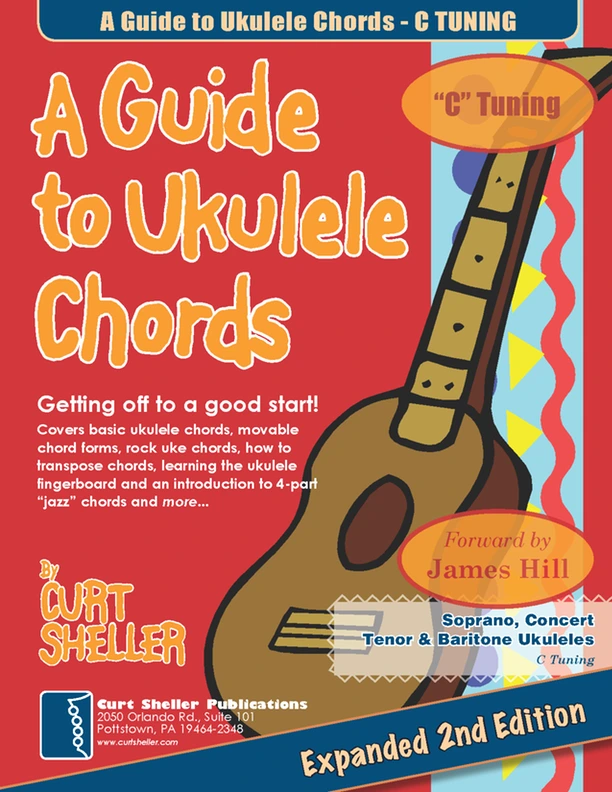
A Guide to Ukulele Chords, 2nd Edition
A Guide to Ukulele Chords, Second Edition is designed as a guide to ukulele chords. Covering the basic ukulele chords that ALL ukulele players SHOULD know. A Guide to Ukulele Chords covers movable chord forms, rock chords, how to transpose chords, learning the ukulele fingerboard and includes an introduction to 4-part, a.k.a jazz chords and more...
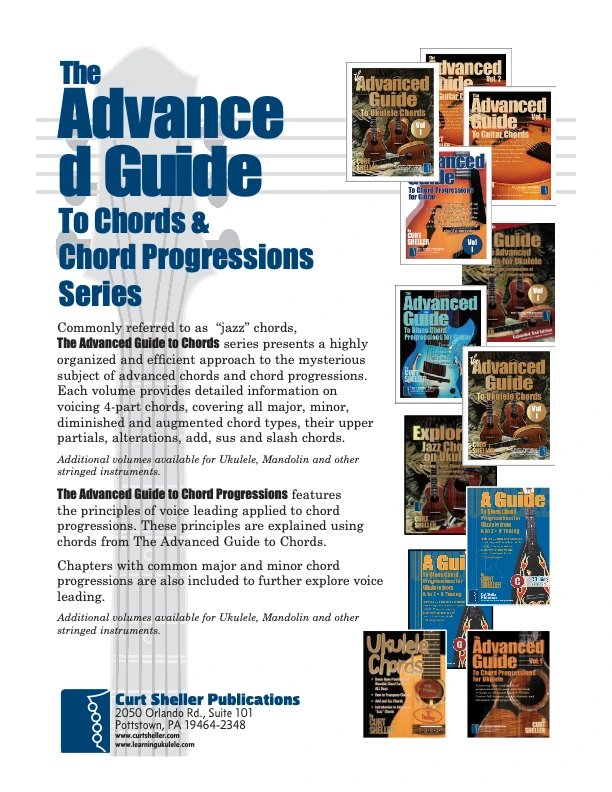
Advanced Guide to Chords and Progressions Series
The Advanced Guide to Chords series presents a highly organized and efficient approach to the mysterious subject of advanced chords and chord progressions. Each volume provides detailed information on voicing 4-part chords, covering all major, minor, diminished and augmented chord types, their upper partials, alterations, add, sus and slash chords.