
Published:
2005-01-02
Updated:
2025-12-08
Learning Ukulele with Curt
Naming Chords on `Ukulele
A Chord can have alternate names based on how it is being used. A chord's function is an important determining factor in naming a chord. So unless you know the harmonic function of a given chord, you might not be able to accurately name it.
Author(s): Curt Sheller Publisher: Curt Sheller Publications Code: UL42-misc-name
Main Category: Chords Main Instrument: Ukulele
Subjects: Chords
2025-12-08

If you're a registered site member and have the correct permissions you can view ALL the pages of this PDF or Samples pages at a larger size using the LearningUkulele.com Online PDF Viewer.
Download PDFThis Download IS part of your Gold Site Access and a FREE download. Thanks for supporting the site. – Curt
Each PDF file is a professionally prepared, formatted, high resolution file that prints out great. You'll need a PDF Reader or application capable of viewing PDF files to view the PDF.
NOTE: Download the current PDF file for the latest, complete, and most up-to-date version. As well as additional information not presented on-line.
A Chord can have alternate names based on how it is being used. A chord's function is an important determining factor in naming a chord. So unless you know the harmonic function of a given chord, you might not be able to accurately name it.
Determining the Name of a Chord?
The naming of chords is a modern invention for naming chords built using tertian harmony — chords built using intervals of major and minor thirds. With the smallest chord composed of three notes, triads, built using thirds.
History
- Plain Staff Notation, used in classical music — the Baroque music period (c. 1600–1750).
- Roman Numerals , commonly used in harmonic analysis to denote the scale step on which the chord is built. A modern variation is the Nashville Number System, substituting Arabic numbers for Roman numeral with some slight variations. {{ config('csp.site.name') }} only uses Uppercase Roman Numerals (Do We Need Lowercase Roman Numerals for Harmonic Analysis?)
- Figured Bass , much used in the Baroque era, uses numbers added to a bass line written on a staff, to enable keyboard players to improvise chords with the right hand while playing the bass with their left.
Chord Letters used in modern musicology, to denote chord root and quality. Chord Names and Symbols used in popular music lead sheets, fake books, and chord charts, to quickly lay out the harmonic ground plan of a piece so that the musician may improvise, jam, or vamp on it. These names are only for chords built in thirds and are actually a recent, early 20th century occurrence.
More Naming Chords on `Ukulele
content below, continue exploring...
Naming chords is a problem on any instrument, without knowing a few things about how chords — especially their Harmonic Function
. The how is it being used with the other chords?
One essential step in determining the name of the chord is to figure out the root or letter name of the chord, which can only be determined by:
- Knowing the harmonic function of the chord or
- Simply ask the bass player. A bass player has extreme power in determining the name of a chord and its harmonic function. They can use this power for good or evil ;-).
Why Name Chords?
Chord names, the Chord Symbols are used by musicians for a number of purposes. Chord-playing instrumentalists in the rhythm section, such as pianists and guitarists, use these symbols to guide their improvised performance of chord voicings and fills. A rock or pop guitarist or keyboardist might literally play the chords as indicated (e.g., the C major chord would be played by playing the notes C, E and G at the same time). In jazz, particularly for music from the 1940s bebop era or later, players typically have latitude to add in the sixth, seventh, and/or ninth of the chord. Jazz chord voicings often omit the root (leaving it to the bass player) and fifth. As such, a jazz guitarist might voice the C major chord with the notes E, A and D—which are the third, sixth, and ninth of the chord. The bassist (electric bass or double bass) uses the chord symbols to help improvise a bass line that outlines the chords, often by emphasizing the root and other key scale tones (third, fifth, and in a jazz context, the seventh).
What Is It About Chords?
- A Chord can have alternate names based on how it's being used—its Harmonic Function. A chord’s function is an important determining factor in naming a chord.
- A Chord can ONLY have one name at a time. It is what it is, not what it could be.
- A Chord should NOT be named by its fingerboard shape alone—beyond a basic open position chord, you're just guessing.
- A Chord can NOT be named by its lowest note—might not be the root.
- A Chord might NOT even have a root—a chord can have a perceived root.
Am7 or C6?
A good example of this is to play all the open strings of a C tuned ukulele and ask most players the name, and you will either get Am7 or C6 . If the real bass note or perceived bass note is C, it might be C6 , if the note is an A it might be Am7. If the harmonic function is a I chord in the Key of C , it is C6 . If it is the I chord in Am it's Am7 if it is the VI chord in the Key of C is Am7 , if it is the II chord in Key of F its Am7 … you get the idea. One really needs to know its harmonic function, before it can be named.
A Tougher Example
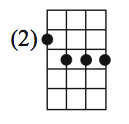
What is the Name(s) of the Above Chord? Unless you know the harmonic function of a given chord (ask the bass player), you'll just be guessing. It might be a harmonically educated guess if you know you notes of chords. But without knowing how it is being used—it's just a guess.
A Chord can only be named in the context of how it is being used and after determining how it's functioning within that context.
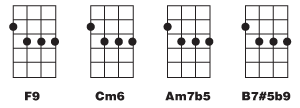
For the above chords, here are just a few of the most commonly alternate chord names for the same shape. Bottom line: chords cannot be named solely based on their chord shape.
NOTE: A
m6
chord is a commonly mis-named chord and is typically/harmonically used as a
9th
chord, as in
F9
vs.
Cm6
above. This is a backdoor
resolution to the
I
chord.(see the Harmonic Analysis
sus2
A
sus2
chord is a very modern construct. In most cases where it is being used it really is a
5add2
or
5add9
chord. It can also be thought of as a chord build using
The Bottom-Line: Chord Name
. Picking an easy chord name, regardless of the harmonic context, might give you better results. Not right, and probably Harmonically Offensive
to professional
musicians — but go for it.
Curt's philosophy is to level-up the musician—not Dumb It Down
. Most players are happy to learn the proper names and how music works. It makes them better musicians and they will have more fun and get to play with better musicians. A WIN, WIN all around.
• These Chord Naming Principles apply to chords—regardless of the instrument •
Additional Information and & Links
:
Chord Notation Systems
- Traditional staff notation.
- Roman numerals, commonly used in harmonic analysis.
- figured bass, widely used in the Baroque era.
- numbered musical notation, a musical notation that use numbers characters instance of graphical symbols, widely used in China.
- Nashville Number System, a variant of modern chord symbols, that use Arabic numerals for scale degrees vs. roman numerals.