
Published:
2013-10-31
Updated:
2021-11-19
Learning Ukulele with Curt
Getting Started with `Ukulele - Lesson Two
For Lesson Two we'll add and build on the lesson and material from lesson one.
Author(s): Curt Sheller Publisher: Curt Sheller Publications Code: ULB01-wk-2
Main Category: Basics Main Instrument: Ukulele
Categories: Chords

2026-08-23
Show Series Lessons
Series Home
For Lesson Two we'll add and build on the lessons and material from lesson two.
In Lesson Two you'll learn the following:
- Learning the Fingerboard, Key Fret (5)
- Secondary Chords - Key of C
- Common Chord Progressions for C Major
- Two Finger - Two Note Fingering Drills
- The Quarter Note Strum - Variations
- Whole Steps and Half Steps Explained
NOTE: Although these lessons are presented as a weekly series, you can and should take as long as you like to master each week's lesson as there is a lot of material in each lesson in the series. Tuns out the understanding part is the easy part. All the hard work is in getting your hands to co-operate.
The individual lessons in this series are viewable from the Lessons button bar above.
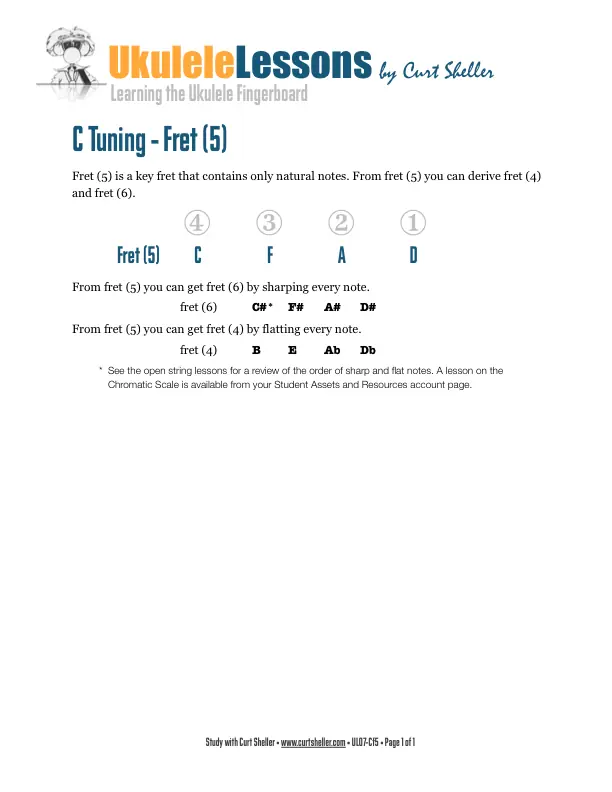
The Fingerboard - Key Fret (5)
The key frets are the three frets that have no sharp or flat notes - only natural notes. Fret (5) is C F A D from strings four to one.
Recommended Lessons, Series & Resources
- Lesson: Learning the Fingerboard, C Tuning - Fret (5)
- Lesson: The Chromatic Scale
After memorizing the chromatic scale, the seven letters and twelve notes of music we can derive the higher and lower frets from any fret we know.
If you know the open strings, G C E A you get fret (1) for G# C# F A#. Fret (12) is also G C E A this gets you fret (11) Gb B Eb Ab
From this weeks fret (5) C F A D you get fret (6) C# F# A# D# and the fret (4) B E Ab Db.
From three frets you now know over 50% of the fingerboard.
Turns out you only need five frets and you can get the entire fingerboard.
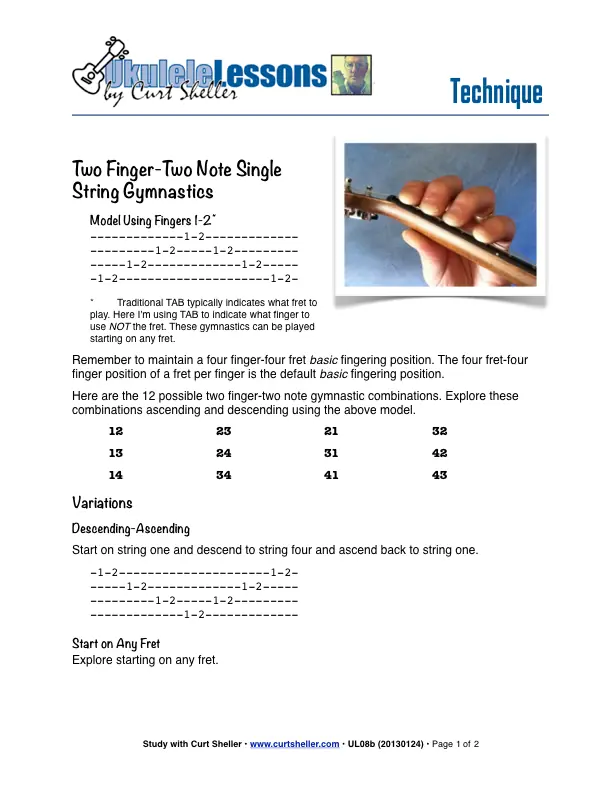
Technique - Two Finger - Two Note Fingering Drills
The Ukulele Gymnastics series contains quite a few lessons for developing your finger strength and independence of the fretting hand. The fretting hand is responsible for playing chords and single notes. The fretting hand and plucking hand are responsible for getting the music out.
Recommended Lessons, Series & Resources
- Lesson: Fingering Gymnastics
- Lesson: Two Finger - Two Note Fingering Drills
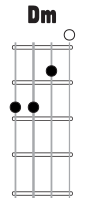
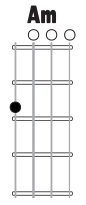
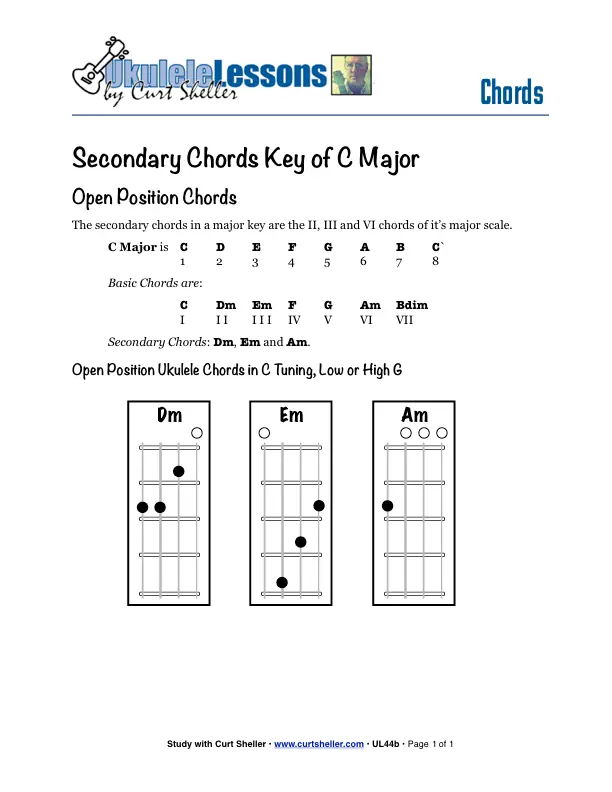
Secondary Chords - Key of C
Continuing with the common of key of C major and adding to the primary chords C, F, G and G7 from last week’s lessons. We can add the secondary chords Dm, Em, and Am.

Recommended Lessons, Series & Resources
- Series: Key Signatures - C Major and A Minor
- Lesson: Secondary Chords of C Major
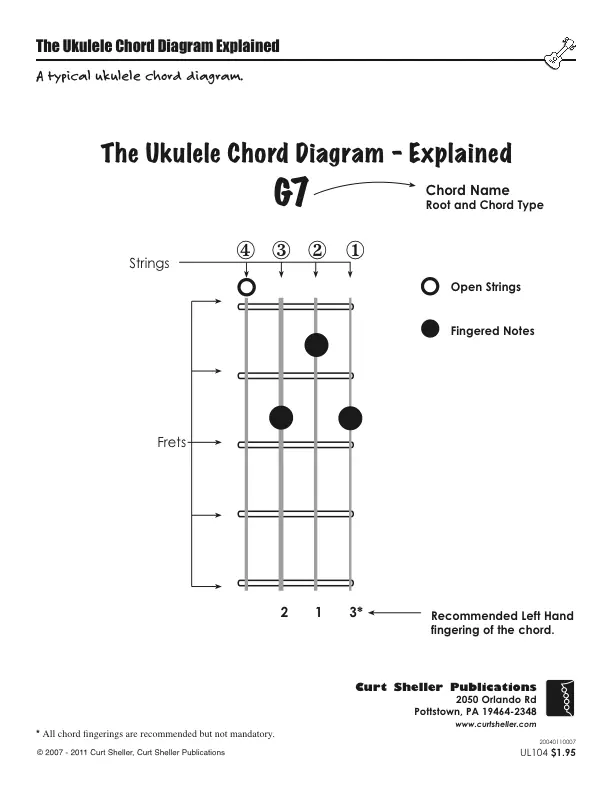
Common Progressions - Key of C
With the primary and secondary chords in the key of C.
Recommended Lessons, Series & Resources
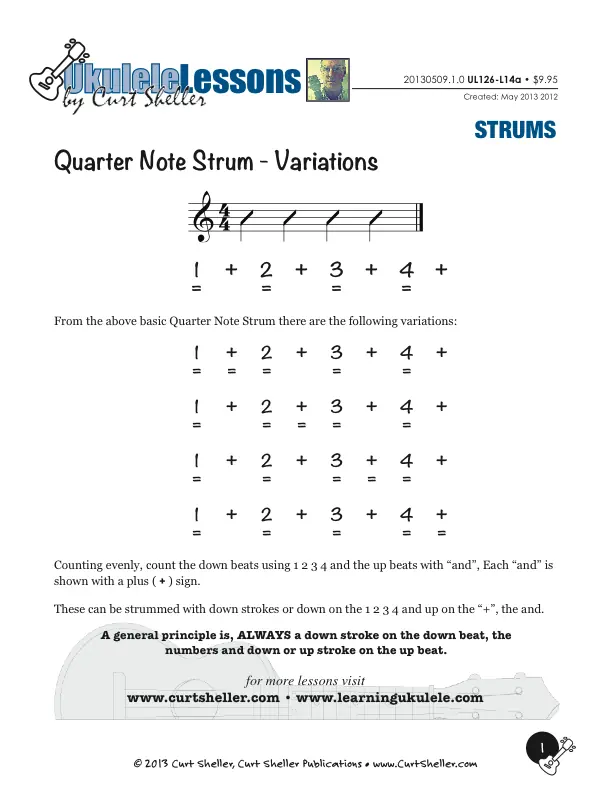
The Quarter Note Strum - Variations
Learning an instrument is about building on what you already know. This is a perfect principle for building on strumming patterns.
Recommended Lessons, Series & Resources
- Lesson: Quarter Note Strum - Variations
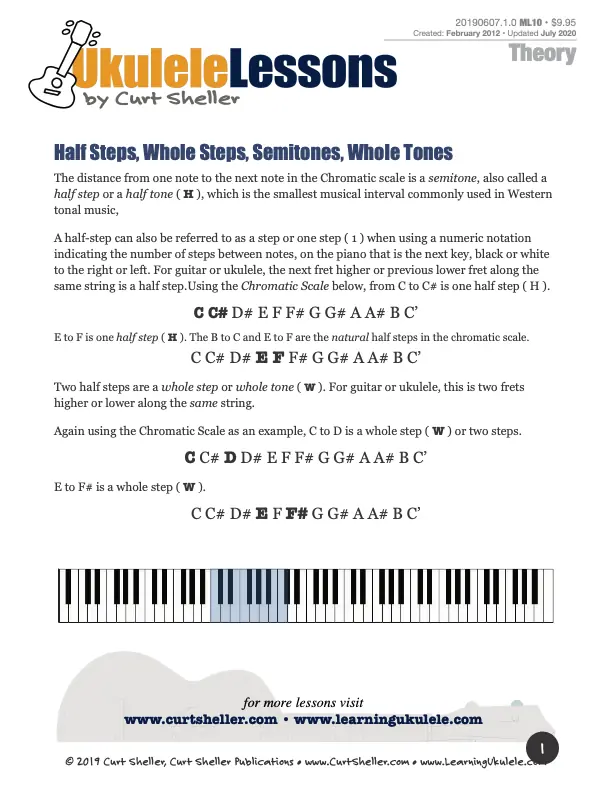
Whole Steps, Half Steps
There is only one scale that contains ALL 12 notes of music in one octave, the Chromatic Scale.
Recommended Lessons, Series & Resources
- Lesson: Whole Steps and Half Steps Explained
- Lesson: The Chromatic Scale


End of Lesson - Thanks, Hope You Enjoyed It!
Related Lessons, Videos, Lesson Series, Songs, Books & Reference Charts, Resources & Assets, Workshops are below.