Published:
2012-04-06
Updated:
2026-09-21
Learning Ukulele with Curt
Harmonic Analysis - Cycles
Harmonic Analysis is the understanding of the functional sequence of chords. It is the process used to analyze the harmonic structure of a progression, song, or composition. This analysis is then used to make scale selections for improvisation and chord substitution. This lesson covers the Cycles harmonic principle.
Author(s): Curt Sheller Publisher: Curt Sheller Publications Code: MLRMAe-9
Main Category: Theory Main Instrument: Any
Categories: Chords, Harmonic-Analysis, RMA, Cycle

2026-08-23
RelatedLessonAssets
Show Series Lessons
Series Home
Number of Pages: 2
If you're a registered site member and have the correct permissions you can view ALL the pages of this PDF at a larger size using the LearningUkulele.com Online PDF Viewer (button below).
Download PDFThis Download is NOT part of your LearningUkulele.com & Learning Ukulele with Curt membership level.
Sign-up for Premium Site Access or Upgrade Your Plan to download this PDF or your can purchase a copy for download
Sign In for Access…Contact Us if there are any issues.
Harmonic Analysis is the understanding of the functional sequence of chords. It is the process used to analyze the harmonic structure of a progression, song or composition. This analysis is then used to make scale selections for improvisation and chord substitution.
This lesson covers the Cycles harmonic principle.
This series, is the book Harmonic Analysis for Chord Substitution and Scale Selection by Curt Sheller broken out into individual lessons with additional examples and content. Always, the latest version of the book.
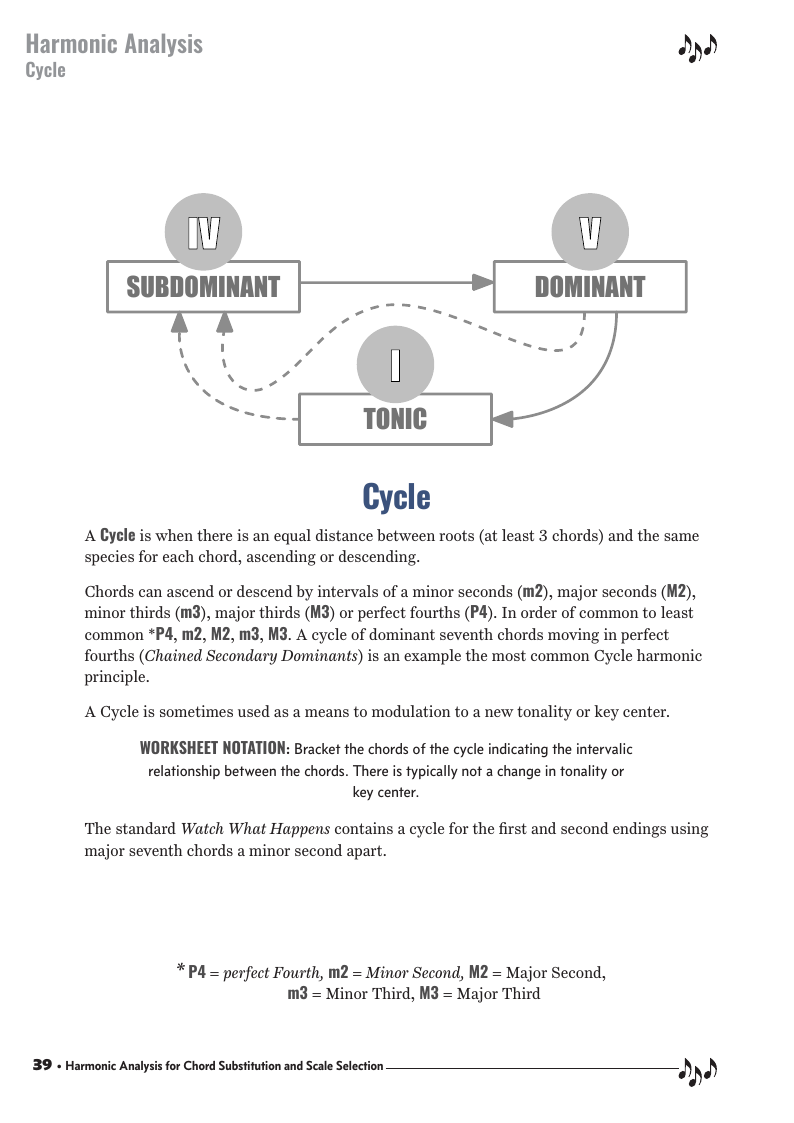
A Cycle is when there is an equal distance between roots (at least 3 chords) and the same species for each chord, ascending or descending.
Chords can ascend or descend by intervals of a minor seconds (m2), major seconds (M2), minor thirds (m3), major thirds (M3) or perfect fourths (P4). In order of common to least common *P4, m2, M2, m3, M3. A cycle of dominant seventh chords moving in perfect fourths (Chained Secondary Dominants) is an example the most common Cycle harmonic principle.
A Cycle is sometimes used as a means to modulation to a new tonality or key center.
WORKSHEET NOTATION: Bracket the chords of the cycle indicating the intervalic relationship between the chords. There is typically not a change in tonality or key center. m2 for Minor Second, M2 for Major Second, P4 for Perfect Fourth, P5 for Perfect Fifth, m3 for Minor Third, M3 for Major Third, etc…
The standard Watch What Happens contains a cycle for the first and second endings using major seventh chords a minor second apart.
More Harmonic Analysis - Cycles
content below, continue exploring...
More Harmonic Analysis - Cycles
Song Examples
Most folk, rock and blues songs remain in one key. Most Jazz and Pop standards will modulate to new key centers.
Jazz Classics
Watch What Happens
1st ending
Major 7 chords descending and ascending minor seconds (m2)
2nd ending
Major 7 chords ascending minor seconds (m2)
I Got Rhythm
Bridge
A cycle of Secondary Dominant chords with a distance of a Perfect Fourth (P4) between roots.
Jordu
Bridge
Contains two Secondary Dominant Seventh chord cycles
Stompin' at the Savoy
Bridge
Contains two Secondary Dominant Seventh chord cycles
Checkout the Songs section of LearningUkulele.com , as many of the songs examples above are available.


End of Lesson - Thanks, Hope You Enjoyed It!
Related Lessons, Videos, Lesson Series, Songs, Books & Reference Charts, Resources & Assets, Workshops are below.
Harmonic Analysis for Scale Selection and Chord Substitution
Harmonic Analysis is the understanding of the functional sequence of chords. It is the process used to analyze the harmonic structure of a progression, song or composition. This analysis is then used to make scale selections for improvisation and chord substitution.