Published:
2013-01-01
Updated:
2018-12-12
Learning Ukulele with Curt
Chord a Day, January 17th - E
Learn a new Ukulele chord every day of the year. The chord for January 17th is E.
Author(s): Curt Sheller Publisher: Curt Sheller Publications Code: ULCAD0117
Main Category: Chords Main Instrument: Ukulele
Categories: Chords, Beginner, Intermediate, Core, Music Keys, Beginner

2026-08-23
RelatedLessonAssets
Learn a new Ukulele chord every day of the year. The chord for January 17th is E.
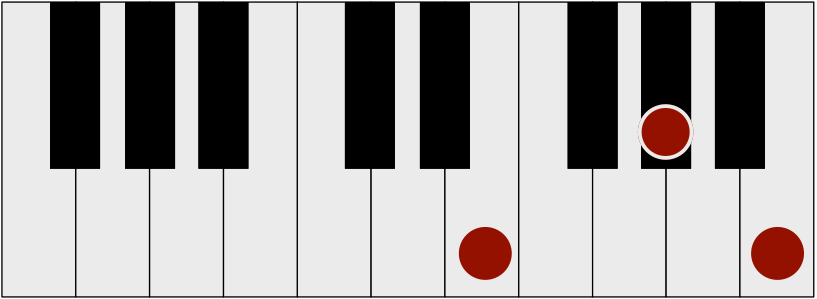
Harmonic Function for: E
The Harmonic Function of a chord is simply how a chord is being used in a harmonic context with other chords in a song or chord progression.
Here are the most common harmonic functions for today's chord.
E is a Full Diatonic , chord in the common Major key(s) of: E (I) , A (IV) , and B (V)
E is a Full Diatonic , chord in the common Minor key(s) of: Am (V) , C#m (III) , G#m (VI)
E is the Dominant chord in the keys of A, Am. A chord truly functioning as a Dominant chord is a V chord and Full Diatonic .
E is the VII chord in the Mixolydian scale/mode . Think Sweet Home Alabama’s D C G (original key) chords, Taking Care of Business, Sweet Child of Mine, Hey Jude . The C is the VII ( b7 ) in D Mixolydian (D E F# G A B C D). This is actually a Common Chord Progression and often misidentified as being in a major key.
Secondary Dominant
Secondary Dominants are a harmonic cornerstone of popular music and jazz in the 20th and 21st century.
E can also function as a Secondary Dominant chord in five (5) major keys: ( V of IV , V of V , V of VI , V of II , V of III ) and three (3) minor keys: ( V of IV , V of V , V of VI ). For more information checkout Secondary Chord and Curt's book: Harmonic Analysis for Scale Selection and Chord Substitution
A Secondary Dominant (also applied dominant, artificial dominant, or borrowed dominant) is a major triad or dominant* seventh chord built and set to resolve to a scale degree other than the tonic, with the dominant of the dominant (written as V/V or V of V) being the most frequently encountered. The chord that the secondary dominant is the dominant of is said to be a temporarily tonic chord. The secondary dominant is normally, though not always, followed by the tonic chord. Tonicization that lasts longer than a phrase is generally regarded as a modulation to a new key (or new tonic).
*NOTE: Dominant IS a harmonic function not a chord type.
In a Blues chord progression a seventh chord can function as the I and the IV and/or V — a tonic, sub-dominant, or dominant role.
In a Blues progression a Seventh chord can also function as the Tonic I chord, a V of IV or a Sub-Dominant IV . Curt's book, A Guide to Blues Chord Progressions for Ukulele A to Z thoroughly explores the blues.
Harmonic Analysis, Scales, and Modes
All harmonic and scale analysis utilizes Roman Numerals related to the major of the current tonality (key) ( I II III IV V VI VII , the 1 2 3 4 5 6 7 of the major scale).
Technically, the modes are numbered the same ( I II III IV V VI VII , the 1 2 3 4 5 6 7 of the major scale) but for comparison they can be numbered relative to the major scale of the same root. Example: C Mixolydian mode ( I II III IV V bVII VII , the 1 2 3 4 5 6 b7 ).
Open Position Chords
Today's chord, E is an Open Position chord.
Open Position Chords are any chord in the first four frets that include at least one open string.
Learn a New Chord Each Day!!!
This Learn a New Chord Each Day!!! series of lessons was created and published in 2013 (13 yrs ago) and has been added to an expanded ever since. 2020 brought videos to the show. 2023 introduced more Harmonic information
For a further exploration of this chord and its movable forms visit the
Movable Ukulele Chords Lesson Series
page.
E is a Core Chord
A core chord is a basic chord that other chords can be derived from – creating new chords from your known chords. Your ever expanding set of core chords creates a solid foundation for playing music on ukulele or any instrument capable of playing chords. There are just far too many chord shapes to memorize all the possibilities. Some chords you can simply create on the fly as needed based on known information and how chords work.
Chord Type(s): Major
Chord Categories: Open Position Triad
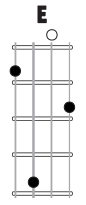

Open Position chords typically do not show the location of the root or letter name of the chord, as these chords are the first chords a ukulele player learns. They are almost entirely learned by shape and sound–hopefully, the chord names. Later on, one develops the ability to determine the location of the chord root(s) or letter name within the chord.
Standard Music Notation and TAB
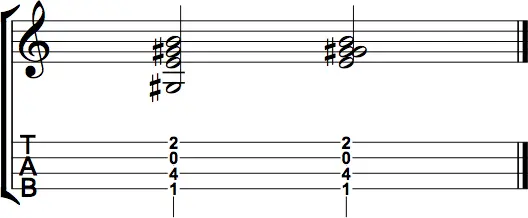
Standard music notation and TAB for C Tuning, Low and High G
variations
The same numbering notation used in TAB can be used to describe the open strings and frets to be played when using text-only notation or verbal communications. Using an open position C as an example, we can describe it as 0003, indicating open strings four, three, and two with fret (3) being fingered on string one. An open position, D7 , indicated as 2020
As you can see that are numerous ways to describe a chord, either verbally Put your finger here…
, in Standard Music Notation
, TAB
, and in text, graphically using a Chord Grid
, etc.
Chord Spelling
Chord Spelling is simply knowing what the notes, the chord tones of a chord are.
The notes of all chords can be determined from its corresponding major scale based on the root of the chord and numeric formula.
The notes for E are:
E G# B
The chord tones are the 1 3 5 scale degrees of the parent E Major Scale .
Recommended Fingering(s)
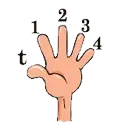 Although additional fingerings are possible for many chords, fingering for any given chord depends on the science of how our fingers work and on the harmonic context the chord is being used in—what was the previous chord, and what's the next chord? The goal is to play all the notes right behind the frets when possible. Remember, longer fingers can reach the lower strings better, and finger two can stack on finger three, and finger three can stack on finger four.
Although you can play any chord with any finger as long as it's yours, the recommended fingering for E is:
Recommended Fingering
0 1 4 2
Alternate Fingering(s)
Although alternate fingerings might be possible, the recommended fingering for any chord should be based on an efficient fingering, easy to reproduce on demand and Low Maintenance.
Fingering Notation
Fingering notation for a chord using text only, without using a chord grid, is typically done using the finger numbers from left to right, string four to string one (nose to toes). Here is the text notation for January 1st C chord.

A Typical text representation of a chord fingering without using a chord grid.
Note: A Zero (0) fingering notation represents an open string that doesn't require using a finger.
Fingering Chords
Additional alternate fingerings might be possible for selected chords. If there isn't an overwhelming musical reason for one fingering over another, let efficiency be the determining factor. Something as simple as longer fingers that can reach the lower strings four and three will go a long way to being efficient when switching chords.
Factors such as playing notes right behind the fret take less effort than in the middle of the fret. Less effort leads to overall efficiency; lower maintenance for maintaining your technique and efficiency leads to speed. This can help in determining what finger to use. Finger three can overlap finger four, and finger two can overlap finger three a little, allowing them to get closer to the fret.
Remember, the thumb's primary role is to support the fingers–not play notes. Think of the thumb as a Stagehand. He is unseen, doesn't get any lines, but is a critical member of the team. There are musical situations where you might use your thumb but they are mainly rhythmic / strumming reasons.
Chord Construction, Notes and Intervals
All chords can be constructed based on their intervals relative to the major scale of the root or letter name of the chord. The individual names of the notes of the chord can also be determined from the same scale.
The chord tones for E are: E G# B
E is the 1 3 5 of the E Major Scale based on the root (E) of the chord.
Next Steps
After memorizing today's E chord and when you are able to switch in time with other chords, the next step is adding various Strums , Fingerpicking patterns, and exploring the Movable Chord versions of today's chord, to your ukulele skills.


End of Lesson - Thanks, Hope You Enjoyed It!
Related Lessons, Videos, Lesson Series, Songs, Books & Reference Charts, Resources & Assets, Workshops are below.
A Guide to Advanced Ukulele Chords - Volume I
Beyond learning basic Ukulele chords, most players struggle with advanced chords. Commonly called "jazz" chords, these more sophisticated voicings find a wide use in all forms of music. A Guide to Advanced Chords for Ukulele - presents a highly organized and efficient approach to the mysterious subject of advanced chords. Chord dictionaries are not the answer.
A Guide to Blues Chord Progression for Ukulele A to Z - C Tuning
The Blues are at the heart of all American music. It has influenced Country, Rock, Folk, Jazz, Bluegrass and just about every form of American music we listen to today. 26 blues progression in C and G tuning, progressing from basic to advanced jazz progression, with chord grids and substitutions explained.
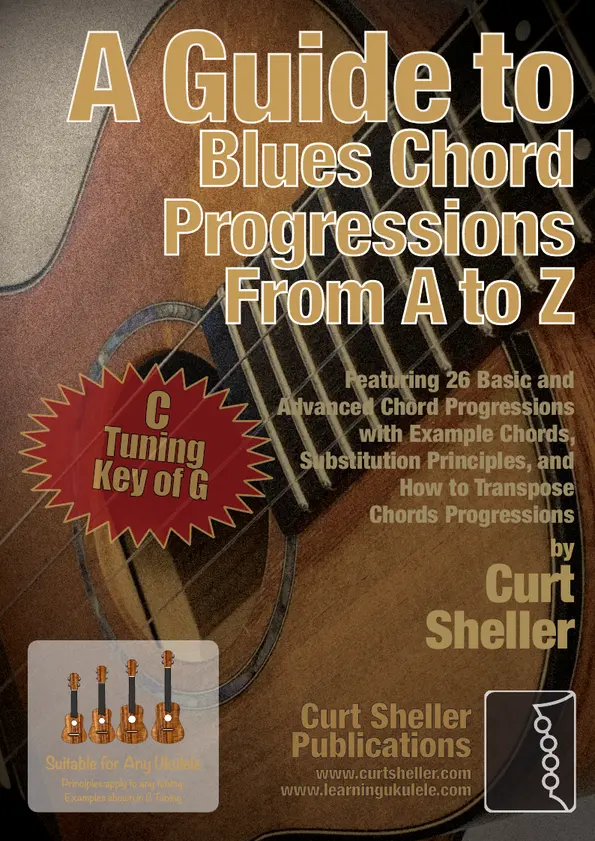
A Guide to Blues Chord Progressions for Ukulele A to Z - G Tuning
The Blues are at the heart of all American music. It has influenced Country, Rock, Folk, Jazz, Bluegrass and just about every form of American music we listen to today. 26 blues progression in C and G tuning, progressing from basic to advanced jazz progression, with chord grids and substitutions explained.
A Guide to Ukulele Chords, 2nd Edition
A Guide to Ukulele Chords, Second Edition is designed as a guide to ukulele chords. Covering the basic ukulele chords that ALL ukulele players SHOULD know. A Guide to Ukulele Chords covers movable chord forms, rock chords, how to transpose chords, learning the ukulele fingerboard and includes an introduction to 4-part, a.k.a jazz chords and more...
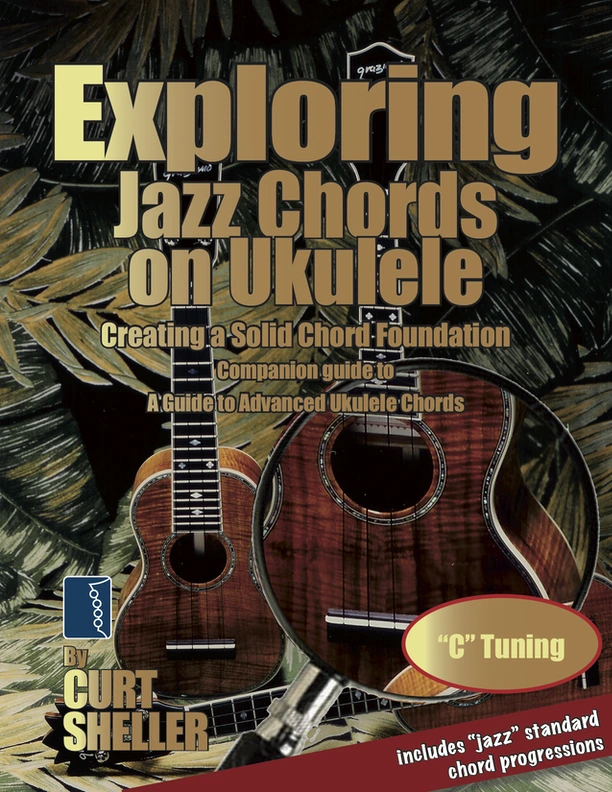
Exploring Jazz Chords on Ukulele
Exploring jazz chords using a variety of common chord progressions based on songs from the standard jazz repertoire. Core Chords are the basic set of chords needed to play a wide range of music, in a variety of styles. This set of chords includes basic open position chords, basic movable form chords and the core 4-part "jazz" chords.
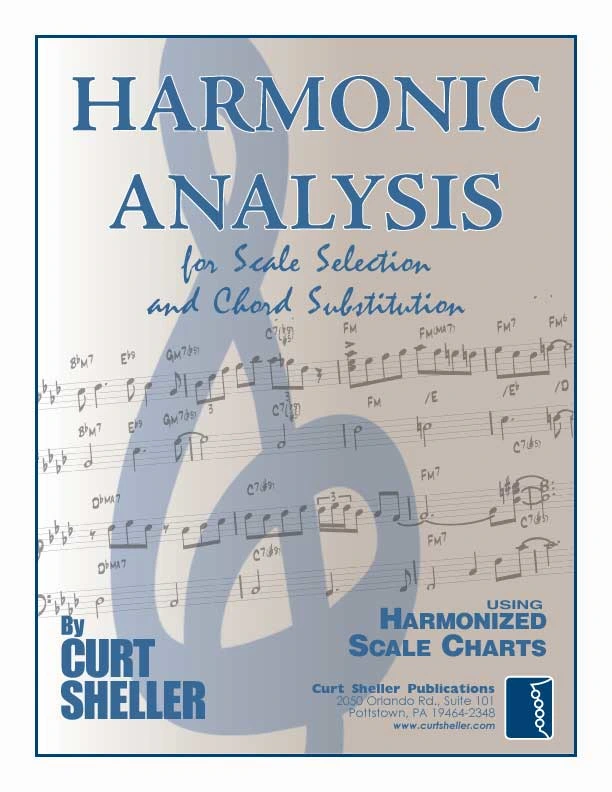
Harmonic Analysis for Scale Selection and Chord Substitution
Harmonic Analysis is the understanding of the functional sequence of chords. It is the process used to analyze the harmonic structure of a progression, song or composition. This analysis is then used to make scale selections for improvisation and chord substitution.
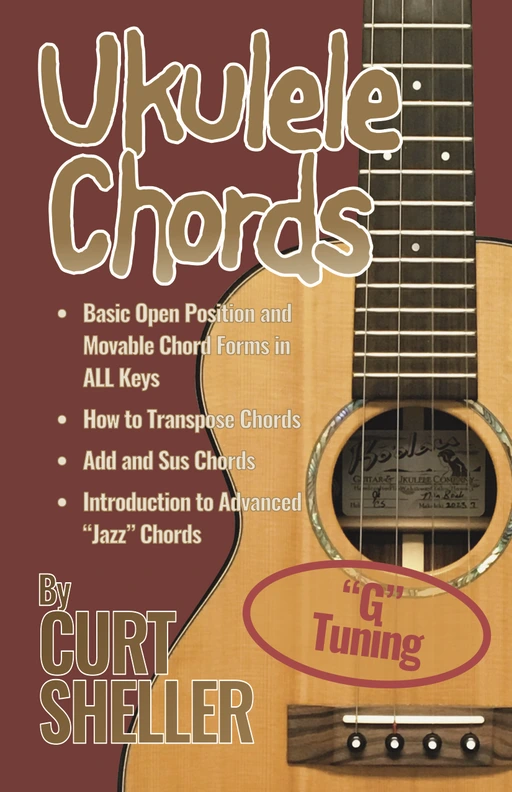
Ukulele Chords - G Tuning
This chord book is the perfect size for every ukulele gig bag or case and a great addition to you music book library. Ukulele Chords covers basic open position and basic movable form chords. From these two chord categories a variety of songs and styles can be played. Seventh chords, Major Sevenths, Minor Sevenths, Diminished, Augmented chords sus and add chords. Tunings: G with low or high D - (DGBE or dGBE).






Core “Jazz” Ukulele Chords - The Big Six
Core Chords for Ukulele, The Big Six - From four F7 chord voicings or shapes, your can build your massive 4-part, a.k.a., “jazz” chord vocabulary. Beyond basic open position chords, basic movable form chords and a core set of 4-part chords. There are just too many chords shapes too memorize.